

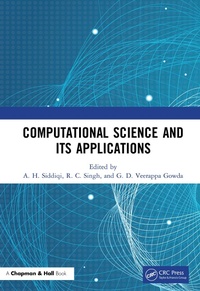
Computational Science and its Applications
1st Edition
Published on 20. October 2020
416 pages
978-1-000-19369-5 (ISBN)
Description

Computational science is a rapidly growing multidisciplinary field concerned with the design, implementation, and use of mathematical models to analyze and solve real-world problems. It is an area of science that spans many disciplines and which involves the development of models and allows the use of computers to perform simulations or numerical analysis to understand problems that are computational and theoretical.
Computational Science and its Applications provides an opportunity for readers to develop abilities to pose and solve problems that combine insights from one or more disciplines from the natural sciences with mathematical tools and computational skills. This requires a unique combination of applied and theoretical knowledge and skills. The topics covered in this edited book are applications of wavelet and fractals, modeling by partial differential equations on flat structure as well as on graphs and networks, computational linguistics, prediction of natural calamities and diseases like epilepsy seizure, heart attack, stroke, biometrics, modeling through inverse problems, interdisciplinary topics of physics, mathematics, and medical science, and modeling of terrorist attacks and human behavior. The focus of this book is not to educate computer specialists, but to provide readers with a solid understanding of basic science as well as an integrated knowledge on how to use essential methods from computational science.
Features:
Modeling of complex systems
Cognitive computing systems for real-world problems
Presentation of inverse problems in medical science and their numerical solutions
Challenging research problems in many areas of computational science
This book could be used as a reference book for researchers working in theoretical research as well as those who are doing modeling and simulation in such disciplines as physics, biology, geoscience, and mathematics, and those who have a background in computational science.
Computational Science and its Applications provides an opportunity for readers to develop abilities to pose and solve problems that combine insights from one or more disciplines from the natural sciences with mathematical tools and computational skills. This requires a unique combination of applied and theoretical knowledge and skills. The topics covered in this edited book are applications of wavelet and fractals, modeling by partial differential equations on flat structure as well as on graphs and networks, computational linguistics, prediction of natural calamities and diseases like epilepsy seizure, heart attack, stroke, biometrics, modeling through inverse problems, interdisciplinary topics of physics, mathematics, and medical science, and modeling of terrorist attacks and human behavior. The focus of this book is not to educate computer specialists, but to provide readers with a solid understanding of basic science as well as an integrated knowledge on how to use essential methods from computational science.
Features:
Modeling of complex systems
Cognitive computing systems for real-world problems
Presentation of inverse problems in medical science and their numerical solutions
Challenging research problems in many areas of computational science
This book could be used as a reference book for researchers working in theoretical research as well as those who are doing modeling and simulation in such disciplines as physics, biology, geoscience, and mathematics, and those who have a background in computational science.
More details
Edition
1. Auflage
Language
English
Place of publication
London
United Kingdom
Publishing group
Taylor & Francis Ltd
Target group
College/higher education
Professional and scholarly
Illustrations
28 Tables, black and white; 175 Illustrations, black and white
ISBN-13
978-1-000-19369-5 (9781000193695)
Copyright in bibliographic data and cover images is held by Nielsen Book Services Limited or by the publishers or by their respective licensors: all rights reserved.
Schweitzer Classification
Other editions
Additional editions
A. H. Siddiqi | R. C. Singh | G. D. Veerappa Gowda
Computational Science and its Applications
Book
10/2024
1st Edition
Chapman & Hall/CRC
€75.80
Shipment within 15-20 days
A. H. Siddiqi | R. C. Singh | G. D. Veerappa Gowda
Computational Science and its Applications
Book
10/2020
1st Edition
Chapman & Hall/CRC
€209.70
Shipment within 15-20 days
Persons
Late Prof. A. H. Siddiqi was an Indian Mathematician and Professor of Applied Mathematics. He was serving as Professor Emeritus in the School of Basic Sciences and Research at Sharda University, Greater Noida, India. He has also served as a Former Pro Vice-Chancellor, Aligarh Muslim University. Siddiqi was also the President of Indian Society of Industrial and Applied Mathematics (ISIAM). He has authored 12 books, edited 12 volumes and published more 100 research papers. He has also held important administrative positions in AMU and other institutions of repute.
Dr. R. C. Singh has rich experience of more than 30 years as a researcher out of which more than 10 years as Professor of Physics. Presently, Dr. Singh is Professor of Physics and in addition to that he is also Controller of Examinations of Sharda University. Dr. Singh obtained his doctorate from Banaras Hindu University (BHU), Varanasi in theoretical Condensed Matter Physics. He obtained his B.Sc. (Hons.) and M.Sc. degrees also in Physics from Banaras Hindu University. Dr. Singh has published more than 30 research papers in peer-reviewed international journals and conference proceedings. He has authored one book and co-edited seven conference proceedings. His area of research interest includes study of phase transitions in molecular liquids using density-functional theory; Time-series analysis using wavelets; Biometrics and Solar cells.
Dr. G. D. Veerappa Gowda is Professor at TIFR Centre for Applicable Mathematics, Bangalore. He has done fundamental work in the areas of Hyperbolic conservation laws, Control theory and Numerical approximation of conservation laws. Dr. Gowda obtained an explicit formula for the entropy weak solution of convex conservation laws with boundary conditions, extending the earlier work of Hopf and Lax for the initial value problem. Dr. Gowda has developed numerical schemes to solve problems arising in oil recovery and sand pile problem on a vertical source.
Dr. R. C. Singh has rich experience of more than 30 years as a researcher out of which more than 10 years as Professor of Physics. Presently, Dr. Singh is Professor of Physics and in addition to that he is also Controller of Examinations of Sharda University. Dr. Singh obtained his doctorate from Banaras Hindu University (BHU), Varanasi in theoretical Condensed Matter Physics. He obtained his B.Sc. (Hons.) and M.Sc. degrees also in Physics from Banaras Hindu University. Dr. Singh has published more than 30 research papers in peer-reviewed international journals and conference proceedings. He has authored one book and co-edited seven conference proceedings. His area of research interest includes study of phase transitions in molecular liquids using density-functional theory; Time-series analysis using wavelets; Biometrics and Solar cells.
Dr. G. D. Veerappa Gowda is Professor at TIFR Centre for Applicable Mathematics, Bangalore. He has done fundamental work in the areas of Hyperbolic conservation laws, Control theory and Numerical approximation of conservation laws. Dr. Gowda obtained an explicit formula for the entropy weak solution of convex conservation laws with boundary conditions, extending the earlier work of Hopf and Lax for the initial value problem. Dr. Gowda has developed numerical schemes to solve problems arising in oil recovery and sand pile problem on a vertical source.
Content
1. Ingredients for Applied Fourier Analysis..........................................................................1
Hans G. Feichtinger
2. Industrial Applications of Optimal Control for Partial Differential
Equations on Networks: Reduction and Decomposition Methods Applied to
the Discrete-Continuous Control of Gas Flow in Complex Pipe Systems...............25
Guenter Leugering
3. A Model to Assess the Role of Spatial Urban Configurations on Crowd
Evacuation Dynamics During Terrorist Attacks............................................................ 41
D. Provitolo, R. Lozi, and E. Tric
4. Free Radical Processes in Medical Grade UHMWPE.................................................... 61
M. Shah Jahan, Benjamin Walters, Afsana Sharmin, and Saghar Gomrok
5. Inverse Problems Involving PDEs with Applications to Imaging..............................77
Taufiquar Khan
6. On an Efficient Family of Steffensen-Like Methods for Finding
Nonlinear Equations............................................................................................................. 91
Vali Torkashvand and Manochehr Kazemi
7. Computational Methods for Conformable Fractional Differential Equations............103
A. H. Siddiqi, R. C. Singh, and Santosh Kumar
8. Pan-Sharpening Using Modified Nonlocal Means-Based Guided Image
Filter in NSCT Domain...................................................................................................... 117
Tarlok Singh and Pammy Manchanda
9. Moser-Trudinger and Adams Inequalities..................................................................... 135
Kunnath Sandeep
10. Computational Ship Hydrodynamics: Modeling and Simulation............................ 149
Sashikumaar Ganesan, Bhanu Teja, and Thivin Anandh
11. DNA-Drug Interaction: Insight from Computer Simulations................................ 171
Anurag Upadhyaya, Shesh Nath, and Sanjay Kumar
12. A Graphical User Interface for Palmprint Recognition............................................... 195
Rohit Khokher and R. C. Singh
13. Wavelet Approach for the Classification of Autism Spectrum Disorder.................209
Noore Zahra, Hessa N. Al Eisa, Kahkashan Tabassum, Sahar A. EI-Rahman, and Mona
Jamjoom
14. De-Noising Raman Spectra Using Total Variation De-Noising with Iterative
Clipping Algorithm............................................................................................................225
Padmesh Tripathi, Nitendra Kumar, and A. H. Siddiqi
15. An Efficient Identity-Based Mutual Authentication Protocol for Cloud
Computing............................................................................................................................233
Vinod Kumar and Musheer Ahmad
16. Development of a Statistical Yield Forecast Model for Rice Using Weather
Variables Over Gorakhpur District of Eastern Uttar Pradesh................................... 243
R. Bhatla, Rachita Tulshyan, Babita Dani, and A. Tripathi
17. Cognitive Computing Agent Systems: An Approach to Building Future
Real-World Intelligent Applications............................................................................... 257
A. Chandiok, A. Prakash, A. H. Siddiqi, and D. K. Chaturvedi
18. Controllability of Quasilinear Stochastic Fractional Dynamical Systems in
Hilbert Spaces...................................................................................................................... 275
R. Mabel Lizzy and K. Balachandran
19. The Advection-Dispersion Equation for Various Seepage Velocity
Patterns in a Heterogeneous Medium............................................................................. 291
Amit Kumar Pandey and Mritunjay Kumar Singh
20. On the Application of Genetic Algorithm and Support Vector Machine for
Classification of MRI Images for Brain Tumors........................................................... 311
D. Gupta and M. Ahmad
21. Proximinality and Remotality in Abstract Spaces....................................................... 325
Sangeeta and T. D. Narang
22. Conformable Fractional Laguerre and Chebyshev Differential Equations
with Corresponding Fractional Polynomials................................................................335
Ajay Dixit and Amit Ujlayan
23. Computational Linguistics: Inverse Problems and Emerging Mathematical
Concepts................................................................................................................................345
Sana A. Ansari and Masood Alam
24. Legendre Wavelets Method for Solution of First-Kind Volterra Problems............. 357
Pooja, J. Kumar, and P. Manchanda
25. Computational Linguistic Analysis of Retail E-Commerce....................................... 371
Rashmi Bhardwaj and Aashima Bangia
26. Impact of Data Assimilation on Simulation of a Monsoonal Heavy Rainfall
Event over India Using ARW Modeling System........................................................... 381
Shilpi Kalra, Sushil Kumar, and A. Routray
Hans G. Feichtinger
2. Industrial Applications of Optimal Control for Partial Differential
Equations on Networks: Reduction and Decomposition Methods Applied to
the Discrete-Continuous Control of Gas Flow in Complex Pipe Systems...............25
Guenter Leugering
3. A Model to Assess the Role of Spatial Urban Configurations on Crowd
Evacuation Dynamics During Terrorist Attacks............................................................ 41
D. Provitolo, R. Lozi, and E. Tric
4. Free Radical Processes in Medical Grade UHMWPE.................................................... 61
M. Shah Jahan, Benjamin Walters, Afsana Sharmin, and Saghar Gomrok
5. Inverse Problems Involving PDEs with Applications to Imaging..............................77
Taufiquar Khan
6. On an Efficient Family of Steffensen-Like Methods for Finding
Nonlinear Equations............................................................................................................. 91
Vali Torkashvand and Manochehr Kazemi
7. Computational Methods for Conformable Fractional Differential Equations............103
A. H. Siddiqi, R. C. Singh, and Santosh Kumar
8. Pan-Sharpening Using Modified Nonlocal Means-Based Guided Image
Filter in NSCT Domain...................................................................................................... 117
Tarlok Singh and Pammy Manchanda
9. Moser-Trudinger and Adams Inequalities..................................................................... 135
Kunnath Sandeep
10. Computational Ship Hydrodynamics: Modeling and Simulation............................ 149
Sashikumaar Ganesan, Bhanu Teja, and Thivin Anandh
11. DNA-Drug Interaction: Insight from Computer Simulations................................ 171
Anurag Upadhyaya, Shesh Nath, and Sanjay Kumar
12. A Graphical User Interface for Palmprint Recognition............................................... 195
Rohit Khokher and R. C. Singh
13. Wavelet Approach for the Classification of Autism Spectrum Disorder.................209
Noore Zahra, Hessa N. Al Eisa, Kahkashan Tabassum, Sahar A. EI-Rahman, and Mona
Jamjoom
14. De-Noising Raman Spectra Using Total Variation De-Noising with Iterative
Clipping Algorithm............................................................................................................225
Padmesh Tripathi, Nitendra Kumar, and A. H. Siddiqi
15. An Efficient Identity-Based Mutual Authentication Protocol for Cloud
Computing............................................................................................................................233
Vinod Kumar and Musheer Ahmad
16. Development of a Statistical Yield Forecast Model for Rice Using Weather
Variables Over Gorakhpur District of Eastern Uttar Pradesh................................... 243
R. Bhatla, Rachita Tulshyan, Babita Dani, and A. Tripathi
17. Cognitive Computing Agent Systems: An Approach to Building Future
Real-World Intelligent Applications............................................................................... 257
A. Chandiok, A. Prakash, A. H. Siddiqi, and D. K. Chaturvedi
18. Controllability of Quasilinear Stochastic Fractional Dynamical Systems in
Hilbert Spaces...................................................................................................................... 275
R. Mabel Lizzy and K. Balachandran
19. The Advection-Dispersion Equation for Various Seepage Velocity
Patterns in a Heterogeneous Medium............................................................................. 291
Amit Kumar Pandey and Mritunjay Kumar Singh
20. On the Application of Genetic Algorithm and Support Vector Machine for
Classification of MRI Images for Brain Tumors........................................................... 311
D. Gupta and M. Ahmad
21. Proximinality and Remotality in Abstract Spaces....................................................... 325
Sangeeta and T. D. Narang
22. Conformable Fractional Laguerre and Chebyshev Differential Equations
with Corresponding Fractional Polynomials................................................................335
Ajay Dixit and Amit Ujlayan
23. Computational Linguistics: Inverse Problems and Emerging Mathematical
Concepts................................................................................................................................345
Sana A. Ansari and Masood Alam
24. Legendre Wavelets Method for Solution of First-Kind Volterra Problems............. 357
Pooja, J. Kumar, and P. Manchanda
25. Computational Linguistic Analysis of Retail E-Commerce....................................... 371
Rashmi Bhardwaj and Aashima Bangia
26. Impact of Data Assimilation on Simulation of a Monsoonal Heavy Rainfall
Event over India Using ARW Modeling System........................................................... 381
Shilpi Kalra, Sushil Kumar, and A. Routray
