

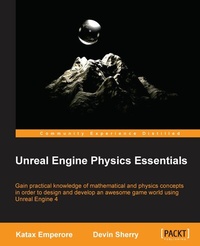
Unreal Engine Physics Essentials
Gain practical knowledge of mathematical and physics concepts in order to design and develop an awesome game world using Unreal Engine 4
Published on 13. January 2025
216 pages
978-1-78439-823-1 (ISBN)
Description

Gain practical knowledge of mathematical and physics concepts in order to design and develop an awesome game world using Unreal Engine 4
Key Features
Use the Physics Asset Tool within Unreal Engine 4 to develop game physics objects for your game world
Explore the Collision mechanics within Unreal Engine 4 to create advanced, real-world physics
A step-by-step guide to implementing the Physics concepts involved in Unreal Engine 4 to create a working Vehicle Blueprint
Book DescriptionThis book gives readers practical insight into the mathematical and physics principles necessary to properly implement physics within Unreal Engine 4. Discover how to manipulate physics within Unreal Engine 4 by learning basic real-world mathematical and physics concepts that assist in the implementation of physics-based objects in your game world. Then, you'll be introduced to PhAT (Physics Asset Tool) within Unreal Engine 4 to learn more about developing game physics objects for your game world. Next, dive into Unreal Engine 4's collision generation, physical materials, blueprints, constraints, and more to get hands-on experience with the tools provided by Epic to create real-world physics in Unreal Engine 4. Lastly, you will create a working Vehicle Blueprint that uses all the concepts covered in this book, as well as covering advanced physics-based topics.What you will learn
Get to know basic to intermediate topics in mathematics and physics
Create assets using the Physics Asset Tool (PhAT) in Unreal Engine 4
Develop Collision Hulls, which are necessary to take advantage of Unreal Engine 4's physics and collision events
Use constraints to create advanced physics-based assets for your game-world
Working knowledge of physics bodies, physics damping, and friction within Unreal Engine 4
Develop physical materials to recreate real-world friction for substances such as glass and ice
Create a working vehicle blueprint from scratch using assets provided by Unreal Engine 4
Implement multiple physical elements and materials to simulate complex behavior over the objects in game
Who this book is forThis book is intended for beginner to intermediate users of Epic Games' Unreal Engine 4 who want to learn more about how to implement physics within their game-world. No matter what your knowledge base of Unreal Engine 4 is, this book contains valuable information on blueprint scripting, collision generation, materials, and the Physical Asset Tool (PhAT) for all users to create better games.
Key Features
Use the Physics Asset Tool within Unreal Engine 4 to develop game physics objects for your game world
Explore the Collision mechanics within Unreal Engine 4 to create advanced, real-world physics
A step-by-step guide to implementing the Physics concepts involved in Unreal Engine 4 to create a working Vehicle Blueprint
Book DescriptionThis book gives readers practical insight into the mathematical and physics principles necessary to properly implement physics within Unreal Engine 4. Discover how to manipulate physics within Unreal Engine 4 by learning basic real-world mathematical and physics concepts that assist in the implementation of physics-based objects in your game world. Then, you'll be introduced to PhAT (Physics Asset Tool) within Unreal Engine 4 to learn more about developing game physics objects for your game world. Next, dive into Unreal Engine 4's collision generation, physical materials, blueprints, constraints, and more to get hands-on experience with the tools provided by Epic to create real-world physics in Unreal Engine 4. Lastly, you will create a working Vehicle Blueprint that uses all the concepts covered in this book, as well as covering advanced physics-based topics.What you will learn
Get to know basic to intermediate topics in mathematics and physics
Create assets using the Physics Asset Tool (PhAT) in Unreal Engine 4
Develop Collision Hulls, which are necessary to take advantage of Unreal Engine 4's physics and collision events
Use constraints to create advanced physics-based assets for your game-world
Working knowledge of physics bodies, physics damping, and friction within Unreal Engine 4
Develop physical materials to recreate real-world friction for substances such as glass and ice
Create a working vehicle blueprint from scratch using assets provided by Unreal Engine 4
Implement multiple physical elements and materials to simulate complex behavior over the objects in game
Who this book is forThis book is intended for beginner to intermediate users of Epic Games' Unreal Engine 4 who want to learn more about how to implement physics within their game-world. No matter what your knowledge base of Unreal Engine 4 is, this book contains valuable information on blueprint scripting, collision generation, materials, and the Physical Asset Tool (PhAT) for all users to create better games.
All prices
More details
Edition
Digital original
Language
English
Place of publication
Birmingham
United Kingdom
Target group
Professional and scholarly
US School Grade: College Graduate Student
Edition type
Digital original
File size
8,15 MB
ISBN-13
978-1-78439-823-1 (9781784398231)
Copyright in bibliographic data and cover images is held by Nielsen Book Services Limited or by the publishers or by their respective licensors: all rights reserved.
Schweitzer Classification
Other editions
Additional editions

Devin Sherry | Katax Emperore
Unreal Engine Physics Essentials
Gain practical knowledge of mathematical and physics concepts in order to design and develop an awesome game world using Unreal Engine 4
Book
09/2015
Packt Publishing
€50.40
Shipment within 3-4 weeks
Persons
Sherry Devin :
Devin Sherry is originally from Levittown, NY, located on Long Island. He studied the topics of Game Development and Game Design at the University of Advancing Technology where he had earned his Bachelor of Arts in Game Design in 2012. During his time in college, Devin worked as a game and level designer with a group of students called Autonomous Games on a real-time strategy styled, third-person shooter called The Afflicted using Unreal Engine 3/UDK where it was presented at GDC in 2013 at the GDC Play Showcase. Today, Devin works as an independent game developer located in Tempe, Arizona, where he works on personal and contracted projects. His achievements include the title Radial Impact, which can be found in the Community Contributions section of the Learn Tab of Unreal Engine 4's Launcher, and his work on his YouTube Channel, Devin Level Design, where he educates viewers on game development within Unreal Engine 3, UDK, and Unreal Engine 4.Emperore Katax :
Katax Emperor is originally from Melbourne, Australia. He received Bachelor's degree in Computer Hardware Engineering and two Master's degree in Multimedia at Swinburne University of Technology in 2012. Katax is involved in particle system programming, developing web-based interactive applications such as games, making animation with 3D applications for use in Unreal Engine, and also doing VJ performance with real-time improvisation style. Katax started programming with Commodore 64 and started making digital art works with Commodore Amiga 500. After Windows 98 was released, he switched to PC. He expanded his experience with 3D applications, fractal and graphic design, and video editing programs. Today, he has a wide range of experience in a number of applications for artists, designers, and developers.
Devin Sherry is originally from Levittown, NY, located on Long Island. He studied the topics of Game Development and Game Design at the University of Advancing Technology where he had earned his Bachelor of Arts in Game Design in 2012. During his time in college, Devin worked as a game and level designer with a group of students called Autonomous Games on a real-time strategy styled, third-person shooter called The Afflicted using Unreal Engine 3/UDK where it was presented at GDC in 2013 at the GDC Play Showcase. Today, Devin works as an independent game developer located in Tempe, Arizona, where he works on personal and contracted projects. His achievements include the title Radial Impact, which can be found in the Community Contributions section of the Learn Tab of Unreal Engine 4's Launcher, and his work on his YouTube Channel, Devin Level Design, where he educates viewers on game development within Unreal Engine 3, UDK, and Unreal Engine 4.Emperore Katax :
Katax Emperor is originally from Melbourne, Australia. He received Bachelor's degree in Computer Hardware Engineering and two Master's degree in Multimedia at Swinburne University of Technology in 2012. Katax is involved in particle system programming, developing web-based interactive applications such as games, making animation with 3D applications for use in Unreal Engine, and also doing VJ performance with real-time improvisation style. Katax started programming with Commodore 64 and started making digital art works with Commodore Amiga 500. After Windows 98 was released, he switched to PC. He expanded his experience with 3D applications, fractal and graphic design, and video editing programs. Today, he has a wide range of experience in a number of applications for artists, designers, and developers.
Content
Table of Contents
Math and Physics Primer in Unreal Engine
Physics Asset Tool (PhAT)
Collision
Constraints
Damping, Friction and Physics Bodies
Materials
Creating a Vehicle Blueprint
Advanced Topics in Physics
Math and Physics Primer in Unreal Engine
Physics Asset Tool (PhAT)
Collision
Constraints
Damping, Friction and Physics Bodies
Materials
Creating a Vehicle Blueprint
Advanced Topics in Physics

