
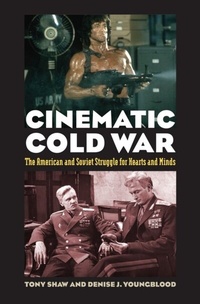
Cinematic Cold War
Description
Alles über E-Books | Antworten auf Fragen rund um E-Books, Kopierschutz und Dateiformate finden Sie in unserem Info- & Hilfebereich.
The Cold War was as much a battle of ideas as a series of military and diplomatic confrontations, and movies were a prime battleground for this cultural combat. As Tony Shaw and Denise Youngblood show, Hollywood sought to export American ideals in movies like Rambo, and the Soviet film industry fought back by showcasing Communist ideals in a positive light, primarily for their own citizens. The two camps traded cinematic blows for more than four decades.
The first book-length comparative survey of cinema's vital role in disseminating Cold War ideologies, Shaw and Youngblood's study focuses on ten films?five American and five Soviet?that in both obvious and subtle ways provided a crucial outlet for the global ?debate? between democratic and communist ideologies. For each nation, the authors outline industry leaders, structure, audiences, politics, and international reach and explore the varied relationships linking each film industry to its respective government. They then present five comparative case studies, each pairing an American with a Soviet film: Man on a Tightrope with The Meeting on the Elbe; Roman Holiday with Spring on Zarechnaya Street; Fail-Safe with Nine Days in One Year; Bananas with Officers; Rambo: First Blood Part II with Incident at Map Grid 36-80.
Shaw breathes new life into familiar American films by Elia Kazan and Woody Allen, while Youngblood helps readers comprehend Soviet films most have never seen. Collectively, their commentaries track the Cold War in its entirety?from its formative phase through periods of thaw and self-doubt to the resurgence of mutual animosity during the Reagan years?and enable readers to identify competing core propaganda themes such as decadence versus morality, technology versus humanity, and freedom versus authority. As the authors show, such themes blurred notions regarding ?propaganda? and ?entertainment,? terms that were often interchangeable and mutually reinforcing during the Cold War.
Featuring engaging commentary and evocative images from the films discussed, Cinematic Cold War offers a shrewd analysis of how the silver screen functioned on both sides of the Iron Curtain. As such it should have great appeal for anyone interested in the Cold War or the cinematic arts.
All prices
More details
Other editions
Additional editions
Persons
Content
Acknowledgments
Note on Transliteration and Translation
Introduction: Culture, Film and the ?New? Cold War History
Part One: Industry, State, and Cold War Contours
Introduction
1. American Cinema and the Cold War
2. Soviet Cinema and the Cold War
Conclusion
Part Two: Sites of Conflict
3. Justifying War
4. Pleasure versus Progress
5. Deterrence and Dissent
6. Conservation versus Anarchy
7. Last Acts
Conclusion
Filmography
Notes
Bibliography
Index

System requirements
File format: ePUB
Copy protection: Adobe-DRM (Digital Rights Management)
System requirements:
- Computer (Windows; MacOS X; Linux): Install the free reader Adobe Digital Editions prior to download (see eBook Help).
- Tablet/smartphone (Android; iOS): Install the free app Adobe Digital Editions or the app PocketBook before downloading (see eBook Help).
- E-reader: Bookeen, Kobo, Pocketbook, Sony, Tolino and many more (not Kindle).
The file format ePub works well for novels and non-fiction books – i.e., „flowing” text without complex layout. On an e-reader or smartphone, line and page breaks automatically adjust to fit the small displays.
This eBook uses Adobe-DRM, a „hard” copy protection. If the necessary requirements are not met, unfortunately you will not be able to open the eBook. You will therefore need to prepare your reading hardware before downloading.
Please note: We strongly recommend that you authorise using your personal Adobe ID after installation of any reading software.
For more information, see our ebook Help page.
File format: PDF
Copy-Protection: Adobe-DRM (Digital Rights Management)
System requirements:
- Computer (Windows; MacOS X; Linux): Install the free reader Adobe Digital Editions prior to download (see eBook Help).
- Tablet/smartphone (Android; iOS): Install the free app Adobe Digital Editions or the app PocketBook before downloading (see eBook Help).
- E-reader: Bookeen, Kobo, Pocketbook, Sony, Tolino and many more (only limited: Kindle).
The file format PDF always displays a book page identically on any hardware. This makes PDF suitable for complex layouts such as those used in textbooks and reference books (images, tables, columns, footnotes). Unfortunately, on the small screens of e-readers or smartphones, PDFs are rather annoying, requiring too much scrolling.
This eBook uses Adobe-DRM, a „hard” copy protection. If the necessary requirements are not met, unfortunately you will not be able to open the eBook. You will therefore need to prepare your reading hardware before downloading.
Please note: We strongly recommend that you authorise using your personal Adobe ID after installation of any reading software.
For more information, see our eBook Help page.
File format: ePUB
Copy protection: Watermark-DRM (Digital Rights Management)
System requirements:
- Computer (Windows; MacOS X; Linux): Use a reading software that can process the file format ePUB: e.g., Adobe Digital Editions or FBReader – both free (see eBook Help).
- Tablet/Smartphone (Android; iOS): Before downloading, install the free app Adobe Digital Editions (see eBook Help).
- E-reader: Bookeen, Kobo, Pocketbook, Sony, Tolino and many more (not Kindle).
The file format ePUB works well for novels and non-fiction books – i.e., „flowing” text without complex layout. On an e-reader or smartphone, line and page breaks automatically adjust to fit the small displays.
This eBook uses Watermark-DRM, a „soft” copy protection. This means that there are no technical restrictions to prevent illegal distribution. However, there is a personalised watermark embedded in the eBook that can be used to identify the purchaser of the eBook in the event of misuse and to provide evidence for legal purposes.
For more information, see our eBook Help page.
