

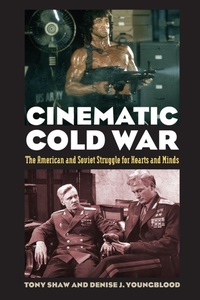
Cinematic Cold War
The American and Soviet Struggle for Hearts and Minds
Published on 15. August 2014
Book
Paperback/Softback
312 pages
978-0-7006-2020-3 (ISBN)
Description
The Cold War was as much a battle of ideas as a series of military and diplomatic confrontations, and movies were a prime battleground for this cultural combat. As Tony Shaw and Denise Youngblood show, Hollywood sought to export American ideals in movies like Rambo, and the Soviet film industry fought back by showcasing Communist ideals in a positive light, primarily for their own citizens. The two camps traded cinematic blows for more than four decades.
The first book-length comparative survey of cinema's vital role in disseminating Cold War ideologies, Shaw and Youngblood's study focuses on ten films-five American and five Soviet-that in both obvious and subtle ways provided a crucial outlet for the global ""debate"" between democratic and communist ideologies. For each nation, the authors outline industry leaders, structure, audiences, politics, and international reach and explore the varied relationships linking each film industry to its respective government. They then present five comparative case studies, each pairing an American with a Soviet film: Man on a Tightrope with The Meeting on the Elbe; Roman Holiday with Spring on Zarechnaya Street; Fail-Safe with Nine Days in One Year; Bananas with Officers; Rambo: First Blood Part II with Incident at Map Grid 36-80. Shaw breathes new life into familiar American films by Elia Kazan and Woody Allen, while Youngblood helps readers comprehend Soviet films most have never seen. Collectively, their commentaries track the Cold War in its entirety-from its formative phase through periods of thaw and self-doubt to the resurgence of mutual animosity during the Reagan years-and enable readers to identify competing core propaganda themes such as decadence versus morality, technology versus humanity, and freedom versus authority. As the authors show, such themes blurred notions regarding ""propaganda"" and ""entertainment,"" terms that were often interchangeable and mutually reinforcing during the Cold War.
Featuring engaging commentary and evocative images from the films discussed, Cinematic Cold War offers a shrewd analysis of how the silver screen functioned on both sides of the Iron Curtain. As such it should have great appeal for anyone interested in the Cold War or the cinematic arts.
The first book-length comparative survey of cinema's vital role in disseminating Cold War ideologies, Shaw and Youngblood's study focuses on ten films-five American and five Soviet-that in both obvious and subtle ways provided a crucial outlet for the global ""debate"" between democratic and communist ideologies. For each nation, the authors outline industry leaders, structure, audiences, politics, and international reach and explore the varied relationships linking each film industry to its respective government. They then present five comparative case studies, each pairing an American with a Soviet film: Man on a Tightrope with The Meeting on the Elbe; Roman Holiday with Spring on Zarechnaya Street; Fail-Safe with Nine Days in One Year; Bananas with Officers; Rambo: First Blood Part II with Incident at Map Grid 36-80. Shaw breathes new life into familiar American films by Elia Kazan and Woody Allen, while Youngblood helps readers comprehend Soviet films most have never seen. Collectively, their commentaries track the Cold War in its entirety-from its formative phase through periods of thaw and self-doubt to the resurgence of mutual animosity during the Reagan years-and enable readers to identify competing core propaganda themes such as decadence versus morality, technology versus humanity, and freedom versus authority. As the authors show, such themes blurred notions regarding ""propaganda"" and ""entertainment,"" terms that were often interchangeable and mutually reinforcing during the Cold War.
Featuring engaging commentary and evocative images from the films discussed, Cinematic Cold War offers a shrewd analysis of how the silver screen functioned on both sides of the Iron Curtain. As such it should have great appeal for anyone interested in the Cold War or the cinematic arts.
More details
Language
English
Place of publication
Kansas
United States
Target group
Professional and scholarly
Illustrations
52 photographs
Dimensions
Height: 229 mm
Width: 152 mm
Thickness: 17 mm
Weight
455 gr
ISBN-13
978-0-7006-2020-3 (9780700620203)
Copyright in bibliographic data and cover images is held by Nielsen Book Services Limited or by the publishers or by their respective licensors: all rights reserved.
Schweitzer Classification
Other editions
Additional editions
Tony Shaw | Denise J. Youngblood
Cinematic Cold War
The American and Soviet Struggle for Hearts and Minds
E-Book
09/2014
1st Edition
University Press of Kansas
from
€56.99
Available for download
Persons
Tony Shawis professor of contemporary history at the University of Hertfordshire, UK and author of Hollywood's Cold War.
Denise J. Youngblood is professor of Russian history at the University of Vermont, USA and author of five books, including, most recently, Russian War Films: On the Cinema Front, 1914-2005.
Denise J. Youngblood is professor of Russian history at the University of Vermont, USA and author of five books, including, most recently, Russian War Films: On the Cinema Front, 1914-2005.