

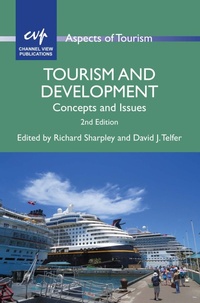
Tourism and Development
Concepts and Issues
2nd Edition
Published on 17. November 2014
568 pages
978-1-84541-475-7 (ISBN)
Description

This book explores and challenges the relationship between tourism and development and establishes a conceptual link between the discrete yet interconnected disciplines of tourism studies and development studies. This revised and expanded second edition provides not only a comprehensive theoretical foundation in development studies but also a critical analysis of contemporary themes and issues relevant to the study of tourism and its potential contribution to development. The second edition contains new chapters on the following topics: * Tourism and Poverty Reduction * Cultural Heritage, Tourism and Socio-economic Development * Tourism, Climate Change and Development * Human Rights Issues in Tourism Development * Tourism, Development and International Studies
Reviews / Votes
This edited book makes a valuable contribution by exploring the important concepts and issues that are linked with the perception that tourism can be a vehicle for leading countries out of poverty. While edited volumes, in my opinion, are not usually the most readable or useful types of books, this edited volume is thorough and extensive, giving anyone who is interested in the issue of tourism and economic development issues a great deal to read through. -- Craig Webster, Ball State University, USA * Journal of Tourism Futures, Vol. 3 Issue 2 * Building on the successful first edition, chapters on such topics as poverty reduction, heritage, climate change and human rights have been added and the result is a well-structured debate within a clear conceptual framework. The ensuing discussion is appropriate, rigorous and comprehensive and demonstrates the global economic and social importance of tourism. This book is now a classic and should be required reading for anyone with a serious interest in international tourism's role in 'development.' * David Harrison, University of South Pacific, Fiji * This volume offers a set of authoritative contributions steering through the vast array of tourism and development concepts and cases. This sound collection of critical pieces is a 'must read' not only for undergraduate and postgraduate students, but also for all those interested or involved in tourism and development. * Marina Novelli, University of Brighton, UK * The first edition of this book provided an invaluable contribution to the integration of the fields of tourism and development studies. The second edition furthers this legacy to provide an insightful updating of the challenges and opportunities for the use of tourism for economic and social advancement within shifting development paradigms and global change. * Andrew Holden, University of Bedfordshire, UK *More details
Series
Edition
2nd Revised edition
Language
English
Place of publication
Bristol
United Kingdom
Publishing group
Channel View Publications Ltd
Target group
Professional and scholarly
Edition type
Revised edition
ISBN-13
978-1-84541-475-7 (9781845414757)
Copyright in bibliographic data and cover images is held by Nielsen Book Services Limited or by the publishers or by their respective licensors: all rights reserved.
Schweitzer Classification
Other editions
Additional editions
Book
11/2014
2nd Edition
Channel View Publications
€58.10
Shipment within 10-20 days
Persons
Richard Sharpley is Professor of Tourism and Development at the University of Central Lancashire, Preston, UK. He has previously held positions at a number of other institutions, including the University of Northumbria (Reader in Tourism) and the University of Lincoln, where he was Professor of Tourism and Head of Department, Tourism and Recreation Management. His principal research interests are within the fields of tourism and development, island tourism, rural tourism and the sociology of tourism.
David J. Telfer is Associate Professor at Brock University, Canada. His principal research areas include the relationship between tourism and development theories, economic linkages between tourism and host communities, tourism planning and rural tourism.
David J. Telfer is Associate Professor at Brock University, Canada. His principal research areas include the relationship between tourism and development theories, economic linkages between tourism and host communities, tourism planning and rural tourism.
Content
Richard Sharpley and David J. Telfer: Introduction: Tourism and Development: A Decade of Change
Part 1: Tourism and Development: Conceptual Perspectives
1. Richard Sharpley: Tourism: A Vehicle for Development?
2. David J. Telfer: The Evolution of Development Theory and Tourism
Part 2: Relationship Between Development and Tourism
3. Tanja Mihalic: Tourism and Economic Development Issues
4. Regina Scheyvens: Tourism and Poverty Reduction
5. David J. Telfer: Tourism and Regional Development Issues
6. Tazim Jamal and Dianne Dredge: Tourism and Community Development Issues
7. Atsuko Hashimoto: Tourism and Socio-cultural Development Issues
8. Dallen J. Timothy: Cultural Heritage, Tourism and Socio-economic Development
9. Chris Southgate and Richard Sharpley: Tourism, Development and the Environment
Part 3: Barriers and Challenges to Tourism Development
10. Raoul Bianchi: Towards a New Political Economy of Global Tourism Revisited
11. C. Michael Hall, Daniel Scott and Stefan Goessling: Tourism, Climate Change and Development
12. Richard Sharpley: The Consumption of Tourism
13. Edward Nkyi and Atsuko Hashimoto: Human Rights Issues in Tourism Development
14. David J. Telfer and Atsuko Hashimoto: Tourism, Development and International Studies
15. Richard Sharpley: Sustainability: A Barrier to Tourism Development?
16. David J. Telfer and Richard Sharpley: Conclusion: Tourism and Development
Part 1: Tourism and Development: Conceptual Perspectives
1. Richard Sharpley: Tourism: A Vehicle for Development?
2. David J. Telfer: The Evolution of Development Theory and Tourism
Part 2: Relationship Between Development and Tourism
3. Tanja Mihalic: Tourism and Economic Development Issues
4. Regina Scheyvens: Tourism and Poverty Reduction
5. David J. Telfer: Tourism and Regional Development Issues
6. Tazim Jamal and Dianne Dredge: Tourism and Community Development Issues
7. Atsuko Hashimoto: Tourism and Socio-cultural Development Issues
8. Dallen J. Timothy: Cultural Heritage, Tourism and Socio-economic Development
9. Chris Southgate and Richard Sharpley: Tourism, Development and the Environment
Part 3: Barriers and Challenges to Tourism Development
10. Raoul Bianchi: Towards a New Political Economy of Global Tourism Revisited
11. C. Michael Hall, Daniel Scott and Stefan Goessling: Tourism, Climate Change and Development
12. Richard Sharpley: The Consumption of Tourism
13. Edward Nkyi and Atsuko Hashimoto: Human Rights Issues in Tourism Development
14. David J. Telfer and Atsuko Hashimoto: Tourism, Development and International Studies
15. Richard Sharpley: Sustainability: A Barrier to Tourism Development?
16. David J. Telfer and Richard Sharpley: Conclusion: Tourism and Development
