

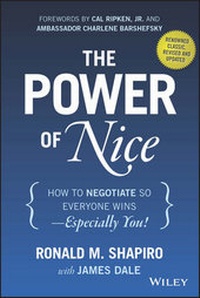
The Power of Nice
Description

In this revised and updated edition of the renowned classic The Power of Nice, negotiations expert, sports agent, New York Times bestselling author, attorney, business leader and educator, Ron Shapiro, shares the key principles of effective negotiation through a combination of a time-tested process, anecdotes, and exercises. Drawing on his unparalleled experiences from the worlds of sports, law, business and politics, as well as dealing with life issues common to us all, Shapiro takes you through the steps of his systematic approach: The Three Ps, Prepare-Probe-Propose.
Learn how to use the process to empower you in negotiations. Regardless of your level of experience or the extent of your confidence, you will get what you want while building stronger relationships for the future. This updated edition contains:
* Significant new material including an expanded view of its applicability to a broad array of business and life challenges
* a new streamlined version of the Preparation Checklist
* a more precise understanding of the concept of WIN-win
* forewords by Cal Ripken, Jr., and Ambassador Charlene Barshefsky, and an Epilogue highlighting negotiation lessons from the life of Nelson Mandela
The book also provides a link to reinforcement of its lessons through the website of the Shapiro Negotiations Institute.
Whether you are negotiating with, among others, a customer or client, a boss or government official, or even setting a teenager's curfew or getting a last seat on an airplane, this invaluable guide will help you read the other side and bring the power of human psychology and a time-tested process to the negotiating table. If you're tired of uneven "compromise" and the feeling of being manipulated, turn the tables for good with The Power of Nice, and learn strength from the master himself.
All prices
More details
Other editions
Additional editions
Persons
JAMES DALE is an author/marketing consultant whose workincludes books, articles, radio, television, sports, technology,public relations and advertising.
SHAPIRO NEGOTIATIONS INSTITUTE is a premier globalprovider of sales, negotiation, and influence training andconsulting. Its success is built on helping professionals at alllevels use a systematic approach to accomplish more, faster, andwith a higher degree of effectiveness. By taking more than 50 yearsof lessons learned in real-life situations, the Institute's teamdigs into specific industry and client challenges, so its tools andtechniques can be implemented immediately with precision.
Content
Foreword to the First Edition by Cal Ripken, Jr. xiv
Acknowledgments xvi
Introduction: Why Change What Works? 2
1 Negotiation 5
"I'll Burn That Bridge When I Come to It"5
Your First Deal 7
What Negotiation Isn't 11
Filling the Negotiator's Toolbox 18
What Negotiation Is 19
What Negotiation Can Be 23
Refresher 26
2 I Win-You Lose Negotiation--An Exercise inFlawed Logic 29
Enemies and Entrenched Positions 29
Hit and Run 32
I'm Not One of Them, Am I? 35
At Least One Dissatisfied Party 43
Refresher 45
3 WIN-win Negotiation 47
Myth and Reality 47
Achieving WIN-win 49
Good Deals Echo, They Lead to More Deals 51
WIN-win Is Not Wimp-Wimp 52
Roadblocks, Minefields, and Wisdom 55
Putting It Together 57
Refresher 64
4 The Three Ps--A Systematic Approach 67
Prepare, Probe, and Propose 70
Refresher 79
5 Prepare...or Else 81
Preparation: The Aerobics of Negotiation 81
How Prepared Are You for Your Negotiations? 82
The Numbers and Letters Game 83
The Numbers and Letters Game Continued... 84
How to Prepare (and How Not To) 87
The Preparation Checklist 89
A Case Study: The Sur-Real Sales Challenge 97
Confidence Is the Secret Weapon (But the Real Secret Is ThatPreparation Is the Key to Confidence) 104
Sources of Information 105
Refresher 110
6 Probe, Probe, Probe 113
The Other Side Is Trying to Tell You How to Make the Deal113
W.H.A.T.? The Probing Technique 120
The Don'ts--How Not to Probe 126
Listening 128
The Zoologist 133
Learning to Listen 135
Refresher 138
7 Propose-But Not Too Fast--Getting the Other Sideto Go First 141
Role Playing 141
Proposing for Real 146
The Three Rules Behind Propose 149
Making Counterproposals 153
Refresher 158
8 Difficult Negotiators 161
...And the Award for Most Difficult Negotiator Goes to... 162
Dealing with the Difficult Negotiator (without Becoming One)166
Emotional Tactics--Nonemotional Responses 170
Challenging Personalities 173
Refresher 177
9 Negotiating from Weakness 179
Perceived Weakness versus Real Weakness 179
Expand the Goals 181
Locate Allies 182
Never Let Them See You Sweat 185
Brainstorming 187
Refresher 192
10 Unlocking Deadlocks 195
If Nothing Works, Change Something 195
Find Reasons to Agree 200
Get Creative 200
Objective Mechanisms 205
Sometimes No Deal Is the Best Deal 209
If Deal Fever Persists, Keep Saying "No" 209
Refresher 216
11 Building Relationships 219
Today versus Tomorrow: How Long Is the Long Run? 219
A Relationship Tool: Bonding 221
The Meet-and-Bond Style 222
Rebonding 225
No Faux Bonding 227
Practice Makes Bonding 228
The Value of Relationships 231
Refresher 234
12 Putting It All Together 237
The Major League Baseball Owners versus the Major League Umpires(and the Major League Umpires versus Themselves) 237
Refresher 244
Epilogue: Nelson Mandela--When the Power of Nice Changed aNation 247
Reinforcement Tools Link 251
Post-Negotiation Assessment Questionnaire 253
Negotiator's Toolbox 255
Index 257
Chapter 1
Negotiation
Let us never fear to negotiate. But let us never negotiate out of fear.
-John F. Kennedy
Nothing in life is to be feared. It is only to be understood.
-Madame Marie Curie
"I'll Burn That Bridge When I Come to It"
Early in my career, I had a law partner who loved his work. He was smart. He knew the law. He always had his clients' best interests at heart. And he liked nothing better than the challenge of negotiation. He had no fear of the other side. In fact, he relished confrontation. He paced outside a conference room like a blitzing linebacker. He had that same hungry look in his eyes, pacing and revving himself up for the kill. He couldn't wait to charge in and nail the quarterback (or the other lawyer) to the Astroturf (or the deal he was after). If a few bones were broken along the way, so be it.or so much the better.
He often got what he and his client wanted. But he only got it once. Nobody wanted or could afford to deal with him twice because he left nothing on the table. Winner take all. Why take a share of the profit when you can take all of it? Why have investors when you can have sole control? Why pay commissions? Why give concessions to a union when you can break the union? Why not squeeze all suppliers to rock bottom? Why not drive all offers up to the last dollar? Why negotiate when you can dictate? My partner literally destroyed the other side, and he reveled in it.
One day he strutted out of yet another of his "eat-the-opposition-for-lunch" meetings, fresh blood dripping from his teeth, having dismembered yet another adversary in the name of dealmaking. Instead of congratulating him, I asked him a question that took him by surprise. "What did the other side want?"
He looked at me with a combination of curiosity at my naiveté and astonishment at the irrelevance of the question. "I don't know, but they didn't get it," he answered.
I persisted, "Maybe they could have gotten what they wanted and you could have gotten what you wanted. What would have been wrong with that?"
Then he sighed like a wise old tobacco-chewing veteran and laid it out for the rookie who just didn't understand how to play the game. "Don't you get it? We won."
"Yeah," I protested, "but what if, some time in the future, the tables turn and the other side gains the upper hand and then they're in a position to change the deal?"
That's when my wise old veteran partner put his arm around me, took a long, dramatic pause, and said, "I'll burn that bridge when I come to it." That wasn't just his snappy comeback. He meant it. It was the embodiment of his negotiation philosophy.
That's the way a lot of people look at negotiation. Two S.O.B.s locked in a room trying to beat the daylights out of each other and may the biggest S.O.B. win. Even way back then, I thought there was a better way to make deals.
Over the years I practiced and perfected what made sense and worked for me: You can be "a nice guy" and still get what you're after. In fact, embracing the systematic approach of this book gives you the power and allows you to get better results, achieve more of your goals, and build longer-term relationships with even greater returns.
The Power of Nice Philosophy
The way to get what you want is to help the other side get what they want.
Your First Deal
What matters in negotiation is results. Everything else is decoration. To get results you must have parties who want to make a deal, each of whom has something to gain. Never forget, everyone who sits down at a negotiating table is there for one simple reason: They want something the other side has.
You picked up this book, so you must feel you have something to gain. As authors, we have already gained by making the book sale. So, have we won and you lost? Hardly. As you'll learn, we don't want a one-time deal; we want an ongoing relationship (your recommendation of our book to others, visiting our website, attending our programs, and buying our next print or digital book). You don't want a one-time deal, either. You want to learn to negotiate every deal well. Therefore, reader and authors have a common interest (another point I'll be making later) and that is to make you a better negotiator.
To achieve that end, we each have to make a commitment. Yours is to answer two questions with complete candor (even if it hurts). Ours is to deliver on four objectives that will make you an effective negotiator.
- What negotiation have you handled recently that has not gone or is not going well? [Remember what I said about candor. Write out your answer and then show it to someone you can't fool (husband, wife, partner, friend, boss, client, mother)]
- What would you like to be able to do differently after reading this book? (Be realistic, but aim high.)
Write down your answers and save them. You're going to want to look back at them at the end of the book.
Robert Mankoff © 1988 from The New Yorker Collection. All Rights Reserved.
Four Objectives You Can Expect
- Displaying Confidence.
The most effective negotiators tend to be the most confident negotiators. Conversely, negotiators who are less confident are less effective. So, how do you get confidence and become a better negotiator? Get smart.
Lack of confidence is mostly lack of knowledge. Knowledge is power. You will be armed with the knowledge it takes to deal from strength. You won't be cocky; you'll be confident. The former is imitating someone who knows what he's doing; the latter is the person who the cocky person is imitating.
- Achieving WIN-win.
Today, everybody talks about win-win negotiation. Both sides win. Both get what they want. Both are equally happy. How delightful. How unrealistic.
If we negotiators were seeking truly equal terms and deals, like King Solomon, we'd simply divide everything in half. In reality, we're out to achieve all (or most) of our goals, to make our most desirable deal. But the best way to do so is to let the other side achieve some of their goals, to make their acceptable deal. That's WIN-win: maximize your win, but don't forget theirs.
The most common approach to dealmaking is I Win-You Lose, the pound-of-flesh school-the only good deal for me is a bad deal for you. The unfortunate fate of too many negotiations is:
We both lose
or
If I can't win, nobody can.
We'll show you how to avoid both of these negative categories.
- Using the 3 Ps.
There's an old saying, "If all you have in your toolbox is a hammer, then every problem looks like a nail." The same holds true for negotiation. More tools enable you to solve more problems. Better tools enable you to find longer lasting, more enriching solutions. Prepare, Probe, and Propose are the first of the tools that we'll put in your negotiator's toolbox.
There is no secret formula that will enable you to get what you want every time you negotiate. But we have created a systematic approach-a step-by-step program-that, if repeated and mastered, will maximize your results. Like all good systems, this one is simple:
Prepare, Probe, and Propose.
That's it. Close the book, you've learned it. Well, it's not quite that simple. We'll show you how to prepare better than the other side; how to probe so you know what they want and why; and how to propose without going first and revealing too much, to avoid impasses or getting backed into a corner, but still achieving what you want. As you'll see, negotiation is a process, not an event.
- Handling Tough Negotiations.
Welcome to the real world of dealmaking. Unfortunately, it's full of tough negotiators and tough negotiations. Some people think you have to be a bad guy to be a good negotiator. So, they act the part. Some aren't really so awful but have to answer to an awful boss who demands that they act the part. Sometimes, the negotiation itself may be brutal. The time, terms, or goals may be so difficult to meet that the process turns loathsome, even if the person opposite you isn't.
The tools in your negotiator's toolbox will enable you to deal with the toughest people and situations, from neutralizing animosity, to breaking deadlocks, to knowing when the best deal is no deal. You'll learn how to out-negotiate the bad guys without becoming one of them.
One more thing: If you've been around sports long enough, you know the value of a good pep talk-whether it's Herb Brooks talking to the 1980 U.S. Olympic Hockey Team-the "miracle on ice," Gene Hackman as the coach in Hoosiers, Babe Ruth talking to a sick kid in the hospital, or Pat O'Brien invoking the memory of the Gipper (Ronald Reagan in his second-most-famous role) in Knute Rockne,...
