

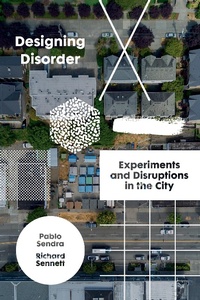
Designing Disorder
Experiments and Disruptions in the City
Published on 7. April 2020
160 pages
978-1-78873-781-4 (ISBN)
Description

In 1970, Richard Sennett published the groundbreaking The Uses of Disorder, arguing that the ideal of a planned and ordered city was flawed. Fifty years later, Sennett returns to these still fertile ideas and, alongside campaigner and architect Pablo Sendra, sets out an agenda for the design and ethics of the Open City.
The public spaces of our cities are under siege from planners, privatisation and increased surveillance. Our streets are becoming ever more lifeless and ordered. What is to be done? Can disorder be designed? In this provocative essay Sendra and Sennett propose a reorganisation of how we think and plan the social life of our cities. 'Infrastructures of disorder' combine architecture, politics, urban planning and activism in order to develop places that nurture rather than stifle, bring together rather than divide up, remain open to change rather than closed off.
The public spaces of our cities are under siege from planners, privatisation and increased surveillance. Our streets are becoming ever more lifeless and ordered. What is to be done? Can disorder be designed? In this provocative essay Sendra and Sennett propose a reorganisation of how we think and plan the social life of our cities. 'Infrastructures of disorder' combine architecture, politics, urban planning and activism in order to develop places that nurture rather than stifle, bring together rather than divide up, remain open to change rather than closed off.
More details
Edition
Ebook UK & RoW
Language
English
Place of publication
London
United Kingdom
Product notice
Reflowable
ISBN-13
978-1-78873-781-4 (9781788737814)
Copyright in bibliographic data and cover images is held by Nielsen Book Services Limited or by the publishers or by their respective licensors: all rights reserved.
Schweitzer Classification
Other editions
Additional editions
Book
04/2022
Verso Books
€19.00
Shipment within 3-4 weeks
Book
04/2020
Verso Books
€24.00
Article exhausted; check for reprint
Persons
Pablo Sendra is Lecturer in Planning and Urban Design at The Bartlett School of Planning, University College London. He is also co-founder and partner of the urban design practice Lugadero and co-founder of the network CivicWise. He develops action research projects and radical teaching in collaboration with community groups and activists in London. He is co-author (with Daniel Fitzpatrick) of Community-Led Regeneration (2020) and co-editor (with Maria Jöo Pita and Civicwise) of Civic Practices (2017).
Richard Sennett's first book was The Uses of Disorder, published in 1970. His previous books include The Fall of Public Man, Flesh and Stone and Respect, as well as the recent Homo Faber trilogy, The Craftsman, Together, Building and Dwellings. For decades he has advised urban programmes for the United Nations. He has been awarded the Hegel and Spinoza prizes, as well as an honorary doctorate by Cambridge University.
Richard Sennett's first book was The Uses of Disorder, published in 1970. His previous books include The Fall of Public Man, Flesh and Stone and Respect, as well as the recent Homo Faber trilogy, The Craftsman, Together, Building and Dwellings. For decades he has advised urban programmes for the United Nations. He has been awarded the Hegel and Spinoza prizes, as well as an honorary doctorate by Cambridge University.
Content
- Cover Page
- Halftitle Page
- Title Page
- Copyright Page
- Contents
- Introduction
- Part I: Civil Society
- 1. The Politics of the Hidden City
- 2. Open Forms
- Part II: Infrastructures for Disorder
- 3. From the Paper to the Plan
- 4. Below
- 5. Above
- 6. Disorder in Section
- 7. Process and Flux
- Part III: Unmaking and Making
- Acknowledgements
- Notes
