

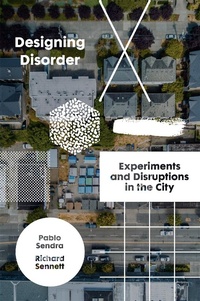
Designing Disorder
Experiments and Disruptions in the City
Published on 7. April 2020
Book
Hardback
160 pages
978-1-78873-780-7 (ISBN)
Description
In 1970, Richard Sennett published the groundbreaking The Uses of Disorder, arguing that the ideal of a planned and ordered city was flawed. Fifty years later, Sennett returns to these still fertile ideas and, alongside campaigner and architect Pablo Sendra, sets out an agenda for the design and ethics of the Open City.
The public spaces of our cities are under siege from planners, privatisation and increased surveillance. Our streets are becoming ever more lifeless and ordered. What is to be done? Can disorder be designed? In this provocative essay Sendra and Sennett propose a reorganisation of how we think and plan the social life of our cities. 'Infrastructures of disorder' combine architecture, politics, urban planning and activism in order to develop places that nurture rather than stifle, bring together rather than divide up, remain open to change rather than closed off.
The public spaces of our cities are under siege from planners, privatisation and increased surveillance. Our streets are becoming ever more lifeless and ordered. What is to be done? Can disorder be designed? In this provocative essay Sendra and Sennett propose a reorganisation of how we think and plan the social life of our cities. 'Infrastructures of disorder' combine architecture, politics, urban planning and activism in order to develop places that nurture rather than stifle, bring together rather than divide up, remain open to change rather than closed off.
Reviews / Votes
Constantly stimulating . . . A lateish-life appraisal of what Richard Sennett has read, written and, most vitally, witnessed on the street or in the marketplace in the tradition of the sharp-eyed, sharp-nosed flaneur taking in every sensation. -- Jonathan Meades * Guardian [for Buidling and Dwelling] * Essential reading for all students of the city. -- Anna Minton * Prospect [for Building and Dwelling] * A thoughtful writer with far-ranging interests and a keen eye for hidden patterns and complex processes that may escape the casual observer. He has always been a pleasure to read. * Wall St Journal [for Building and Dwelling] * No one knows more than [Sennett] about cities and the efforts that have been made over the past two centuries to order and plan them to make them more liveable for their inhabitants. It is this eternally problematic relationship between the city's form - buildings, streets, highways, transport networks - and the quality of collective life it can offer its citizens, that has been at the heart of his life-long project as an urbanist and practising planner. -- Jerry White * Times Literary Supplement [for Building and Dwelling] * In this very readable essay, Sennett pushes on the ideas he developed in his 'Uses of Disorder'. The upshot seems to be the 'open city'; the antithesis of places like New York'sHudson Yards; a pre-determined, real-estate driven 'community' that can only degrade over time. Given contingent times, a necessary critical view of the modern urban realm. * RIBA Journal * The promotion of this sense of impotence, and the resulting inertia, are encouraged by a patronising capitalist "nanny state" on behalf of corporations for whom profits, not people, matter. The only antidote to that inertia is surely to start planning the "disorder" promulgated by Sendra and Sennett. * Morning Star * Timely and relevant...For both Sennett and Sendra, cities are at their best when they resist homogeneity and promote difference, and when they empower people to actively shape and reshape their built environment and its public uses. -- Eoin O Broin * Irish Times * A bold invitation to take sides ... a city of power (Hudson Yards) versus a city of the people (the Garment District in New York City), before formulating the no less audacious goal of the book: to enable urban spontaneity by means of design -- Placido Gonzalez Martinez * Journal of Urban Design * Evocatively, he paints a picture of brittle cities, which serve closed systems and whose buildings are destroyed rather than adapted as their use changes. -- Charmaine Chan * South China Morning Post * This book can be seen as an ongoing and open-ended conversation rather than a static presentation of the authors' points of view ... a very lively and engaging read. -- Judith Ryser * Urban Design * I thought of my home town, Dublin, while reading Pablo Sendra and Richard Sennett's Designing Disorder: Experiments and Disruptions in the City. Here, the authors explore ethical urban design in an age of privatisation, hostile architecture and widespread surveillance. -- Naoise Dolan * Observer, Best Books of 2020 * A good public space should offer the possibility of surprise. Sennett and Sendra contrast the idea of the "brittle city" or the "closed city" with the idea of the "open city": a place that can change as its residents', visitors', and workers' needs change. A building, street, or neighborhood should always remain "incomplete," so that it can adapt with the times. . . .worth reading as a guide to post-pandemic urban-space management. * City Journal * This short, 154-page book, contains thought provoking ideas, philosophies and history regarding experiments and disruptions in an urban environment. -- Kevin Cassidy * Criminal Law and Criminal Justice Books *
More details
Language
English
Place of publication
London
United Kingdom
Product notice
sewn/stitched
Cloth over boards
Illustrations
1x8pp colour insert
Dimensions
Height: 216 mm
Width: 148 mm
Thickness: 20 mm
Weight
276 gr
ISBN-13
978-1-78873-780-7 (9781788737807)
Copyright in bibliographic data and cover images is held by Nielsen Book Services Limited or by the publishers or by their respective licensors: all rights reserved.
Schweitzer Classification
Other editions
New editions
Book
04/2022
Verso Books
€19.00
Shipment within 3-4 weeks
Additional editions
E-Book
04/2020
Verso Books
€19.49
Available for download
Persons
Pablo Sendra is Lecturer in Planning and Urban Design at The Bartlett School of Planning, University College London. He is also co-founder and partner of the urban design practice Lugadero and co-founder of the network CivicWise. He develops action research projects and radical teaching in collaboration with community groups and activists in London. He is co-author (with Daniel Fitzpatrick) of Community-Led Regeneration (2020) and co-editor (with Maria Joao Pita and Civicwise) of Civic Practices (2017).