

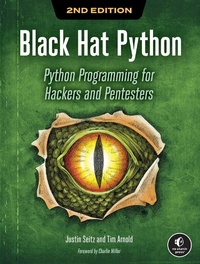
Black Hat Python, 2nd Edition
Python Programming for Hackers and Pentesters
Published on 13. April 2021
216 pages
978-1-7185-0113-3 (ISBN)
Description

Fully-updated, second edition of this worldwide bestseller with over 100,000 copies sold.
When it comes to creating powerful and effective hacking tools, Python is the language of choice for most security analysts. In Black Hat Python, you'll explore the darker side of Python's capabilities--writing network sniffers, manipulating packets, infecting virtual machines, creating stealthy trojans, and more.
The second edition of this bestseller has been updated to cover Python 3, and the authors have added coverage of new modules and techniques that reflect current industry best practices. You will find expanded explanations of strategies, from splitting bytes to leveraging computer-vision libraries, that you can apply to future hacking projects.
You will see how the hacking techniques work and create your own personal arsenal of readable and maintainable code using clean coding techniques as you learn how to:
• Create a trojan command-and-control using GitHub
• Detect sandboxing and automate common malware tasks, like keylogging and screenshotting
• Escalate Windows privileges with creative process control
• Use offensive memory forensics tricks to retrieve password hashes and inject shellcode into a virtual machine
• Extend the popular Burp Suite web-hacking tool
• Abuse Windows COM automation to perform a man-in-the-browser attack
• Exfiltrate data from a network most sneakily
When it comes to offensive security, your ability to create powerful tools on the fly is indispensable. Learn how with Black Hat Python.
New to this edition:
All Python code has been updated to cover Python 3 and includes updated libraries used in current Python applications. Additionally, there are more in-depth explanations of the code and the programming techniques have been updated to current, common tactics. Examples of new material that readers will learn include how to sniff network traffic, evade anti-virus software, brute-force web applications, and set up a command-and-control (C2) system using GitHub.
When it comes to creating powerful and effective hacking tools, Python is the language of choice for most security analysts. In Black Hat Python, you'll explore the darker side of Python's capabilities--writing network sniffers, manipulating packets, infecting virtual machines, creating stealthy trojans, and more.
The second edition of this bestseller has been updated to cover Python 3, and the authors have added coverage of new modules and techniques that reflect current industry best practices. You will find expanded explanations of strategies, from splitting bytes to leveraging computer-vision libraries, that you can apply to future hacking projects.
You will see how the hacking techniques work and create your own personal arsenal of readable and maintainable code using clean coding techniques as you learn how to:
• Create a trojan command-and-control using GitHub
• Detect sandboxing and automate common malware tasks, like keylogging and screenshotting
• Escalate Windows privileges with creative process control
• Use offensive memory forensics tricks to retrieve password hashes and inject shellcode into a virtual machine
• Extend the popular Burp Suite web-hacking tool
• Abuse Windows COM automation to perform a man-in-the-browser attack
• Exfiltrate data from a network most sneakily
When it comes to offensive security, your ability to create powerful tools on the fly is indispensable. Learn how with Black Hat Python.
New to this edition:
All Python code has been updated to cover Python 3 and includes updated libraries used in current Python applications. Additionally, there are more in-depth explanations of the code and the programming techniques have been updated to current, common tactics. Examples of new material that readers will learn include how to sniff network traffic, evade anti-virus software, brute-force web applications, and set up a command-and-control (C2) system using GitHub.
More details
Other editions
Additional editions
Justin Seitz | Tim Arnold
Black Hat Python, 2nd Edition
Python Programming for Hackers and Pentesters
Book
04/2021
2nd Edition
No Starch Press
€42.00
Available immediately
Book
12/2014
1st Edition
No Starch Press
€28.00
Article exhausted; check for reprint
Persons
Justin Seitz is the president and co-founder of Dark River Systems Inc., where he spends his time shipping Hunchly (https://www.hunch.ly), consulting for hedge funds and doing OSINT research. He is the author of Gray Hat Python (No Starch Press), the first book to cover Python for security analysis.
Tim Arnold has worked as a professional Python software developer at the SAS Institute for more than 20 years. He contributes to several open source software projects and volunteers as a hacking trainer in his local community.
Tim Arnold has worked as a professional Python software developer at the SAS Institute for more than 20 years. He contributes to several open source software projects and volunteers as a hacking trainer in his local community.
Content
Preface
Chapter 1: Setting up Your Python Environment
Chapter 2: Basic Networking Tools
Chapter 3: Writing a Sniffer
Chapter 4: Owning the Network with Scapy
Chapter 5: Web Hackery
Chapter 6: Extending Burp Proxy
Chapter 7: GitHub Command and Control
Chapter 8: Common Trojaning Tasks on Windows
Chapter 9: Fun with Internet Explorer
Chapter 10: Windows Privilege Escalation
Chapter 11: Automating Offensive Forensics
Index
Chapter 1: Setting up Your Python Environment
Chapter 2: Basic Networking Tools
Chapter 3: Writing a Sniffer
Chapter 4: Owning the Network with Scapy
Chapter 5: Web Hackery
Chapter 6: Extending Burp Proxy
Chapter 7: GitHub Command and Control
Chapter 8: Common Trojaning Tasks on Windows
Chapter 9: Fun with Internet Explorer
Chapter 10: Windows Privilege Escalation
Chapter 11: Automating Offensive Forensics
Index
