

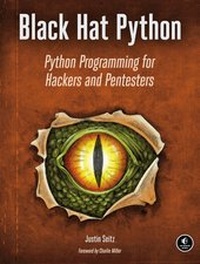
Black Hat Python
Python Programming for Hackers and Pentesters
1st Edition
Published on 21. December 2014
Book
Paperback/Softback
XX, 170 pages
978-1-59327-590-7 (ISBN)
Description
When it comes to creating powerful and effective hacking tools, Python is the language of choice for most security analysts. But just how does the magic happen?
In Black Hat Python, the latest from Justin Seitz (author of the best-selling Gray Hat Python), you'll explore the darker side of Python's capabilities-writing network sniffers, manipulating packets, infecting virtual machines, creating stealthy trojans, and more. You'll learn how to:
- Create a trojan command-and-control using GitHub
- Detect sandboxing and automate common malware tasks, like keylogging and screenshotting
- Escalate Windows privileges with creative process control
- Use offensive memory forensics tricks to retrieve password hashes and inject shellcode into a virtual machine
- Extend the popular Burp Suite web-hacking tool
- Abuse Windows COM automation to perform a man-in-the-browser attack
- Exfiltrate data from a network most sneakily
Insider techniques and creative challenges throughout show you how to extend the hacks and how to write your own exploits.
When it comes to offensive security, your ability to create powerful tools on the fly is indispensable. Learn how in Black Hat Python.
In Black Hat Python, the latest from Justin Seitz (author of the best-selling Gray Hat Python), you'll explore the darker side of Python's capabilities-writing network sniffers, manipulating packets, infecting virtual machines, creating stealthy trojans, and more. You'll learn how to:
- Create a trojan command-and-control using GitHub
- Detect sandboxing and automate common malware tasks, like keylogging and screenshotting
- Escalate Windows privileges with creative process control
- Use offensive memory forensics tricks to retrieve password hashes and inject shellcode into a virtual machine
- Extend the popular Burp Suite web-hacking tool
- Abuse Windows COM automation to perform a man-in-the-browser attack
- Exfiltrate data from a network most sneakily
Insider techniques and creative challenges throughout show you how to extend the hacks and how to write your own exploits.
When it comes to offensive security, your ability to create powerful tools on the fly is indispensable. Learn how in Black Hat Python.
Reviews / Votes
"Whether you're interested in becoming a serious hacker/penetration tester or just want to know how they work, this book is one you need to read. Intense, technically sound, and eye-opening."<-Computerworld
"Black Hat Python is an excellent way to start by fully investigating how the language can be used for both the light - and dark - sides of hacking."
<-ZDNet
More details
Language
English
Place of publication
Heidelberg
Germany
Target group
Professional and scholarly
Python programmers curious about security
- Penetration testers
- Reverse engineers
- Software testers
- Hackers and
- Security analysts
Product notice
Unsewn / adhesive bound
Dimensions
Height: 23.3 cm
Width: 17.7 cm
ISBN-13
978-1-59327-590-7 (9781593275907)
Schweitzer Classification
Other editions
New editions
Justin Seitz | Tim Arnold
Black Hat Python, 2nd Edition
Python Programming for Hackers and Pentesters
Book
04/2021
2nd Edition
No Starch Press
€42.00
Available immediately
Additional editions
Justin Seitz | Tim Arnold
Black Hat Python, 2nd Edition
Python Programming for Hackers and Pentesters
E-Book
04/2021
No Starch Press
€34.99
Available for download

Conrad Barski | Chris Wilmer
Bitcoin for the Befuddled
E-Book
11/2014
No Starch Press
€19.49
Available for download
Person
Justin Seitz is a senior security researcher for Immunity, Inc., where he spends his time bug hunting, reverse engineering, writing exploits, and coding Python. He is the author of Gray Hat Python (No Starch Press), the first book to cover Python for security analysis.
Content
Introduction
Chapter 1: Setting Up Your Python Environment
Chapter 2: The Network: Basics
Chapter 3: The Network: Raw Sockets and Sniffing
Chapter 4: Owning the Network with Scapy
Chapter 5: Web Hackery
Chapter 6: Extending Burp Proxy
Chapter 7: GitHub Command and Control
Chapter 8: Common Trojaning Tasks on Windows
Chapter 9: Fun With Internet Explorer
Chapter 10: Windows Privilege Escalation
Chapter 11: Automating Offensive Forensics
Index
Chapter 1: Setting Up Your Python Environment
Chapter 2: The Network: Basics
Chapter 3: The Network: Raw Sockets and Sniffing
Chapter 4: Owning the Network with Scapy
Chapter 5: Web Hackery
Chapter 6: Extending Burp Proxy
Chapter 7: GitHub Command and Control
Chapter 8: Common Trojaning Tasks on Windows
Chapter 9: Fun With Internet Explorer
Chapter 10: Windows Privilege Escalation
Chapter 11: Automating Offensive Forensics
Index