

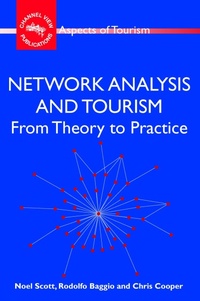
Network Analysis and Tourism
From Theory to Practice
Published on 9. June 2008
220 pages
978-1-84541-310-1 (ISBN)
Description

This book aims to provide a comprehensive review of the contribution of network analysis to the understanding of tourism destinations and organizations. Theoretical and methodological aspects are discussed along with a series of applications. While this is a relatively new approach in the tourism literature, in other social and natural sciences network analysis has a long tradition and has provided important insights for the knowledge of the structure and the dynamics of many complex systems. The study of network structures, both from a quantitative and qualitative point of view, can deliver a number of useful outcomes also for the analysis of tourism destinations and organizations.
Reviews / Votes
The book is a real joy to read. I congratulate the editors for an interesting, succinct, and comprehensive book on the application of network analysis in interpreting and analysing tourism. * Prem Chhetri, RMIT University, Australia, in Tourism Recreation Research Volume 34, Number 3. * At last a book that addresses a fast growing field of enquiry within tourism studies, a field in which there has been a noticeable paucity of compressed knowledge in the medium of a reader for academic studies. A great strength of the book is certainly its accessibility to the 'lay' person interested in the potential and limitations of network analysis techniques in the realm of tourism research. As such it will be of particular interest to the growing body of network theory oriented research students at doctoral and possibly masters levels in tourism institutions and departments, as well as offering insights to those in more generic fields within social and political science studies. It is a commendable and timely introduction to the field, which will be of particular use as a research methods reader in network analysis. -- Philip Goulding, Sheffield Hallam University, UK in the Journal of Policy Research in Tourism, Leisure and Events, 1(3): 2009, in November 2009More details
Series
Language
English
Place of publication
Bristol
United Kingdom
Publishing group
Channel View Publications Ltd
Target group
Professional and scholarly
Product notice
Reflowable
ISBN-13
978-1-84541-310-1 (9781845413101)
Copyright in bibliographic data and cover images is held by Nielsen Book Services Limited or by the publishers or by their respective licensors: all rights reserved.
Schweitzer Classification
Other editions
Additional editions
Book
06/2008
Channel View Publications
€47.50
Shipment within 10-20 days
Persons
Noel Scott has extensive experience as a senior tourism manager and researcher and over 25 years in industry research positions. He holds a doctorate in tourism management and Master degrees in marketing and business administration and is a senior lecturer at The University of Queensland, Brisbane, Australia.
Rodolfo Baggio holds a degree in Physics (MPhys) and a PhD in Tourism Management. After having worked for leading information technology firms for over 20 years he is presently at the Bocconi University, Milan, Italy, where he teaches courses in Computer Science and coordinates the Information and Communication Technologies area at the Master in Economics and Tourism. He is also Research Fellow at the Carlo F. Dondena Centre for Research on Social Dynamics. He has managed several international research projects and actively researches and publishes in the field of information technology and tourism. His current interests focus on the application of complexity theory and network analysis methods to the study of tourism destinations.
Chris Cooper is Pro-Vice Chancellor and Dean of the Business Faculty at Oxford Brookes University, UK. He was Chair of the UN World Tourism Organization Education Council (2005 - 2007) and was awarded the UN Ulysses Medal for contributions to tourism education and policy. He co-edits Current Issues in Tourism and sits on editorial boards for leading tourism, hospitality and leisure journals. He has authored a number of leading textbooks and is the co-series editor of Channelview's influential book series 'Aspects of Tourism'.
Rodolfo Baggio holds a degree in Physics (MPhys) and a PhD in Tourism Management. After having worked for leading information technology firms for over 20 years he is presently at the Bocconi University, Milan, Italy, where he teaches courses in Computer Science and coordinates the Information and Communication Technologies area at the Master in Economics and Tourism. He is also Research Fellow at the Carlo F. Dondena Centre for Research on Social Dynamics. He has managed several international research projects and actively researches and publishes in the field of information technology and tourism. His current interests focus on the application of complexity theory and network analysis methods to the study of tourism destinations.
Chris Cooper is Pro-Vice Chancellor and Dean of the Business Faculty at Oxford Brookes University, UK. He was Chair of the UN World Tourism Organization Education Council (2005 - 2007) and was awarded the UN Ulysses Medal for contributions to tourism education and policy. He co-edits Current Issues in Tourism and sits on editorial boards for leading tourism, hospitality and leisure journals. He has authored a number of leading textbooks and is the co-series editor of Channelview's influential book series 'Aspects of Tourism'.
Content
1. Introduction - Noel Scott, Rodolfo Baggio and Chris Cooper
2. The Historical Development of Network Theories - Noel Scott, Rodolfo Baggio and Chris Cooper
3. The Network Concept and Tourism - Noel Scott, Rodolfo Baggio and Chris Cooper
QUALITATIVE APPROACHES TO TOURISM NETWORK ANALYSIS
4. Conceptual Tools for Evaluating Tourism Partnerships - Roger March and Ian Wilkinson
5. Tourism Destination Networks and Knowledge Transfer - Noel Scott, Rodolfo Baggio and Chris Cooper
6. Policy Networks and Tourism Governance - Dianne Dredge and Christof Pforr
7. Network Governance and Connectivity: A Case Study - Kathryn Pavlovich
8. The Benefits of Networks to Small and Medium Sized Tourism Enterprises - Carlos Costa, Zelia Breda, Rui Costa and Joana Miguens
9. International Tourism Trade Networks: The Case of the Chinese Inbound Travel Trade to Australia - Grace Wen Pan
10. Power, Destination Branding and the Implications of a Social Network Perspective - Giuseppe Marzano
QUANTITATIVE APPROACHES TO TOURISM NETWORK ANALYSIS
11. Issues in Quantitative Network Analysis - Noel Scott, Rodolfo Baggio and Chris Cooper
12. Visualizing Tourism Networks: Connecting the Dots Noel Scott, Rodolfo Baggio and Chris Cooper
13. Complex Tourism Networks - Noel Scott, Rodolfo Baggio and Chris Cooper
14. Technological Tourism Networks and Network Simulation - Noel Scott, Rodolfo Baggio and Chris Cooper
15. Conclusions - Noel Scott, Rodolfo Baggio and Chris Cooper
2. The Historical Development of Network Theories - Noel Scott, Rodolfo Baggio and Chris Cooper
3. The Network Concept and Tourism - Noel Scott, Rodolfo Baggio and Chris Cooper
QUALITATIVE APPROACHES TO TOURISM NETWORK ANALYSIS
4. Conceptual Tools for Evaluating Tourism Partnerships - Roger March and Ian Wilkinson
5. Tourism Destination Networks and Knowledge Transfer - Noel Scott, Rodolfo Baggio and Chris Cooper
6. Policy Networks and Tourism Governance - Dianne Dredge and Christof Pforr
7. Network Governance and Connectivity: A Case Study - Kathryn Pavlovich
8. The Benefits of Networks to Small and Medium Sized Tourism Enterprises - Carlos Costa, Zelia Breda, Rui Costa and Joana Miguens
9. International Tourism Trade Networks: The Case of the Chinese Inbound Travel Trade to Australia - Grace Wen Pan
10. Power, Destination Branding and the Implications of a Social Network Perspective - Giuseppe Marzano
QUANTITATIVE APPROACHES TO TOURISM NETWORK ANALYSIS
11. Issues in Quantitative Network Analysis - Noel Scott, Rodolfo Baggio and Chris Cooper
12. Visualizing Tourism Networks: Connecting the Dots Noel Scott, Rodolfo Baggio and Chris Cooper
13. Complex Tourism Networks - Noel Scott, Rodolfo Baggio and Chris Cooper
14. Technological Tourism Networks and Network Simulation - Noel Scott, Rodolfo Baggio and Chris Cooper
15. Conclusions - Noel Scott, Rodolfo Baggio and Chris Cooper
