

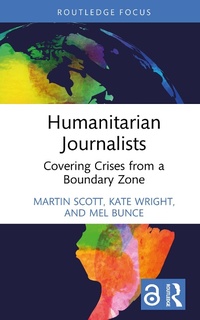
Humanitarian Journalists
Covering Crises from a Boundary Zone
1st Edition
Published on 27. December 2022
146 pages
978-1-000-85769-6 (ISBN)
Description

This book documents the unique reporting practices of humanitarian journalists - an influential group of journalists defying conventional approaches to covering humanitarian crises.
Based on a 5-year study, involving over 150 in-depth interviews, this book examines the political, economic and social forces that sustain and influence humanitarian journalists. The authors argue that - by amplifying marginalised voices and providing critical, in-depth explanations of neglected crises - these journalists show us that another kind of humanitarian journalism is possible. However, the authors also reveal the heavy price these reporters pay for deviating from conventional journalistic norms. Their peripheral position at the 'boundary zone' between the journalistic and humanitarian fields means that a humanitarian journalist's job is often precarious - with direct implications for their work, especially as 'watchdogs' for the aid sector. As a result, they urgently need more support if they are to continue to do this work and promote more effective and accountable humanitarian action.
A rigorous study of how unique professional practices can be produced at the 'boundary zone' between fields, this book will interest students and scholars of journalism and communication studies, sociology and humanitarian studies. It will also appeal to those interested in studies of news and media work as occupational identities.
Based on a 5-year study, involving over 150 in-depth interviews, this book examines the political, economic and social forces that sustain and influence humanitarian journalists. The authors argue that - by amplifying marginalised voices and providing critical, in-depth explanations of neglected crises - these journalists show us that another kind of humanitarian journalism is possible. However, the authors also reveal the heavy price these reporters pay for deviating from conventional journalistic norms. Their peripheral position at the 'boundary zone' between the journalistic and humanitarian fields means that a humanitarian journalist's job is often precarious - with direct implications for their work, especially as 'watchdogs' for the aid sector. As a result, they urgently need more support if they are to continue to do this work and promote more effective and accountable humanitarian action.
A rigorous study of how unique professional practices can be produced at the 'boundary zone' between fields, this book will interest students and scholars of journalism and communication studies, sociology and humanitarian studies. It will also appeal to those interested in studies of news and media work as occupational identities.
Reviews / Votes
"This book offers an in-depth and detailed exploration of 'humanitarian reporting' outside of mainstream news organisations, based on extensive empirical research. It makes a valuable and innovative contribution to the field and one that is better sensitised to the fast-changing media ecology and changing forms of humanitarianism in the world today."Professor Simon Cottle, Cardiff University, UK
"Drawing on a unique 5-year collaboration and over 150 in-depth interviews with practitioners, Scott, Wright, and Bunce document the precarious conditions in which humanitarian journalists do their jobs, analyze how these journalists contribute to accountable humanitarian action, and argue for qualified support from governments and private donors. A must read."
Florencia Enghel, Associate Professor in Media and Communication Studies, Joenkoeping University, Sweden
"Why do journalists sacrifice security to create new professional practices? This empirically rich book, about actors working the interface between journalism and humanitarianism, puts liminal spaces at the centre of inquiry into changing fields of power, and should in turn be put on many reading lists."
Professor Alexa Robertson, Stockholm University, Sweden
More details
Series
Edition
1. Auflage
Language
English
Place of publication
London
United Kingdom
Publishing group
Taylor & Francis Ltd
Target group
Professional and scholarly
Product notice
Reflowable
Illustrations
4 Tables, black and white; 5 Line drawings, black and white; 5 Illustrations, black and white
File size
1,91 MB
ISBN-13
978-1-000-85769-6 (9781000857696)
Copyright in bibliographic data and cover images is held by Nielsen Book Services Limited or by the publishers or by their respective licensors: all rights reserved.
Schweitzer Classification
Other editions
Additional editions
Book
08/2024
1st Edition
Routledge
€33.00
Shipment within 10-20 days
Book
12/2022
1st Edition
Routledge
€71.80
Shipment within 10-20 days
Persons
Martin Scott is an Associate Professor in Media and International Development at the University of East Anglia.
Kate Wright is a Senior Lecturer in Media and Communications, Politics, and International Relations at the University of Edinburgh.
Mel Bunce is a Professor of International Journalism and Head of the Journalism Department at City, University of London.
Kate Wright is a Senior Lecturer in Media and Communications, Politics, and International Relations at the University of Edinburgh.
Mel Bunce is a Professor of International Journalism and Head of the Journalism Department at City, University of London.
Content
Lists of Figures
List of Tables
Preface
Acknowledgements
List of Abbreviations
Introduction: Who Are Humanitarian Journalists?
1. Making News in a Boundary Zone
2. Insiders and Outsiders: Peripheral, Precarious, and Constructive Watchdogs
3. Adding Value, Amplifying Marginalised Voices, and Covering Under-Reported Crises
4. Fifty Shades of Humanitarianism
5. Is Humanitarian Journalism a Field-in-the-Making?
Concluding Remarks
Index
List of Tables
Preface
Acknowledgements
List of Abbreviations
Introduction: Who Are Humanitarian Journalists?
1. Making News in a Boundary Zone
2. Insiders and Outsiders: Peripheral, Precarious, and Constructive Watchdogs
3. Adding Value, Amplifying Marginalised Voices, and Covering Under-Reported Crises
4. Fifty Shades of Humanitarianism
5. Is Humanitarian Journalism a Field-in-the-Making?
Concluding Remarks
Index
