

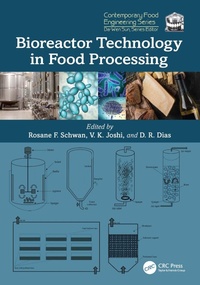
Bioreactor Technology in Food Processing
1st Edition
Published on 29. November 2024
648 pages
978-0-429-75439-5 (ISBN)
Description

Bioreactor Technology in Food Processing brings peculiarities, specificities, and updates on bioreactors and bioprocesses related to food and beverage production. The 26 chapters of this book are the result of the participation of more than 70 professionals, including professors, researchers, and experts from the industrial sector from different countries around the world.
The chapters cover such topics as history, classification, scale-up, analytical tools, and mathematical and kinetic models for the operation of bioreactors in the food industry. In addition, chapters detail the characteristics of bioreactors for the production of food (bread, cheese, and coffee fermentation) and fermented beverages (beer, wine), distilled beverages, and organic compounds such as enzymes, acids, aromas, and pigments (biocolorants), among others.
Key Features:
Describes the basic and applied aspects of bioreactor in food processing
Gathers information on bioreactors that is scattered in different journals and monographs as reviews and research articles
Covers various types of bioreactors including stirred tank, airlift, photo-bioreactor, and disposable bioreactors
Gives a broad overview of what exactly is involved in designing a bioreactor and optimizing its performance and finally their applications in the food processing industry
The broad interdisciplinary approach of this book will certainly make your reading very interesting, and we hope that it can contribute to knowledge and instigate creative thinking to overcome the challenges that food bioprocessing brings us.
The chapters cover such topics as history, classification, scale-up, analytical tools, and mathematical and kinetic models for the operation of bioreactors in the food industry. In addition, chapters detail the characteristics of bioreactors for the production of food (bread, cheese, and coffee fermentation) and fermented beverages (beer, wine), distilled beverages, and organic compounds such as enzymes, acids, aromas, and pigments (biocolorants), among others.
Key Features:
Describes the basic and applied aspects of bioreactor in food processing
Gathers information on bioreactors that is scattered in different journals and monographs as reviews and research articles
Covers various types of bioreactors including stirred tank, airlift, photo-bioreactor, and disposable bioreactors
Gives a broad overview of what exactly is involved in designing a bioreactor and optimizing its performance and finally their applications in the food processing industry
The broad interdisciplinary approach of this book will certainly make your reading very interesting, and we hope that it can contribute to knowledge and instigate creative thinking to overcome the challenges that food bioprocessing brings us.
More details
Series
Edition
1. Auflage
Language
English
Place of publication
London
United Kingdom
Publishing group
Taylor & Francis Ltd
Target group
Professional and scholarly
Illustrations
87 Tables, black and white; 150 Line drawings, black and white; 21 Halftones, black and white; 171 Illustrations, black and white
File size
33,23 MB
ISBN-13
978-0-429-75439-5 (9780429754395)
Copyright in bibliographic data and cover images is held by Nielsen Book Services Limited or by the publishers or by their respective licensors: all rights reserved.
Schweitzer Classification
Other editions
Additional editions
Rosane F. Schwan | V. K. Joshi | Disney R. Dias
Bioreactor Technology in Food Processing
Book
approx. 06/2026
1st Edition
CRC Press
€100.50
Not yet published
Rosane F. Schwan | V. K. Joshi | Disney R. Dias
Bioreactor Technology in Food Processing
Book
11/2024
1st Edition
CRC Press
€276.40
Shipment within 10-20 days

Book
01/2012
CRC Press
Unfortunately, price unknown
Available (delivery time upon request)
Persons
Dr. Rosane Freitas Schwan is a Full Professor within the Microbiology Group, Department of Biology at the Federal University of Lavras, Minas Gerais, Brazil, where she is involved in research on the microbiology of fermented foods and beverages. Prof. Schwan is Agricultural engineer from the Federal University of Espirito Santo, MSc. at UFV (Vicosa-MG) and PhD from the University of Bath (UK). Dr. Schwan was a researcher in the Cocoa Research Centre (CEPLAC) (1984-1996), where published techniques for improving the quality of the chocolate. At UFLA, since 1996, conducts research with coffee fermentation, sugar cane, cocoa, cassava and other substrates to improve the quality and development of new processes for foods and beverage. She is currently Director of the culture collection of agriculture microbiology - CCMA in DBI/UFLA, and Associate Editor of the Brazilian Journal of Microbiology and Food Microbiology. Supervisor of several MSC and PhD students from the programs in Agricultural Microbiology and Food Science in UFLA. Authored numerous publications addressing different aspects of knowledge and microbial biodiversity of natural and spontaneous fermentative processes over almost 30 years and recently, recently, she co-edited a volume in the CRC series in Fermented foods and beverages Series on Cocoa and Coffee Fermentation.
Professor V.K. Joshi, MSc, Ph.D., is an eminent scientist and a teacher with more than 35 years of research experience in fruit fermentation technology, fermented foods, food toxicology, quality assurance, and waste utilization. He is the former head of the Department of Postharvest Technology and currently the head of the Department of Food Science and Technology at the same university. He has made a very significant contribution to the development of technology of non-grape fruit wines, apple pomace utilization, lactic acid, and indigenous fermented foods. A recipient of several awards for research and teaching, he has guided several postgraduate students, authored or edited more than 10 books and more than 300 research, reviews, book chapters, and popular articles besides presenting several lead papers in conferences and seminars.
Disney Ribeiro Dias is Associate Professor in the Department of Food Science, at the School of Agricultural Sciences at the Federal University of Lavras, Lavras, Minas Gerais, Brazil. He was a research scholar (2019-2020) at the Massachusetts Institute of Technology, MIT, in the laboratory coordinated by Prof. Anthony J. Sinskey. He is a CNPq Research Productivity Fellow - Level 2. He has a degree in Pharmacy from the Federal University of Alfenas (1998), a master's degree in food sciences from the Federal University of Lavras (2001) and a PhD in Food Sciences from the Federal University of Lavras (2007). He is author or coauthor of over 100 peer-reviewed papers and over 25 book chapters that reflect his research interests in Industrial and Fermentation Microbiology, working mainly in the areas of microbial fermentation and microbial metabolism products.
Professor V.K. Joshi, MSc, Ph.D., is an eminent scientist and a teacher with more than 35 years of research experience in fruit fermentation technology, fermented foods, food toxicology, quality assurance, and waste utilization. He is the former head of the Department of Postharvest Technology and currently the head of the Department of Food Science and Technology at the same university. He has made a very significant contribution to the development of technology of non-grape fruit wines, apple pomace utilization, lactic acid, and indigenous fermented foods. A recipient of several awards for research and teaching, he has guided several postgraduate students, authored or edited more than 10 books and more than 300 research, reviews, book chapters, and popular articles besides presenting several lead papers in conferences and seminars.
Disney Ribeiro Dias is Associate Professor in the Department of Food Science, at the School of Agricultural Sciences at the Federal University of Lavras, Lavras, Minas Gerais, Brazil. He was a research scholar (2019-2020) at the Massachusetts Institute of Technology, MIT, in the laboratory coordinated by Prof. Anthony J. Sinskey. He is a CNPq Research Productivity Fellow - Level 2. He has a degree in Pharmacy from the Federal University of Alfenas (1998), a master's degree in food sciences from the Federal University of Lavras (2001) and a PhD in Food Sciences from the Federal University of Lavras (2007). He is author or coauthor of over 100 peer-reviewed papers and over 25 book chapters that reflect his research interests in Industrial and Fermentation Microbiology, working mainly in the areas of microbial fermentation and microbial metabolism products.
Content
1. Bioreactor technology in food processing - history and perspectives 2. Microorganisms and bioprocessing application in food 3. Bioreactor: General configuration, classification, and bioreactor types 4. Analytical tools and operational requirements for bioreactors 5. An integrated systematic approach for modeling, simulation, and scaling up of food bioreactors 6. Scale-up technology of bioreactors 7. Food bioreactor technology: Economics aspects, IPR issues, and sustainability 8. Application of bioreactor technology for the food industry 9. Production of bread and bioreactor technology 10. Beer and Wine production and Bioreactor technology 11. Processing distilled beverages from cereals 12. Bioreactor for Coffee Fermentation 13. Bioreactors in the aroma production 14. Microbial Enzymes in Food Industry and Bioreactor Technology 15. Bioreactor technology in the production of fructooligosaccharides 16. Bioreactor Technology in the Production of Fructose Syrups 17. Bioreactor Technology for Pectin Production 18. Production of vitamins in a bioreactor 19. Bioreactor Technology, fermentation strategy and statistical approaches for pigment production by microorganisms 20. Bioreactor Technology for D-Gluconic Acid 21. Bioreactor technology for succinic and fumaric acids 22. Bioreactor technology for the production of ellagic acid 23. Biocolor: source, role, and its therapeutic significance 24. Bioreactor technology for the production of biocolor by selected microalgae 25. Bioreactor technology in the production of biocolor from plant and food waste 26. Bioreactor Technology in Waste Utilization and Management
