

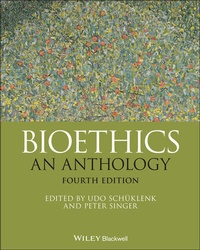
Bioethics
Description

For more than two decades, Bioethics: An Anthology has been widely regarded as the definitive single-volume compendium of seminal readings on both traditional and cutting-edge ethical issues in biology and medicine. Acclaimed for its scope and depth of coverage, this landmark work brings together compelling writings by internationally-renowned bioethicist to help readers develop a thorough understanding of the central ideas, critical issues, and current debate in the field.
Now fully revised and updated, the fourth edition contains a wealth of new content on ethical questions and controversies related to the COVID-19 pandemic, advances in CRISPR gene editing technology, physician-assisted death, public health and vaccinations, transgender children, medical aid in dying, the morality of ending the lives of newborns, and much more. Throughout the new edition, carefully selected essays explore a wide range of topics and offer diverse perspectives that underscore the interdisciplinary nature of bioethical study. Edited by two of the field's most respected scholars, Bioethics: An Anthology:
* Covers an unparalleled range of thematically-organized topics in a single volume
* Discusses recent high-profile cases, debates, and ethical issues
* Features three brand-new sections: Conscientious Objection, Academic Freedom and Research, and Disability
* Contains new essays on topics such as brain death, life and death decisions for the critically ill, experiments on humans and animals, neuroethics, and the use of drugs to ease the pain of unrequited love
* Includes a detailed index that allows the reader to easily find terms and topics of interest
Bioethics: An Anthology, Fourth Edition remains a must-have resource for all students, lecturers, and researchers studying the ethical implications of the health-related life sciences, and an invaluable reference for doctors, nurses, and other professionals working in health care and the biomedical sciences.
More details
Other editions
Additional editions
Persons
UDO SCHÜKLENK is Ontario Research Chair in Bioethics and Public Policy, Queen's University at Kingston, Ontario, Canada. He has held academic appointments in Australia, the UK, and South Africa, and is a long-serving Joint Editor-in-Chief of the journal Bioethics, the official publication of the International Association of Bioethics.
PETER SINGER is Ira W. DeCamp Professor of Bioethics, Princeton University, USA. He is best known as the author of Animal Liberation, widely considered to be the founding statement of the animal rights movement, and for his role in inspiring the growth of effective altruism.
Content
Acknowledgments xiii
Introduction 1
Part I Abortion 9
Introduction 11
1 Abortion and Infanticide 15
Michael Tooley
2 A Defense of Abortion 31
Judith Jarvis Thomson
3 The Wrong of Abortion 42
Patrick Lee and Robert P. George
4 Why Abortion is Immoral 54
Don Marquis
Part II Issues in Reproduction 67
Introduction 69
Assisted Reproduction 73
5 The McCaughey Septuplets: God's Will or Human Choice? 75
Gregory Pence
6 The Meaning of Synthetic Gametes for Gay and Lesbian People and Bioethics Too 78
Timothy F. Murphy
7 Rights, Interests, and Possible People 85
Derek Parfit
Prenatal Screening, Sex Selection, and Cloning 91
8 Genetics and Reproductive Risk: Can Having Children Be Immoral? 93
Laura M. Purdy
9 Sex Selection and Preimplantation Genetic Diagnosis 101
The Ethics Committee of the American Society of Reproductive Medicine
10 Sex Selection and Preimplantation Diagnosis: A Response to the Ethics Committee of the American Society of Reproductive Medicine 107
Julian Savulescu and Edgar Dahl
11 Why We Should Not Permit Embryos to Be Selected as Tissue Donors 110
David King
12 The Moral Status of Human Cloning: Neo-Lockean Persons versus Human Embryos 115
Michael Tooley
Part III Genetic Manipulation 133
Introduction 135
13 Questions about Some Uses of Genetic Engineering 139
Jonathan Glover
14 The Moral Significance of the Therapy-Enhancement Distinction in Human Genetics 151
David B. Resnik
15 In Defense of Posthuman Dignity 162
Nick Bostrom
16 Statement on NIH Funding of Research Using Gene-Editing Technologies in Human Embryos 170
Francis S. Collins
17 Genome Editing and Assisted Reproduction: Curing Embryos, Society or Prospective Parents? 172
Giulia Cavaliere
18 Who's Afraid of the Big Bad (Germline Editing) Wolf? 185
R. Alta Charo
19 An Ethical Pathway for Gene Editing 191
Julian Savulescu and Peter Singer
Part IV Life and Death Issues 195
Introduction 197
20 The Sanctity of Life 207
Jonathan Glover
21 Declaration on Euthanasia 218
Sacred Congregation for the Doctrine of the Faith
Killing and Letting Die 223
22 Active and Passive Euthanasia 225
James Rachels
23 The Morality of Killing: A Traditional View 230
Germain Grisez and Joseph M. Boyle, Jr.
24 Is Killing No Worse Than Letting Die? 235
Winston Nesbitt
25 Why Killing is Not Always Worse - and Sometimes Better - Than Letting Die 240
Helga Kuhse
26 Moral Fictions and Medical Ethics 244
Franklin G. Miller, Robert D. Truog, and Dan W. Brock
Newborns 255
27 Can a Physician Ever Justifiably Euthanize a Severely Disabled Newborn? 257
Robert M. Sade
28 No to Infant Euthanasia 259
Gilbert Meilaender
29 Physicians Can Justifiably Euthanize Certain Severely Impaired Neonates 262
Udo Schuklenk
30 You Should Not Have Let Your Baby Die 266
Gary Comstock
31 After-Birth Abortion: Why Should the Baby Live? 269
Alberto Giubilini and Francesca Minerva
32 Does a Human Being Gain the Right to Live after He or She is Born? 275
Christopher Kaczor
33 Hard Lessons: Learning from the Charlie Gard Case 280
Dominic Wilkinson and Julian Savulescu
Brain Death 289
34 A Definition of Irreversible Coma 291
Report of the Ad Hoc Committee of the Harvard Medical School to Examine the Definition of Brain Death
35 The Challenge of Brain Death for the Sanctity of Life Ethic 296
Peter Singer
36 The Philosophical Debate 308
The President's Council on Bioethics
37 An Alternative to Brain Death 318
Jeff McMahan
Advance Directives 323
38 Life Past Reason 325
Ronald Dworkin
39 Dworkin on Dementia: Elegant Theory, Questionable Policy 333
Rebecca Dresser
Voluntary Euthanasia and Medically Assisted Suicide 343
40 The Note 345
Chris Hill
41 When Self-Determination Runs Amok 350
Daniel Callahan
42 When Abstract Moralizing Runs Amok 356
John Lachs
43 Physician-Assisted Death and Severe, Treatment-Resistant Depression 361
Bonnie Steinbock
44 Are Concerns about Irremediableness, Vulnerability, or Competence Sufficient to Justify Excluding All Psychiatric Patients from Medical Aid in Dying? 378
William Rooney, Udo Schuklenk, and Suzanne van de Vathorst
Part V Resource Allocation 393
Introduction 395
45 In a Pandemic, Should We Save Younger Lives? 399
Peter Singer and Lucy Winkett
46 The Value of Life 403
John Harris
47 Bubbles under the Wallpaper: Healthcare Rationing and Discrimination 413
Nick Beckstead and Toby Ord
48 Rescuing Lives: Can't We Count? 420
Paul T. Menzel
49 Should Alcoholics Compete Equally for Liver Transplantation? 423
Alvin H. Moss and Mark Siegler
Part VI Obtaining Organs 431
Introduction 433
50 Organ Donation and Retrieval: Whose Body is it Anyway? 435
Eike-Henner W. Kluge
51 The Case for Allowing Kidney Sales 439
Janet Radcliffe-Richards, A. S. Daar, R. D. Guttmann, R. Hoffenberg, I. Kennedy, M. Lock, R. A. Sells and N. Tilney and for the International Forum Transplant Ethics
52 Ethical Issues in the Supply and Demand of Kidneys 443
Debra Satz
53 The Survival Lottery 456
John Harris
Part VII Ethical Issues in Research 463
Introduction 465
Experimentation with Humans 473
54 Belmont Report: Ethical Principles and Guidelines for the Protection of Human Subjects of Research 475
National Commission for the Protection of Human Subjects of Biomedical and Behavioral Research
55 Scientific Research is a Moral Duty 483
John Harris
56 Participation in Biomedical Research is an Imperfect Moral Duty: A Response to John Harris 495
Sandra Shapshay and Kenneth D. Pimple
57 Unethical Trials of Interventions to Reduce Perinatal Transmission of the Human Immunodeficiency Virus in Developing Countries 501
Peter Lurie and Sidney M. Wolfe
58 We're Trying to Help Our Sickest People, Not Exploit Them 507
Danstan Bagenda and Philippa Musoke-Mudido
59 Pandemic Ethics: The Case for Risky Research 510
Peter Singer and Richard Yetter Chappell
Experimentation with Animals 515
60 Duties towards Animals 517
Immanuel Kant
61 A Utilitarian View 519
Jeremy Bentham
62 The Harmful, Nontherapeutic Use of Animals in Research is Morally Wrong 521
Nathan Nobis
63 The Use of Nonhuman Animals in Biomedical Research 535
Dario L. Ringach
64 Ethical Issues When Modelling Brain Disorders in Non-Human Primates 550
Carolyn P. Neuhaus
Academic Freedom and Research 559
65 On Liberty 561
John Stuart Mill
66 Should Some Knowledge Be Forbidden?: The Case of Cognitive Differences Research 566
Janet A. Kourany
67 Academic Freedom and Race: You Ought Not to Believe What You Think May Be True 575
James R. Flynn
Part VIII Public Health Issues 585
Introduction 587
68 Ethics and Infectious Disease 591
Michael J. Selgelid
69 XDR-TB in South Africa: No Time for Denial or Complacency 602
Jerome Amir Singh, Ross Upshur, and Nesri Padayatchi
70 Clinical Ethics During the Covid-19 Pandemic: Missing the Trees for the Forest 612
Vijayaprasad Gopichandran
71 The Moral Obligation to be Vaccinated: Utilitarianism, Contractualism, and Collective Easy Rescue 620
Alberto Giubilini, Thomas Douglas, and Julian Savulescu
72 Taking Responsibility for Responsibility 638
Neil Levy
Part IX Ethical Issues in the Practice of Healthcare 651
Introduction 653
When do Doctors have a Duty to Treat? 659
73 What Healthcare Professionals Owe Us: Why Their Duty to Treat During a Pandemic is Contingent on Personal Protective Equipment (PPE) 661
Udo Schuklenk
74 Conscientious Objection in Health Care 667
Mark R. Wicclair
75 Conscientious Objection in Medicine: Accommodation versus Professionalism and the Public Good 682
Udo Schuklenk
Confidentiality 693
76 Confidentiality in Medicine: A Decrepit Concept 695
Mark Siegler
77 A Defense of Unqualified Medical Confidentiality 699
Kenneth Kipnis
Truth-Telling 713
78 On a Supposed Right to Lie from Altruistic Motives 715
Immanuel Kant
79 Should Doctors Tell the Truth? 717
Joseph Collins
80 On Telling Patients the Truth 724
Roger Higgs
Informed Consent and Patient Autonomy 731
81 On Liberty 733
John Stuart Mill
82 From Schloendorff v. NewYork Hospital 736
Justice Benjamin N. Cardozo
83 Informed Consent: Its History, Meaning, and Present Challenges 737
Tom L. Beauchamp
84 The Doctor-Patient Relationship in Different Cultures 745
Ruth Macklin
85 Transgender Children and the Right to Transition: Medical Ethics When Parents Mean Well But Cause Harm 758
Maura Priest
86 Amputees by Choice 777
Carl Elliott
87 Rational Desires and the Limitation of Life-Sustaining Treatment 788
Julian Savulescu
Part X Disability 807
Introduction 809
88 Valuing Disability, Causing Disability 811
Elizabeth Barnes
89 Is Disability Mere Difference? 829
Greg Bognar
90 Prenatal Diagnosis and Selective Abortion: A Challenge to Practice and Policy 835
Adrienne Asch
91 Down Syndrome Screening Isn't about Public Health: It's about Eliminating a Group of People 851
Renate Lindeman
92 I Would've Aborted a Fetus with Down Syndrome: Women Need that Right 854
Ruth Marcus
Part XI Neuroethics 857
Introduction 859
93 Neuroethics: Ethics and the Sciences of the Mind 861
Neil Levy
94 Engineering Love 867
Julian Savulescu and Anders Sandberg
95 Unrequited Love Hurts: Should Doctors Treat Broken Hearts? 870
Francesca Minerva
96 Stimulating Brains, Altering Minds 876
Walter Glannon
97 Authenticity or Autonomy? When Deep Brain Stimulation Causes a Dilemma 883
Felicitas Kraemer
98 On the Necessity of Ethical Guidelines for Novel Neurotechnologies 889
Sara Goering and Rafael Yuste
Index 895
Acknowledgments
The editor and publisher gratefully acknowledge the permission granted to reproduce the copyright material in this book:
- Michael Tooley, "Abortion and Infanticide," pp. 37-65 from Philosophy and Public Affairs 1 (1972). Reproduced with permission of John Wiley & Sons.
- Judith Jarvis Thomson, "A Defense of Abortion," pp. 47-66 from Philosophy and Public Affairs 1: 1 (1971). Reproduced with permission of John Wiley & Sons.
- Patrick Lee and Robert P. George, "The Wrong of Abortion," pp. 13-26 from Andrew I. Cohen and Christopher Health Wellman (eds.), Contemporary Debates in Applied Ethics (Hoboken, NJ: Wiley-Blackwell, 2014). Reproduced with permission of John Wiley & Sons.
- Don Marquis, "Why Abortion Is Immoral," pp. 183-202 from Journal of Philosophy 86: 4 (April 1989). Reproduced with permission of the author and The Journal of Philosophy, Inc.
- Gregory Pence, "Multiple Gestation and Damaged Babies: God's Will or Human Choice?" This essay draws on "The McCaughey Septuplets: God's Will or Human Choice," pp. 39-43 from Gregory Pence, Brave New Bioethics (Lanham, MD: Rowman & Littlefield, 2002). © 2002 Gregory Pence. Reproduced courtesy of Gregory Pence.
- Timothy Murphy, "The Meaning of Synthetic Gametes for Gay and Lesbian People and Bioethics Too," pp. 762-765 from Journal of Medical Ethics 40 (2014). Reproduced with permission of BMJ Publishing Group Ltd.
- Derek Parfit, "Rights, Interests, and Possible People," pp. 369-375 from Samuel Gorovitz et al. (eds.), Moral Problems in Medicine (Englewood Cliffs, NJ: Prentice Hall, 1976). Reproduced courtesy of Derek Parfit.
- Laura M. Purdy, "Genetics and Reproductive Risk: Can Having Children be Immoral?," pp. 39-49 from Reproducing Persons: Issues in Feminist Bioethics (Ithaca, NY: Cornell University Press, 1996). Reproduced with permission of Cornell University Press.
- The Ethics Committee of the American Society of Reproductive Medicine, "Sex Selection and Preimplantation Genetic Diagnosis," pp. 595-598 from Fertility and Sterility 72: 4 (October 1999). Reproduced with permission of Elsevier.
- Julian Savulescu and Edgar Dahl, "Sex Selection and Preimplantation Diagnosis: A Response to the Ethics Committee of the American Society of Reproductive Medicine," pp. 1879-1880 from Human Reproduction 15: 9 (2000). Reproduced with permission of Oxford University Press.
- David King, "Why We Should Not Permit Embryos to Be Selected as Tissue Donors," pp. 13-16 from The Bulletin of Medical Ethics 190 (August 2003). © 2003 RSM Press. Reproduced with permission of the Royal Society of Medicine.
- Michael Tooley, "The Moral Status of the Cloning of Human Cloning: Neo Lockean Persons Versus Human Embryos." Written for this edition (2021) and reproduced courtesy of Michael Tooley.
- Jonathan Glover, "Questions about Some Uses of Genetic Engineering," pp. 25-33, 33-36, 42-43, and 45-53 from What Sort of People Should There Be? (Harmondsworth: Penguin Books, 1984).
- David B. Resnik, "The Moral Significance of the Therapy-Enhancement Distinction in Human Genetics," pp. 365-377 from Cambridge Quarterly of Healthcare Ethics 9: 3 (Summer 2000) Reproduced with permission of Cambridge University Press.
- Nick Bostrom, "In Defense of Posthuman Dignity," pp. 202-214 from Bioethics 19: 3 (2005). Reproduced with permission of John Wiley & Sons.
- Francis S. Collins, "Statement on NIH Funding of Research Using Gene-editing Technologies in Human Embryos," https://www.nih.gov/about-nih/who-we-are/nih-director/statements/statement-nih-funding-research-using-gene-editing-technologies-human-embryos. Public domain.
- Giulia Cavaliere, "Genome Editing and Assisted Reproduction: Curing Embryos, Society or Prospective Parents, pp. 215-225 from Medicine, Health Care and Philosophy 21. Springer Nature / CC BY 4.0.
- R. Alta Charo, "Who's Afraid of the Big Bad (Germline Editing) Wolf?" pp. 93-100 from Perspectives in Biology and Medicine 63: 1 (Winter 2020). Reproduced with permission of Johns Hopkins University Press.
- Julian Savulescu and Peter Singer, "An Ethical Pathway for Gene Editing," pp. 221-222 from Bioethics 33: 2 (2019). Reproduced with permission of John Wiley & Sons.
- Jonathan Glover, "The Sanctity of Life," pp. 39-59 from Causing Death and Lives (London: Pelican, 1977).
- Sacred Congregation for the Doctrine of the Faith, "Declaration on Euthanasia" (Vatican City, 1980). Public domain.
- James Rachels, "Active and Passive Euthanasia," pp. 78-80 from New England Journal of Medicine 292 (1975). © 1975 Massachusetts Medical Society. Reproduced with permission of Massachusetts Medical Society.
- Germain Grisez and Joseph M. Boyle, Jr., "The Morality of Killing: A Traditional View," pp. 381-419 from Life and Death with Liberty and Justice: A Contribution to the Euthanasia Debate (Notre Dame, IN: University of Notre Dame Press, 1971). Reproduced with permission of University of Notre Dame Press.
- Winston Nesbitt, "Is Killing No Worse Than Letting Die?" pp. 101-105 from Journal of Applied Philosophy 12: 1 (1995). Reproduced with permission of John Wiley & Sons.
- Helga Kuhse, "Why Killing Is Not Always Worse - and Sometimes Better - Than Letting Die," pp. 371-374 from Cambridge Quarterly of Healthcare 7: 4 (1998). Reproduced with permission of Cambridge University Press.
- Franklin G. Miller, Robert D. Truog, and Dan W.Brock, "Moral Fictions and Medical Ethics," pp. 453-460 from Bioethics 24: 9 (2010). Reproduced with permission of John Wiley & Sons.
- Robert M. Sade, "Can a Physician Ever Justifiably Euthanize a Severely Disabled Neonate?" p. 532 from The Journal of Thoracic and Cardiovascular Surgery 149 (2015). Reproduced with permission of Elsevier.
- Gilbert Meilaender, "No to Infant Euthanasia," pp. 533-534 from The Journal of Thoracic and Cardiovascular Surgery 149 (2015). Reproduced with permission of Elsevier.
- Udo Schüklenk, "Physicians Can Justifiably Euthanize Certain Severely Impaired Neonates," pp. 535-537 from The Journal of Thoracic and Cardiovascular Surgery 149 (2015). Reproduced with permission of Elsevier.
- Gary Comstock, "You Should Not Have Let Your Baby Die" from The New York Times, July 12, 2017. Reproduced with permission of New York Times / PARS.
- Alberto Giubilini and Francesa Minerva, "After-Birth Abortion: Why Should the Baby Live?"pp. 261-263 from Journal of Medical Ethics 39 (2013). Reproduced with permission of BMJ Publishing Group Ltd.
- Christopher Kaczor, "Abortion as a Human Rights Violation," pp. 92-98 from Kate Greasley and Christopher Kaczor (eds.), Abortion Rights: For and Against (Cambridge: Cambridge University Press, 2018). Reproduced with permission of Cambridge University Press.
- Dominic Wilkinson and Julian Savulescu, "Hard Lessons: Learning from the Charlie Gard Case," pp. 438-442 from Journal of Medical Ethics 44 (2018). Reproduced with permission of BMJ Publishing Group Ltd.
- Report of the Ad Hoc Committee of the Harvard Medical School to Examine the Definition of Brain Death, "A Definition of Irreversible Coma," pp. 85-88 from Journal of the American Medical Association 205: 6 (August 1968).
- Peter Singer, "The Challenge of Brain Death for the Sanctity of Life Ethic," pp. 153-165 from Ethics & Bioethics in Central Europe 8: 3-4 (2018).
- The President's Council on Bioethics, "The Philosophical Debate," pp. 49-68 from Controversies in the Determination of Death (white paper). Washington, D.C., December 2008. Public domain.
- Jeff McMahan, "Alternative to Brain Death," pp. 47-48 from Journal of Law, Medicine and Ethics 34 (2006). Includes only the section "An Alternative Understanding of Brain Death," with some editing to remove references to the earlier section. Reproduced with permission of Sage Publications Ltd.
- Ronald Dworkin, "Life Past Reason," pp. 218-229 from Life's Dominion: An Argument about Abortion, Euthanasia, and Individual Freedom (New York: Knopf, 1993). © 1993 by Ronald Dworkin. Reproduced with permission of Alfred A. Knopf, an imprint of the Knopf Doubleday Publishing Group, a division of Random House LLC. All rights reserved.
- Rebecca Dresser, "Dworkin on Dementia: Elegant Theory, Questionable Policy," pp. 32-38 from Hastings Center Report 25: 6 (November/December 1995). Reproduced with permission of John Wiley & Sons.
- Chris Hill, "The Note," pp. 9-17 from Helga Kuhse (ed.), Willing to Listen, Wanting to Die (Ringwood, Australia: Penguin Books,...
