

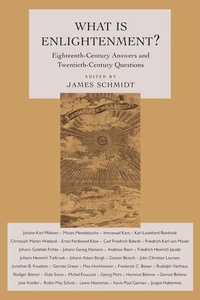
What Is Enlightenment?
Eighteenth-Century Answers and Twentieth-Century Questions
1st Edition
Published on 8. September 1996
500 pages
978-0-520-91689-0 (ISBN)
Description

This collection contains the first English translations of a group of important eighteenth-century German essays that address the question, "What is Enlightenment?" The book also includes newly translated and newly written interpretive essays by leading historians and philosophers, which examine the origins of eighteenth-century debate on Enlightenment and explore its significance for the present.
In recent years, critics from across the political and philosophical spectrum have condemned the Enlightenment for its complicity with any number of present-day social and cultural maladies. It has rarely been noticed, however, that at the end of the Enlightenment, German thinkers had already begun a scrutiny of their age so wide-ranging that there are few subsequent criticisms that had not been considered by the close of the eighteenth century. Among the concerns these essays address are the importance of freedom of expression, the relationship between faith and reason, and the responsibility of the Enlightenment for revolutions.
Included are translations of works by such well-known figures as Immanuel Kant, Moses Mendelssohn, Johann Gottlieb Fichte, and Johann Georg Hamann, as well as essays by thinkers whose work is virtually unknown to American readers. These eighteenth-century texts are set against interpretive essays by such major twentieth-century figures as Max Horkheimer, Jürgen Habermas, and Michel Foucault.
In recent years, critics from across the political and philosophical spectrum have condemned the Enlightenment for its complicity with any number of present-day social and cultural maladies. It has rarely been noticed, however, that at the end of the Enlightenment, German thinkers had already begun a scrutiny of their age so wide-ranging that there are few subsequent criticisms that had not been considered by the close of the eighteenth century. Among the concerns these essays address are the importance of freedom of expression, the relationship between faith and reason, and the responsibility of the Enlightenment for revolutions.
Included are translations of works by such well-known figures as Immanuel Kant, Moses Mendelssohn, Johann Gottlieb Fichte, and Johann Georg Hamann, as well as essays by thinkers whose work is virtually unknown to American readers. These eighteenth-century texts are set against interpretive essays by such major twentieth-century figures as Max Horkheimer, Jürgen Habermas, and Michel Foucault.
More details
Other editions
Additional editions

Book
09/1996
1st Edition
University of California Press
€39.00
Article exhausted; check different version
Book
09/1996
1st Edition
University of California Press
€43.33
Shipment within 10-20 days
Content
- Intro
- Title Page
- Copyright Page
- Contents
- Preface
- Introduction: What is Enlightenment? A Question, its Context, and Some Consequences
- Part I: The Eighteenth-Century Debate
- 1: The Question and Some Answers
- What is to be Done toward the Enlightenment of the Citizenry? (1783)
- On the Question: What is Enlightenment? (1784)
- An Answer to the Question: What is Enlightenment? (1784)
- Thoughts on Enlightenment (1784)
- A Couple of Gold Nuggets, from the. Wastepaper, or Six Answers to Six Questions (1789)
- 2: The Public Use of Reason
- On Freedom of Thought and of the Press: For Princes, Ministers, and Writers ( 1784)
- On Freedom of the Press and its Limits: For Consideration by Rulers, Censors, and Writers (1787)
- Publicity (1792)
- Reclamation of the Freedom of Thought from the Princes of Europe, Who have Oppressed it Until Now (1793)
- 3: Faith and Enlightenment
- Letter to Christian Jacob Kraus (18 December 1784)
- Metacritique on the Purism of Reason (1784)
- On Enlightenment: Is it and Could it be Dangerous to the State, to Religion, or Dangerous in General? A Word to be Heeded by Princes, Statesmen, and Clergy (1788)
- 4: The Politics of Enlightenment
- Something Lessing Said: A Commentary on Journeys of the Popes (1782)
- True and False Political Enlightenment (1792)
- On the Influence of Enlightenment on Revolutions (1794)
- Does Enlightenment Cause Revolutions? (1795)
- Part II: Historical Reflections
- The Berlin Wednesday Society
- The Subversive Kant: The Vocabulary of "Public" and "Publicity"
- On Enlightenment for the Common Man
- Modern Culture Comes of Age: Hamann versus Kant on the Root Metaphor of Enlightenment
- Jacobi's Critique of the Enlightenment
- Early Romanticism and the Aufklärung
- Progress: Ideas, Skepticism, and Critique- The Heritage of the Enlightenment
- Part III: Twentieth-Century Questions
- What is Enlightenment?
- Reason against Itself: Some Remarks on Enlightenment
- What is Enlightened Thinking?
- What is Critique?
- The Unity of Reason in the Diversity of its Voices
- The Battle of Reason with the Imagination
- The Failure of Kant's Imagination
- The Gender of Enlightenment
- Autonomy, Individuality, and Self-Determination
- Enlightened Cosmopolitanism: The Political Perspective of the Kantian "Sublime"
- Contributors to Parts II and III
- Select Bibliography
- Index
