

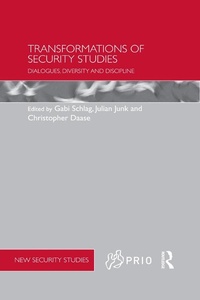
Transformations of Security Studies
Dialogues, Diversity and Discipline
Published on 30. October 2015
264 pages
978-1-317-48104-1 (ISBN)
Description

This volume brings together a group of distinguished scholars to engage in a dialogue on key developments in the study of security.
The book provides a comprehensive overview of theoretical, empirical and methodological developments within security studies, whose political and societal importance has grown significantly in recent years. By bringing together scholars who hold differing perspectives on security, this volume provides insights into a variety of approaches and their newest developments, including 'mainstream' as well as heterodox perspectives on security. Thus, it aims to build bridges of communication between different 'camps' by initiating a dialogue on the identity and diversity of security studies. It does so in three parts: The first part of the book includes paradigmatic approaches to security that are closely connected to major debates in International Relations such as realism, institutionalism, constructivism as well as approaches to the culture, ethics of security and critical security studies. The second part places emphasis on the broadening and deepening of the concept of security in recent decades. It discusses key empirical frontiers including the continued centrality of the state, the link between democracy and security, environmental security as well as financial security. The third part of the book presents various methodological approaches to the question of security and peace. It provides an overview of new approaches such as the visual turn, quantifying security and method combinations.
This book will be of much interest to students of critical security studies, international relations and research methods.
The book provides a comprehensive overview of theoretical, empirical and methodological developments within security studies, whose political and societal importance has grown significantly in recent years. By bringing together scholars who hold differing perspectives on security, this volume provides insights into a variety of approaches and their newest developments, including 'mainstream' as well as heterodox perspectives on security. Thus, it aims to build bridges of communication between different 'camps' by initiating a dialogue on the identity and diversity of security studies. It does so in three parts: The first part of the book includes paradigmatic approaches to security that are closely connected to major debates in International Relations such as realism, institutionalism, constructivism as well as approaches to the culture, ethics of security and critical security studies. The second part places emphasis on the broadening and deepening of the concept of security in recent decades. It discusses key empirical frontiers including the continued centrality of the state, the link between democracy and security, environmental security as well as financial security. The third part of the book presents various methodological approaches to the question of security and peace. It provides an overview of new approaches such as the visual turn, quantifying security and method combinations.
This book will be of much interest to students of critical security studies, international relations and research methods.
More details
Series
Language
English
Place of publication
London
United Kingdom
Publishing group
Taylor & Francis Ltd
Target group
College/higher education
Professional and scholarly
Illustrations
10 s/w Zeichnungen
10 Line drawings, black and white
File size
1,59 MB
ISBN-13
978-1-317-48104-1 (9781317481041)
Copyright in bibliographic data and cover images is held by Nielsen Book Services Limited or by the publishers or by their respective licensors: all rights reserved.
Schweitzer Classification
Other editions
Additional editions
Gabi Schlag | Julian Junk | Christopher Daase
Transformations of Security Studies
Dialogues, Diversity and Discipline
Book
02/2017
1st Edition
Routledge
€57.40
Shipment within 10-20 days
Gabi Schlag | Julian Junk | Christopher Daase
Transformations of Security Studies
Dialogues, Diversity and Discipline
Book
11/2015
1st Edition
Routledge
€145.80
Shipment within 10-20 days
Persons
Gabi Schlag is Teaching Associate and Research Fellow at the Otto von Guericke University Magdeburg, Germany, and holds a PhD from the Goethe University Frankfurt, Germany.
Julian Junk is a Researcher at both the Peace Research Institute Frankfurt and the Goethe University Frankfurt, Germany.
Christopher Daase is Professor of International Organization at the Goethe University Frankfurt, Germany, and co-editor of Rethinking Security Governance: The problem of unintended consequences (Routledge, 2010, co-edited with Cornelius Friesendorf).
Julian Junk is a Researcher at both the Peace Research Institute Frankfurt and the Goethe University Frankfurt, Germany.
Christopher Daase is Professor of International Organization at the Goethe University Frankfurt, Germany, and co-editor of Rethinking Security Governance: The problem of unintended consequences (Routledge, 2010, co-edited with Cornelius Friesendorf).
Content
Introduction: Transformations of Security and Security Studies, Gabi Schlag, Julian Junk and Christopher Daase PART I: Paradigmatic Approaches to Security 1. Realism: Not Expanding, But Still Evolving, Charles L. Glaser 2. Is the Crisis of Security Institutions a Crisis of Institutional Theory?, Caroline Fehl 3. Is there Life Beyond Language? Discourses of Security, K.M. Fierke 4. On Paradox and Pathologies: A Cultural Approach to Security, Christopher Daase 5. An Ethics of Security, J. Peter Burgess PART II: Subjects of Security 6. Power Politics Revisited: Are Realist Theories Really at Odds with the New Security Threats?, Carlo Masala 7. Democratic Distinctiveness and the New Security Agenda, Anna Geis, Wolfgang Wagner 8. Securing the Environment: From Defense to Resilience, Chris Methmann and Angela Oels 9. Financial Security, Nina Boy PART III: Methodologies of Studying Security 10. Imaging Security: A Visual Methodology for Security Studies, Gabi Schlag 11. Global, State, and Idividual Security in Quantitative Conflict Research, Havard Hegre, Idunn Kristiansen 12. Combining Methods: Connections and Zooms in Analysing Hybrids, Julian Junk and Valentin Rauer 13. A Dialogue on the Identity and Diversity of Security Studies: A Conclusion of the Volume, Julian Junk, Gabi Schlag and Christopher Daase
