

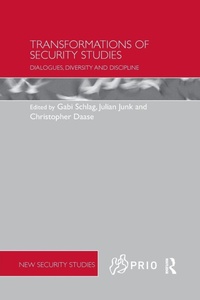
Transformations of Security Studies
Dialogues, Diversity and Discipline
1st Edition
Published on 7. February 2017
Book
Paperback/Softback
250 pages
978-1-138-73386-2 (ISBN)
Description
This book offers a broad overview of the many strands of contemporary security studies and a path towards a dialogue about the theoretical, empirical, and methodological identity of this important research field.
More details
Series
Language
English
Place of publication
London
United Kingdom
Publishing group
Taylor & Francis Ltd
Target group
College/higher education
Illustrations
10 s/w Zeichnungen
10 Line drawings, black and white
Dimensions
Height: 234 mm
Width: 156 mm
Thickness: 14 mm
Weight
409 gr
ISBN-13
978-1-138-73386-2 (9781138733862)
Copyright in bibliographic data and cover images is held by Nielsen Book Services Limited or by the publishers or by their respective licensors: all rights reserved.
Schweitzer Classification
Other editions
Additional editions
Gabi Schlag | Julian Junk | Christopher Daase
Transformations of Security Studies
Dialogues, Diversity and Discipline
Book
11/2015
1st Edition
Routledge
€145.80
Shipment within 10-20 days
Gabi Schlag | Julian Junk | Christopher Daase
Transformations of Security Studies
Dialogues, Diversity and Discipline
E-Book
10/2015
Routledge
€49.99
Available for download
Gabi Schlag | Julian Junk | Christopher Daase
Transformations of Security Studies
Dialogues, Diversity and Discipline
E-Book
10/2015
Routledge
€49.99
Available for download
Persons
Gabi Schlag is Teaching Associate and Research Fellow at the Otto von Guericke University Magdeburg, Germany, and holds a PhD from the Goethe University Frankfurt, Germany.
Julian Junk is a Researcher at both the Peace Research Institute Frankfurt and the Goethe University Frankfurt, Germany.
Christopher Daase is Professor of International Organization at the Goethe University Frankfurt, Germany, and co-editor of Rethinking Security Governance: The problem of unintended consequences (Routledge, 2010, co-edited with Cornelius Friesendorf).
Julian Junk is a Researcher at both the Peace Research Institute Frankfurt and the Goethe University Frankfurt, Germany.
Christopher Daase is Professor of International Organization at the Goethe University Frankfurt, Germany, and co-editor of Rethinking Security Governance: The problem of unintended consequences (Routledge, 2010, co-edited with Cornelius Friesendorf).
Content
1. Introduction: Dialogues on Security, Christopher Daase, Julian Junk and Gabi Schlag
Part I: Paradigmatic Approaches to Security - Then and Now
2. Realism: Not Expanding, But Still Evolving, Charles L. Glaser
3. Is the Crisis of Security Institutions a Crisis of Institutionalist Theory?, Caroline Fehl
4. Is There Life Beyond Language? Discourses of Security, Karin Fierke
5. Cultures of Security: Explaining Extended Security, Christopher Daase
6. Security as Ethics, Peter J. Burgess
Part II: The Subject of Security - Widening and Deepening the Concept of Security
7. Power politics revisited: Are realist theories really at odds with the new security threats?, Carlo Masala
8. Democratic Distinctiveness and the New Security Agenda, Wolfgang Wagner and Anna Geis
9. Securing the Environment: From Defense to Resilience, Angela Oels and Chris Methmann
10. Financial Security, Nina Boy
Part III: Methodologies of Security - Approaching the Limits of Security Analysis
11. 'Strong Objectivity' in Security Studies: Ethnographic Contributions to Method Development, Anna Leander
12. Imaging Security: A Visual Methodology for Security Studies, Gabi Schlag
13. Opportunities and Challenges of Quantifying Security, Harvard Hegre and Idunn Kristiansen
14. Analyzing Hybrids. Actor-Network-Theory and Method Combinations in Security Studies, Valentin Rauer and Julian Junk
15. Conclusion: A Dialogue on Security, Gabi Schlag, Julian Junk and Christopher Daase
Part I: Paradigmatic Approaches to Security - Then and Now
2. Realism: Not Expanding, But Still Evolving, Charles L. Glaser
3. Is the Crisis of Security Institutions a Crisis of Institutionalist Theory?, Caroline Fehl
4. Is There Life Beyond Language? Discourses of Security, Karin Fierke
5. Cultures of Security: Explaining Extended Security, Christopher Daase
6. Security as Ethics, Peter J. Burgess
Part II: The Subject of Security - Widening and Deepening the Concept of Security
7. Power politics revisited: Are realist theories really at odds with the new security threats?, Carlo Masala
8. Democratic Distinctiveness and the New Security Agenda, Wolfgang Wagner and Anna Geis
9. Securing the Environment: From Defense to Resilience, Angela Oels and Chris Methmann
10. Financial Security, Nina Boy
Part III: Methodologies of Security - Approaching the Limits of Security Analysis
11. 'Strong Objectivity' in Security Studies: Ethnographic Contributions to Method Development, Anna Leander
12. Imaging Security: A Visual Methodology for Security Studies, Gabi Schlag
13. Opportunities and Challenges of Quantifying Security, Harvard Hegre and Idunn Kristiansen
14. Analyzing Hybrids. Actor-Network-Theory and Method Combinations in Security Studies, Valentin Rauer and Julian Junk
15. Conclusion: A Dialogue on Security, Gabi Schlag, Julian Junk and Christopher Daase