

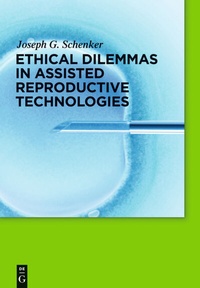
Ethical Dilemmas in Assisted Reproductive Technologies
1st Edition
Published on 29. August 2011
XXIII, 389 pages
978-3-11-024021-4 (ISBN)
Description

Assisted reproductive technologies (ART) include the artificial or partially artificial methods to achieve pregnancy. These new technologies lead to substantial changes regarding of ethical and legal aspects in reproductive medicine. The book focuses on current hot topics about ethical dilemmas in ART, e.g. about the duties of ethical committees, guidelines regarding informed consent, ethical and legal aspects of sperm donation, embryo donation, ethics of embryonic stem cells, therapeutical cloning, patenting of human genes, commercialization.
More details
Other editions
Additional editions

Joseph G. Schenker
Ethical Dilemmas in Assisted Reproductive Technologies
Book
08/2011
1st Edition
De Gruyter
€289.00
Article exhausted; check different version

Joseph G. Schenker
Ethical Dilemmas in Assisted Reproductive Technologies
Book
08/2011
1st Edition
De Gruyter
€300.00
Shipment within 7-9 days
Person
Joseph G. Schenker, Hebrew University, Hadassah Hospital, Jerusalem, Israel.
Content
1 - Contents [Seite 6]
2 - Preface [Seite 18]
3 - Author index [Seite 22]
4 - 1 The foundations and application of medical ethics [Seite 26]
4.1 - 1.1 Introduction [Seite 26]
4.2 - 1.2 Historical background [Seite 26]
4.3 - 1.3 General ethical theories and principles [Seite 27]
4.4 - 1.4 Modern medical ethics [Seite 33]
4.5 - 1.5 Conclusion [Seite 38]
5 - 2 Legislation for assisted reproductive technologies [Seite 40]
5.1 - 2.1 Introduction [Seite 40]
5.2 - 2.2 Legislation and regulations [Seite 41]
5.3 - 2.3 Legislative motivations [Seite 43]
5.4 - 2.4 Evidence-based legal policy [Seite 45]
5.5 - 2.5 The focus of legislation [Seite 47]
5.6 - 2.6 Human rights [Seite 50]
6 - 3 Reproductive rights as an integral part of women's rights [Seite 54]
6.1 - 3.1 Introduction [Seite 54]
6.2 - 3.2 Granting women equal rights: the origin of discrimination [Seite 55]
6.2.1 - 3.2.1 Cornerstones of women's rights [Seite 57]
6.2.1.1 - 3.2.1.1 Dignity, body integrity, and freedom from violence [Seite 57]
6.2.1.2 - 3.2.1.2 Equality and empowerment [Seite 59]
6.2.1.3 - 3.2.1.3 Full, unconditional access to health care services [Seite 60]
6.2.2 - 3.2.2 A right to treat infertility [Seite 61]
7 - 4 Right to reproduce [Seite 68]
7.1 - 4.1 Socioeconomic issues [Seite 68]
7.2 - 4.2 Religious issues [Seite 70]
7.3 - 4.3 Legal and historical aspects [Seite 70]
7.4 - 4.4 Moral aspects [Seite 73]
7.5 - 4.5 ART-related aspects [Seite 74]
8 - 5 Informed consent for treatment of fertility [Seite 78]
8.1 - 5.1 Introduction [Seite 78]
8.2 - 5.2 The right to experience parenthood and its standing [Seite 79]
8.3 - 5.3 The informed-consent doctrine [Seite 80]
8.3.1 - 5.3.1 The doctrine and its nature [Seite 80]
8.3.2 - 5.3.2 Application of the doctrine to fertility treatments [Seite 80]
8.4 - 5.4 Mutual consent of spouses [Seite 81]
8.4.1 - 5.4.1 Joint process [Seite 81]
8.4.2 - 5.4.2 The good of the child and consideration of parental capability [Seite 82]
8.5 - 5.5 Validity of the consent [Seite 83]
8.5.1 - 5.5.1 Effect of the initial consent [Seite 83]
8.5.2 - 5.5.2 Withdrawal of patient consent [Seite 84]
8.5.3 - 5.5.3 Physician's withdrawal of consent [Seite 84]
8.5.4 - 5.5.4 Consent after death [Seite 85]
8.6 - 5.5 Conclusion [Seite 85]
9 - 6 Specific ethical and legal aspects of ART practice in eastern European countries [Seite 88]
9.1 - 6.1 Introduction [Seite 88]
9.2 - 6.2 Situation in eastern European countries [Seite 88]
9.2.1 - 6.2.1 Number of centers [Seite 88]
9.2.2 - 6.2.2 Legal regulation of ART [Seite 89]
9.2.3 - 6.2.3 Coverage or reimbursement of ART [Seite 90]
9.2.4 - 6.2.4 Marital status in ART [Seite 91]
9.2.5 - 6.2.5 The number of transferred embryos in ART [Seite 92]
9.2.6 - 6.2.6 Cryopreservation [Seite 93]
9.2.7 - 6.2.7 Posthumous ART [Seite 95]
9.2.8 - 6.2.8 Gamete donation [Seite 96]
9.2.9 - 6.2.9 Anonymity [Seite 97]
9.2.10 - 6.2.10 Micromanipulation [Seite 98]
9.2.11 - 6.2.11 In vitro maturation of oocytes [Seite 99]
9.2.12 - 6.2.12 Welfare of the child [Seite 100]
9.2.13 - 6.2.13 Multifetal-pregnancy reduction [Seite 101]
9.2.14 - 6.2.14 Preimplantation genetic diagnosis [Seite 102]
9.2.15 - 6.2.15 Surrogacy [Seite 103]
9.2.16 - 6.2.16 Research on the embryo [Seite 104]
9.2.17 - 6.2.18 Gamete intrafallopian transfer [Seite 106]
9.2.18 - 6.2.19 The moral status of the embryo [Seite 106]
9.3 - 6.3 Conclusions [Seite 107]
10 - 7 Sperm donation and sperm-bank management [Seite 112]
10.1 - 7.1 Introduction [Seite 112]
10.2 - 7.2 Limiting the number of donor offspring [Seite 113]
10.2.1 - 7.2.1 United States [Seite 113]
10.2.2 - 7.2.2 United Kingdom [Seite 113]
10.3 - 7.3 Minimizing the risk of infection and genetic complications from sperm donors [Seite 114]
10.4 - 7.4 Age requirements for sperm donors [Seite 114]
10.5 - 7.5 Anonymity versus nonanonymity of sperm donors [Seite 115]
10.5.1 - 7.5.1 Anonymous sperm donation [Seite 115]
10.5.2 - 7.5.2 Nonanonymous sperm donation [Seite 116]
10.6 - 7.6 Sperm-donor compensation [Seite 117]
10.7 - 7.7 Informed consent and counseling [Seite 118]
10.8 - 7.8 Conclusions [Seite 118]
11 - 8 Oocyte donation: medical and legal perspectives [Seite 120]
11.1 - 8.1 Introduction: Indications for egg donation [Seite 120]
11.2 - 8.2 Preparation of donor and recipient [Seite 121]
11.3 - 8.3 Outcome determining factors [Seite 123]
11.4 - 8.4 Obstetric and perinatal outcomes [Seite 123]
11.5 - 8.5 Ethical aspects [Seite 124]
11.6 - 8.6 Legislation [Seite 126]
11.6.1 - 8.6.1 The new Israeli legislation [Seite 129]
11.7 - 8.7 Summary [Seite 132]
12 - 9 Egg donation: ethical considerations and regulatory context [Seite 136]
12.1 - 9.1 Introduction [Seite 136]
12.2 - 9.2 The regulatory context [Seite 136]
12.3 - 9.3 Donating eggs [Seite 137]
12.3.1 - 9.3.1 Informed consent [Seite 137]
12.3.2 - 9.3.2 Meeting demand: remuneration and other programs [Seite 138]
12.3.2.1 - 9.3.2.1 Financial compensation [Seite 138]
12.3.2.2 - 9.3.2.2 Egg-sharing programs [Seite 139]
12.3.3 - 9.3.3 Other obligations [Seite 140]
12.4 - 9.4 Use of donated eggs [Seite 140]
12.4.1 - 9.4.1 Informed consent [Seite 140]
12.4.2 - 9.4.2 Nontraditional patients and access to donated eggs [Seite 140]
12.4.3 - 9.4.3 Age [Seite 141]
12.5 - 9.5 Donor identity and disclosure [Seite 141]
12.6 - 9.6 Conclusions [Seite 143]
13 - 10 Medical, ethical, and legal aspects of fetal reduction [Seite 146]
13.1 - 10.1 History [Seite 146]
13.2 - 10.2 Ethical issues [Seite 148]
13.2.1 - 10.2.1 Moral compromise [Seite 152]
13.3 - 10.3 Legal issues [Seite 153]
13.3.1 - 10.3.1 Recommendations [Seite 153]
13.4 - 10.4 Summary [Seite 154]
13.5 - 10.5 Acknowledgments [Seite 154]
14 - 11 Fertility treatments in human immunodeficiency virus (HIV) infected patients [Seite 156]
14.1 - 11.1 Introduction [Seite 156]
14.2 - 11.2 HIV and the male genital tract [Seite 157]
14.3 - 11.3 HIV and the female genital tract [Seite 158]
14.4 - 11.4 Assisted reproductive technologies in HIV-positive patients [Seite 158]
14.5 - 11.5 Semen processing [Seite 159]
14.6 - 11.6 Viral testing of spermatozoa [Seite 160]
14.7 - 11.7 Success rates [Seite 160]
14.8 - 11.8 Summary [Seite 160]
15 - 12 Pregnancies in perimenopause and beyond [Seite 164]
15.1 - 12.1 Medical aspects and considerations [Seite 164]
15.1.1 - 12.1.1 Fertility fecundity and abortions [Seite 164]
15.1.2 - 12.1.2 Pregnancy-associated physiological changes [Seite 165]
15.1.3 - 12.1.3 Obstetrical and intrapartum complications [Seite 165]
15.1.4 - 12.1.4 Maternal mortality [Seite 166]
15.1.5 - 12.1.5 Neonatal outcome [Seite 166]
15.2 - 12.2 Oocyte-donation programs [Seite 166]
15.3 - 12.3 Ethical aspects [Seite 167]
15.3.1 - 12.3.1 The issue of choice [Seite 167]
15.3.2 - 12.3.2 The welfare of the child [Seite 168]
15.4 - 12.4 Coping with the medical risks [Seite 168]
15.5 - 12.5 Legislation, regulation, and religion aspects [Seite 169]
15.6 - 12.6 Summary [Seite 170]
16 - 13 Legal control of surrogacy - international perspectives [Seite 174]
16.1 - 13.1 Introduction [Seite 174]
16.2 - 13.2 Surrogacy - definition [Seite 174]
16.3 - 13.3 Surrogacy - history [Seite 174]
16.4 - 13.4 Legal control of surrogacy - international perspectives [Seite 175]
16.4.1 - 13.4.1 Prohibition of Surrogacy by legislation [Seite 175]
16.4.2 - 13.4.2 Counties - surrogacy no prohibited by law [Seite 176]
16.4.3 - 13.4.3 Surrogacy in China [Seite 177]
16.4.4 - 13.4.4 Non commercial surrogacy [Seite 177]
16.4.5 - 13.4.5 Greece Law [Seite 177]
16.4.6 - 13.4.6 South Africa [Seite 178]
16.5 - 13.5 Commercial surrogacy [Seite 178]
16.5.1 - 13.5.1 Former Countries of the Soviet Union [Seite 178]
16.5.2 - 13.5.2 India [Seite 179]
16.5.3 - 13.5.3 Surrogacy in USA [Seite 179]
16.5.4 - 13.5.4 Surrogacy in Russia [Seite 180]
16.6 - 13.6 Russian Public Opinion [Seite 183]
16.7 - 13.7 Surrogacy in Islamic Countries [Seite 183]
16.8 - 13.8 Cross-border Surrogacy [Seite 184]
16.9 - 13.9 Conclusions [Seite 186]
17 - 14 Preimplantation genetic diagnosis in assisted reproduction: medical, ethical, and legal aspects [Seite 190]
17.1 - 14.1 Introduction [Seite 190]
17.2 - 14.2 Biopsy methods for preimplantation genetic diagnosis [Seite 191]
17.2.1 - 14.2.1 Polar-body biopsy [Seite 191]
17.2.2 - 14.2.2 Embryo biopsy [Seite 192]
17.3 - 14.3 Chromosomal aneuploidies in preimplantation development [Seite 192]
17.4 - 14.4 Chromosomal rearrangements [Seite 194]
17.5 - 14.5 Impact of PGD on IVF outcome [Seite 195]
17.6 - 14.6 Conclusion [Seite 197]
18 - 15 Preimplantation genetic diagnosis of late-onset diseases [Seite 200]
18.1 - 15.1 Introduction [Seite 200]
18.2 - 15.2 Embryo selection [Seite 202]
18.3 - 15.3 Huntington's disease [Seite 203]
18.4 - 15.4 Cardiovascular disorders [Seite 205]
18.5 - 15.5 Alzheimer's disease [Seite 206]
18.6 - 15.6 Genetic testing for cancer [Seite 206]
18.7 - 15.7 Breast cancer [Seite 207]
18.8 - 15.8 Genetic counseling [Seite 210]
18.9 - 15.9 Conclusion [Seite 210]
19 - 16 Bioethics of human embryonic stem cells and cloning for stem cells: an Israeli perspective [Seite 214]
19.1 - 16.1 The scientific and medical aspects [Seite 214]
19.2 - 16.2 Ethical issues related to human embryo stem cells [Seite 215]
19.2.1 - 16.2.1 Pluralism of moral views on the preimplantation embryo [Seite 215]
19.2.2 - 16.2.2 Potentiality of human preimplantation embryo [Seite 216]
19.2.3 - 16.2.3 Personal status of the embryo [Seite 216]
19.2.4 - 16.2.4 Therapeutic aims of human ES cells [Seite 217]
19.2.5 - 16.2.5 Pluralism of decisions on human ES cell production and research in various countries [Seite 217]
19.2.6 - 16.2.6 A case study: ethical regulations on human ES cell research in Israel [Seite 219]
19.3 - 16.3 Ethical views on cloning to obtain autologous ES cells [Seite 220]
19.3.1 - 16.3.1 Bioethical arguments [Seite 220]
19.3.2 - 16.3.2 National and international resolutions [Seite 221]
19.3.3 - 16.3.3 Case study: regulations in Israel regarding cloning for ES cells [Seite 222]
20 - 17 The future of human embryonic stem cell research: medical, legal, and ethical perspectives [Seite 226]
20.1 - 17.1 Introduction: Human embryonic stem cell research [Seite 226]
20.2 - 17.2 The first possible clinical applications of cells differentiated from hESC [Seite 226]
20.3 - 17.3 Challenges in clinical treatment using hESC-derived cells [Seite 227]
20.3.1 - 17.3.1 Microbial contamination [Seite 227]
20.3.2 - 17.3.2 GMP and EU tissues and cells directive [Seite 227]
20.3.3 - 17.3.3 Immunogenicity [Seite 228]
20.3.4 - 17.3.4 Tumorigenicity [Seite 228]
20.4 - 17.4 iPS cells versus hESC [Seite 229]
20.5 - 17.5 Legal and ethical aspects of hESC research [Seite 229]
20.6 - 17.6 Conclusions [Seite 231]
21 - 18 Preservation of fertility in children with cancer: medical, ethical, and legal aspects [Seite 234]
21.1 - 18.1 Introduction [Seite 234]
21.2 - 18.2 Population at risk [Seite 235]
21.3 - 18.3 Medical and surgical options for fertility preservation [Seite 236]
21.4 - 18.4 The ethical propriety of fertility-preservation options [Seite 237]
21.5 - 18.5 Autonomy, justice, and treating pediatric patients [Seite 239]
21.6 - 18.6 Ethical and legal issues with unused tissue and gametes [Seite 239]
21.7 - 18.7 Posthumous reproduction [Seite 240]
21.8 - 18.8 Conclusion [Seite 241]
22 - 19 Fertility preservation for cancer patients: a review of current options and their advantages and disadvantages [Seite 244]
22.1 - 19.1 Introduction [Seite 244]
22.2 - 19.2 Cancer and fertility preservation [Seite 244]
22.3 - 19.3 Current options for fertility preservation [Seite 245]
22.4 - 19.4 Medical options: GnRH agonists [Seite 245]
22.5 - 19.5 Surgical options: ovarian transposition and cryopreservation of ovarian cortical tissue [Seite 246]
22.5.1 - 19.5.1 Ovarian transposition [Seite 246]
22.5.2 - 19.5.2 Cryopreservation of ovarian cortical tissue [Seite 247]
22.6 - 19.6 ART: in vitro fertilization and in vitro maturation [Seite 248]
22.6.1 - 19.6.1 Embryo and oocyte cryopreservation after ovarian stimulation [Seite 248]
22.6.1.1 - 19.6.1.1 Embryo cryopreservation [Seite 248]
22.6.1.2 - 19.6.1.2 Oocyte cryopreservation [Seite 249]
22.6.2 - 19.6.2 Embryo and oocyte cryopreservation without prior ovarian Stimulation [Seite 250]
22.6.3 - 19.6.3 IVM embryo cryopreservation [Seite 251]
22.6.4 - 19.6.4 IVM-oocyte vitrification [Seite 251]
22.6.5 - 19.6.5 Fertility preservation: the McGill experience [Seite 252]
22.7 - 19.7 Conclusion [Seite 252]
23 - 20 Sexual orientation and use of assisted reproductive technology: social and psychological issues [Seite 258]
23.1 - 20.1 Introduction [Seite 258]
23.2 - 20.2 A note about terminology [Seite 258]
23.3 - 20.3 Routes to parenthood among nonheterosexual adults [Seite 259]
23.4 - 20.4 Legal issues surrounding sexual orientation and family formation [Seite 259]
23.5 - 20.5 Sexual orientation and incidence of parenthood [Seite 260]
23.6 - 20.6 Sexual orientation and plans for parenthood [Seite 260]
23.7 - 20.7 Studies of sexual orientation and plans for parenthood [Seite 261]
23.8 - 20.8 Outcomes for children of lesbians and gay men [Seite 262]
23.9 - 20.9 Relationships with peers [Seite 262]
23.10 - 20.10 Child behavior problems [Seite 263]
23.11 - 20.11 Gender development [Seite 263]
23.12 - 20.12 Conclusions and future directions [Seite 264]
23.13 - 20.13 Assisted reproduction among nonheterosexual adults [Seite 264]
23.14 - 20.14 Barriers to ART use by nonheterosexual adults [Seite 264]
23.15 - 20.15 Donor-insemination decisions [Seite 266]
23.16 - 20.16 Recommendations for clinical practice [Seite 267]
23.17 - 20.17 Conclusion [Seite 268]
24 - 21 Access to fertility treatment by lesbian couples [Seite 270]
24.1 - 21.1 Introduction [Seite 270]
24.2 - 21.2 Legal changes [Seite 271]
24.3 - 21.3 Assisted reproduction [Seite 274]
24.4 - 21.4 Being a lesbian and a mother [Seite 275]
24.5 - 21.5 Donor anonymity [Seite 275]
24.6 - 21.6 Ethical assessment [Seite 277]
24.7 - 21.7 A Child with two mothers [Seite 279]
25 - 22 ART practice and tourism [Seite 282]
25.1 - 22.1 Introduction [Seite 282]
25.2 - 22.2 Background and methods [Seite 283]
25.3 - 22.3 Major findings [Seite 284]
25.3.1 - 22.3.1 The United Arab Emirates [Seite 286]
25.3.1.1 - 22.3.1.1 Reproductive travel to the UAE [Seite 286]
25.3.1.2 - 22.3.1.2 Reproductive travel from the UAE [Seite 287]
25.3.1.3 - 22.3.1.3 Reproductive travel to and from the UAE [Seite 288]
25.3.2 - 22.3.2 The East Coast of the United States [Seite 288]
25.4 - 22.4 Conclusion [Seite 290]
26 - 23 A savior child conceived by PGD/HLA: medical and ethical aspects [Seite 294]
26.1 - 23.1 Introduction [Seite 294]
26.2 - 23.2 Medical indications and social acceptance of PGD [Seite 294]
26.2.1 - 23.2.1 Chromosomal abnormalities [Seite 294]
26.2.2 - 23.2.2 Monogenic diseases [Seite 295]
26.2.3 - 23.2.3 Adult-onset diseases and cancer-predisposing genes [Seite 295]
26.2.4 - 23.2.4 Creating a "savior child" [Seite 296]
26.3 - 23.3 Other possible applications of PGD: savior embryos, gender selection, and designer babies [Seite 297]
26.3.1 - 23.3.1 Savior embryos [Seite 297]
26.3.2 - 23.3.2 Gender selection [Seite 298]
26.3.3 - 23.3.3 Designer babies [Seite 298]
26.4 - 23.4 Legislation and professional guidelines for the uses of PGD/HLA [Seite 299]
26.5 - 23.5 Ethical considerations [Seite 299]
26.5.1 - 23.5.1 Embryo wastage [Seite 300]
26.5.2 - 23.5.2 Moral status of the human embryo [Seite 300]
26.5.3 - 23.5.3 Harm of embryo biopsy [Seite 302]
26.5.4 - 23.5.4 The condition of absolute medical necessity [Seite 302]
26.5.5 - 23.5.5 PGD SC and family ethics [Seite 304]
26.5.6 - 23.5.6 Well-being of the savior child [Seite 306]
26.5.7 - 23.5.7 PGD, parental interests and public access [Seite 308]
27 - 24 Posthumous reproduction: ethical and legal perspectives [Seite 314]
27.1 - 24.1 Introduction [Seite 314]
27.2 - 24.2 The source [Seite 315]
27.2.1 - 24.2.1 What counts as consent? [Seite 315]
27.2.2 - 24.2.2 Coercion [Seite 316]
27.2.3 - 24.2.3 Minors as sources [Seite 317]
27.3 - 24.3 Requesters of retrieval [Seite 318]
27.4 - 24.4 Reproductive partners [Seite 319]
27.5 - 24.5 Children [Seite 320]
27.6 - 24.6 Summary [Seite 320]
28 - 25 Human reproductive cloning: ethical perspectives [Seite 322]
28.1 - 25.1 Introduction [Seite 322]
28.2 - 25.2 The potential value of HRC [Seite 322]
28.3 - 25.3 Ethical concerns with HRC [Seite 326]
28.4 - 25.4 HRC and the value of our unique genetic make-up [Seite 331]
28.5 - 25.5 Conclusion [Seite 332]
29 - 26 ART practice - religious views [Seite 334]
29.1 - 26.1 Introduction [Seite 334]
29.2 - 26.2 The Jewish law [Seite 335]
29.2.1 - 26.2.1 Torah [Seite 335]
29.2.2 - 26.2.2 The Mishnah [Seite 336]
29.2.3 - 26.2.3 The Talmud [Seite 336]
29.2.4 - 26.2.4 Post-Talmudic codes [Seite 336]
29.2.5 - 26.2.5 Responsa [Seite 336]
29.2.6 - 26.2.6 Orthodox Judaism [Seite 337]
29.2.7 - 26.2.7 Reform Judaism [Seite 337]
29.2.8 - 26.2.8 Conservative [Seite 338]
29.3 - 26.3 Christian denominations [Seite 339]
29.3.1 - 26.3.1 Roman Catholic Church [Seite 339]
29.3.2 - 26.3.2 Anglican Church [Seite 340]
29.3.3 - 26.3.3 The Protestant Church [Seite 341]
29.3.4 - 26.3.4 Eastern Orthodox Church [Seite 341]
29.4 - 26.4 Hinduism [Seite 342]
29.5 - 26.5 Buddhism [Seite 343]
30 - 27 A Catholic ethical perspective on human reproductive technology [Seite 346]
30.1 - 27.1 Catholic position on respect for the human embryo [Seite 346]
30.1.1 - 27.1.1 Biblical perspective [Seite 346]
30.1.2 - 27.1.2 Christian tradition [Seite 346]
30.1.3 - 27.1.3 Embryo defined [Seite 347]
30.1.4 - 27.1.4 Catholic Christian teaching [Seite 347]
30.1.5 - 27.1.5 A person from conception [Seite 349]
30.1.6 - 27.1.6 Ethics and destructive research on human embryos [Seite 349]
30.1.7 - 27.1.7 Morality and personalized natural law [Seite 350]
30.1.8 - 27.1.8 Secular ethics and the human embryo [Seite 351]
30.1.9 - 27.1.9 Challenge to find ethical alternatives [Seite 352]
30.2 - 27.2 Catholic ethics, marriage, and reproductive technology [Seite 352]
30.2.1 - 27.2.1 Catholic Christian position on children of the marriage union [Seite 352]
30.2.2 - 27.2.2 Assisted insemination [Seite 353]
30.2.3 - 27.2.3 Rights of children and natural parents [Seite 354]
30.2.4 - 27.2.4 Donor gametes [Seite 354]
30.2.5 - 27.2.5 Surrogacy [Seite 354]
30.2.6 - 27.2.6 Access to ART by single women and lesbians [Seite 355]
30.2.7 - 27.2.7 Human reproductive cloning [Seite 355]
30.3 - 27.3 Conclusion [Seite 355]
31 - 28 Islamic laws and reproduction [Seite 358]
31.1 - 28.1 Islamic laws [Seite 358]
31.2 - 28.2 Reproduction in Islam [Seite 358]
31.3 - 28.3 ART and Islam [Seite 359]
31.4 - 28.4 Islam and various ART practices [Seite 360]
31.5 - 28.5 Surrogacy [Seite 360]
31.6 - 28.6 Multifetal pregnancy reduction [Seite 360]
31.7 - 28.7 Pregnancy in postmenopause [Seite 360]
31.8 - 28.8 Sex selection [Seite 361]
31.9 - 28.9 Cryopreservation [Seite 362]
31.10 - 28.10 Embryo implantation following husband's death [Seite 362]
31.11 - 28.11 Embryo research [Seite 363]
31.12 - 28.12 Gene therapy [Seite 363]
31.13 - 28.13 Cloning [Seite 364]
31.14 - 28.14 ART practices in different Muslim countries [Seite 364]
32 - 29 Jewish law (halakha) and reproduction [Seite 368]
32.1 - 29.1 Introduction [Seite 368]
32.2 - 29.2 Homosexuality [Seite 369]
32.3 - 29.3 Lesbianism [Seite 369]
32.4 - 29.4 Evaluation of the infertile couple [Seite 370]
32.5 - 29.5 The laws of niddah [Seite 370]
32.6 - 29.6 Infertility treatment [Seite 371]
32.7 - 29.7 The beginning of human life [Seite 373]
32.8 - 29.8 Artificial insemination by husband [Seite 375]
32.9 - 29.9 Artificial insemination by donor [Seite 375]
32.10 - 29.10 Oocyte donation [Seite 376]
32.11 - 29.11 Surrogacy [Seite 377]
32.11.1 - 29.11.1 Legalizing surrogacy in Israel [Seite 378]
32.11.2 - 29.11.2 The state-appointed permission committee [Seite 378]
32.11.2.1 - 29.11.2.1 Guidelines set by the committee for surrogacy [Seite 378]
32.11.2.2 - 29.11.2.2 Expenses [Seite 379]
32.11.2.3 - 29.11.2.3 Legal status of the newborn [Seite 379]
32.11.2.4 - 29.11.2.4 Surrogate mother's withdrawal from the agreement [Seite 379]
32.11.2.5 - 29.11.2.5 Legal rights of the surrogate mother [Seite 380]
32.11.2.6 - 29.11.2.6 Enforcement of the law [Seite 380]
32.11.2.7 - 29.11.2.7 Right to privacy [Seite 380]
32.11.2.8 - 29.11.2.8 Illegal financing [Seite 380]
32.11.2.9 - 29.11.2.9 Legal adoption [Seite 380]
32.12 - 29.12 Fetal reduction [Seite 381]
32.13 - 29.13 Gender preselection [Seite 382]
32.14 - 29.14 Cryopreservation [Seite 382]
32.15 - 29.15 Posthumous reproduction [Seite 383]
32.16 - 29.16 Cloning [Seite 384]
32.17 - 29.17 Preembryo research [Seite 385]
33 - 30 Commercialized assisted reproduction [Seite 388]
33.1 - 30.1 Position of reproductive treatment in the economy [Seite 388]
33.2 - 30.2 Commercialization of assisted reproduction [Seite 388]
33.3 - 30.3 Divergent national policies toward reproductive treatment [Seite 388]
33.4 - 30.4 International economic integration and assisted reproduction [Seite 389]
33.5 - 30.5 Absence of effective restrictions on reproductive tourism [Seite 390]
33.6 - 30.6 Natural barriers to reproductive tourism [Seite 390]
33.7 - 30.7 Intellectual property and assisted reproduction [Seite 391]
33.8 - 30.8 Doing business in the reproductive industry [Seite 391]
33.9 - 30.9 Assisted reproduction in united Europe [Seite 392]
33.9.1 - 30.9.1 Case study: German patients in Czech centers [Seite 393]
34 - 31 The intersection between economic and ethical aspects of ART [Seite 396]
34.1 - 31.1 Introduction [Seite 396]
34.2 - 31.2 A framework for economic and ethical aspects of ART [Seite 397]
34.3 - 31.3 Distributive justice and funding of ART [Seite 398]
34.3.1 - 31.3.1 International differences in funding [Seite 398]
34.3.2 - 31.3.2 Provision of ART in developing countries [Seite 401]
34.3.3 - 31.3.3 Morally challenging funding decisions [Seite 402]
34.4 - 31.4 The cost of ART treatment [Seite 402]
34.4.1 - 31.4.1 Treatment costs [Seite 402]
34.4.2 - 31.4.2 The costs of multiple births [Seite 403]
34.4.3 - 31.4.3 Valuing ART treatment from an economic perspective [Seite 405]
34.5 - 31.5 The affordability of ART treatment and its implications [Seite 406]
34.5.1 - 31.5.1 Affordability and utilization [Seite 406]
34.5.2 - 31.5.2 Affordability and clinical practice [Seite 409]
34.5.2.1 - 31.5.2.1 It makes economic as well as clinical sense to reduce multiple-births [Seite 410]
34.6 - 31.6 Conclusion [Seite 411]
2 - Preface [Seite 18]
3 - Author index [Seite 22]
4 - 1 The foundations and application of medical ethics [Seite 26]
4.1 - 1.1 Introduction [Seite 26]
4.2 - 1.2 Historical background [Seite 26]
4.3 - 1.3 General ethical theories and principles [Seite 27]
4.4 - 1.4 Modern medical ethics [Seite 33]
4.5 - 1.5 Conclusion [Seite 38]
5 - 2 Legislation for assisted reproductive technologies [Seite 40]
5.1 - 2.1 Introduction [Seite 40]
5.2 - 2.2 Legislation and regulations [Seite 41]
5.3 - 2.3 Legislative motivations [Seite 43]
5.4 - 2.4 Evidence-based legal policy [Seite 45]
5.5 - 2.5 The focus of legislation [Seite 47]
5.6 - 2.6 Human rights [Seite 50]
6 - 3 Reproductive rights as an integral part of women's rights [Seite 54]
6.1 - 3.1 Introduction [Seite 54]
6.2 - 3.2 Granting women equal rights: the origin of discrimination [Seite 55]
6.2.1 - 3.2.1 Cornerstones of women's rights [Seite 57]
6.2.1.1 - 3.2.1.1 Dignity, body integrity, and freedom from violence [Seite 57]
6.2.1.2 - 3.2.1.2 Equality and empowerment [Seite 59]
6.2.1.3 - 3.2.1.3 Full, unconditional access to health care services [Seite 60]
6.2.2 - 3.2.2 A right to treat infertility [Seite 61]
7 - 4 Right to reproduce [Seite 68]
7.1 - 4.1 Socioeconomic issues [Seite 68]
7.2 - 4.2 Religious issues [Seite 70]
7.3 - 4.3 Legal and historical aspects [Seite 70]
7.4 - 4.4 Moral aspects [Seite 73]
7.5 - 4.5 ART-related aspects [Seite 74]
8 - 5 Informed consent for treatment of fertility [Seite 78]
8.1 - 5.1 Introduction [Seite 78]
8.2 - 5.2 The right to experience parenthood and its standing [Seite 79]
8.3 - 5.3 The informed-consent doctrine [Seite 80]
8.3.1 - 5.3.1 The doctrine and its nature [Seite 80]
8.3.2 - 5.3.2 Application of the doctrine to fertility treatments [Seite 80]
8.4 - 5.4 Mutual consent of spouses [Seite 81]
8.4.1 - 5.4.1 Joint process [Seite 81]
8.4.2 - 5.4.2 The good of the child and consideration of parental capability [Seite 82]
8.5 - 5.5 Validity of the consent [Seite 83]
8.5.1 - 5.5.1 Effect of the initial consent [Seite 83]
8.5.2 - 5.5.2 Withdrawal of patient consent [Seite 84]
8.5.3 - 5.5.3 Physician's withdrawal of consent [Seite 84]
8.5.4 - 5.5.4 Consent after death [Seite 85]
8.6 - 5.5 Conclusion [Seite 85]
9 - 6 Specific ethical and legal aspects of ART practice in eastern European countries [Seite 88]
9.1 - 6.1 Introduction [Seite 88]
9.2 - 6.2 Situation in eastern European countries [Seite 88]
9.2.1 - 6.2.1 Number of centers [Seite 88]
9.2.2 - 6.2.2 Legal regulation of ART [Seite 89]
9.2.3 - 6.2.3 Coverage or reimbursement of ART [Seite 90]
9.2.4 - 6.2.4 Marital status in ART [Seite 91]
9.2.5 - 6.2.5 The number of transferred embryos in ART [Seite 92]
9.2.6 - 6.2.6 Cryopreservation [Seite 93]
9.2.7 - 6.2.7 Posthumous ART [Seite 95]
9.2.8 - 6.2.8 Gamete donation [Seite 96]
9.2.9 - 6.2.9 Anonymity [Seite 97]
9.2.10 - 6.2.10 Micromanipulation [Seite 98]
9.2.11 - 6.2.11 In vitro maturation of oocytes [Seite 99]
9.2.12 - 6.2.12 Welfare of the child [Seite 100]
9.2.13 - 6.2.13 Multifetal-pregnancy reduction [Seite 101]
9.2.14 - 6.2.14 Preimplantation genetic diagnosis [Seite 102]
9.2.15 - 6.2.15 Surrogacy [Seite 103]
9.2.16 - 6.2.16 Research on the embryo [Seite 104]
9.2.17 - 6.2.18 Gamete intrafallopian transfer [Seite 106]
9.2.18 - 6.2.19 The moral status of the embryo [Seite 106]
9.3 - 6.3 Conclusions [Seite 107]
10 - 7 Sperm donation and sperm-bank management [Seite 112]
10.1 - 7.1 Introduction [Seite 112]
10.2 - 7.2 Limiting the number of donor offspring [Seite 113]
10.2.1 - 7.2.1 United States [Seite 113]
10.2.2 - 7.2.2 United Kingdom [Seite 113]
10.3 - 7.3 Minimizing the risk of infection and genetic complications from sperm donors [Seite 114]
10.4 - 7.4 Age requirements for sperm donors [Seite 114]
10.5 - 7.5 Anonymity versus nonanonymity of sperm donors [Seite 115]
10.5.1 - 7.5.1 Anonymous sperm donation [Seite 115]
10.5.2 - 7.5.2 Nonanonymous sperm donation [Seite 116]
10.6 - 7.6 Sperm-donor compensation [Seite 117]
10.7 - 7.7 Informed consent and counseling [Seite 118]
10.8 - 7.8 Conclusions [Seite 118]
11 - 8 Oocyte donation: medical and legal perspectives [Seite 120]
11.1 - 8.1 Introduction: Indications for egg donation [Seite 120]
11.2 - 8.2 Preparation of donor and recipient [Seite 121]
11.3 - 8.3 Outcome determining factors [Seite 123]
11.4 - 8.4 Obstetric and perinatal outcomes [Seite 123]
11.5 - 8.5 Ethical aspects [Seite 124]
11.6 - 8.6 Legislation [Seite 126]
11.6.1 - 8.6.1 The new Israeli legislation [Seite 129]
11.7 - 8.7 Summary [Seite 132]
12 - 9 Egg donation: ethical considerations and regulatory context [Seite 136]
12.1 - 9.1 Introduction [Seite 136]
12.2 - 9.2 The regulatory context [Seite 136]
12.3 - 9.3 Donating eggs [Seite 137]
12.3.1 - 9.3.1 Informed consent [Seite 137]
12.3.2 - 9.3.2 Meeting demand: remuneration and other programs [Seite 138]
12.3.2.1 - 9.3.2.1 Financial compensation [Seite 138]
12.3.2.2 - 9.3.2.2 Egg-sharing programs [Seite 139]
12.3.3 - 9.3.3 Other obligations [Seite 140]
12.4 - 9.4 Use of donated eggs [Seite 140]
12.4.1 - 9.4.1 Informed consent [Seite 140]
12.4.2 - 9.4.2 Nontraditional patients and access to donated eggs [Seite 140]
12.4.3 - 9.4.3 Age [Seite 141]
12.5 - 9.5 Donor identity and disclosure [Seite 141]
12.6 - 9.6 Conclusions [Seite 143]
13 - 10 Medical, ethical, and legal aspects of fetal reduction [Seite 146]
13.1 - 10.1 History [Seite 146]
13.2 - 10.2 Ethical issues [Seite 148]
13.2.1 - 10.2.1 Moral compromise [Seite 152]
13.3 - 10.3 Legal issues [Seite 153]
13.3.1 - 10.3.1 Recommendations [Seite 153]
13.4 - 10.4 Summary [Seite 154]
13.5 - 10.5 Acknowledgments [Seite 154]
14 - 11 Fertility treatments in human immunodeficiency virus (HIV) infected patients [Seite 156]
14.1 - 11.1 Introduction [Seite 156]
14.2 - 11.2 HIV and the male genital tract [Seite 157]
14.3 - 11.3 HIV and the female genital tract [Seite 158]
14.4 - 11.4 Assisted reproductive technologies in HIV-positive patients [Seite 158]
14.5 - 11.5 Semen processing [Seite 159]
14.6 - 11.6 Viral testing of spermatozoa [Seite 160]
14.7 - 11.7 Success rates [Seite 160]
14.8 - 11.8 Summary [Seite 160]
15 - 12 Pregnancies in perimenopause and beyond [Seite 164]
15.1 - 12.1 Medical aspects and considerations [Seite 164]
15.1.1 - 12.1.1 Fertility fecundity and abortions [Seite 164]
15.1.2 - 12.1.2 Pregnancy-associated physiological changes [Seite 165]
15.1.3 - 12.1.3 Obstetrical and intrapartum complications [Seite 165]
15.1.4 - 12.1.4 Maternal mortality [Seite 166]
15.1.5 - 12.1.5 Neonatal outcome [Seite 166]
15.2 - 12.2 Oocyte-donation programs [Seite 166]
15.3 - 12.3 Ethical aspects [Seite 167]
15.3.1 - 12.3.1 The issue of choice [Seite 167]
15.3.2 - 12.3.2 The welfare of the child [Seite 168]
15.4 - 12.4 Coping with the medical risks [Seite 168]
15.5 - 12.5 Legislation, regulation, and religion aspects [Seite 169]
15.6 - 12.6 Summary [Seite 170]
16 - 13 Legal control of surrogacy - international perspectives [Seite 174]
16.1 - 13.1 Introduction [Seite 174]
16.2 - 13.2 Surrogacy - definition [Seite 174]
16.3 - 13.3 Surrogacy - history [Seite 174]
16.4 - 13.4 Legal control of surrogacy - international perspectives [Seite 175]
16.4.1 - 13.4.1 Prohibition of Surrogacy by legislation [Seite 175]
16.4.2 - 13.4.2 Counties - surrogacy no prohibited by law [Seite 176]
16.4.3 - 13.4.3 Surrogacy in China [Seite 177]
16.4.4 - 13.4.4 Non commercial surrogacy [Seite 177]
16.4.5 - 13.4.5 Greece Law [Seite 177]
16.4.6 - 13.4.6 South Africa [Seite 178]
16.5 - 13.5 Commercial surrogacy [Seite 178]
16.5.1 - 13.5.1 Former Countries of the Soviet Union [Seite 178]
16.5.2 - 13.5.2 India [Seite 179]
16.5.3 - 13.5.3 Surrogacy in USA [Seite 179]
16.5.4 - 13.5.4 Surrogacy in Russia [Seite 180]
16.6 - 13.6 Russian Public Opinion [Seite 183]
16.7 - 13.7 Surrogacy in Islamic Countries [Seite 183]
16.8 - 13.8 Cross-border Surrogacy [Seite 184]
16.9 - 13.9 Conclusions [Seite 186]
17 - 14 Preimplantation genetic diagnosis in assisted reproduction: medical, ethical, and legal aspects [Seite 190]
17.1 - 14.1 Introduction [Seite 190]
17.2 - 14.2 Biopsy methods for preimplantation genetic diagnosis [Seite 191]
17.2.1 - 14.2.1 Polar-body biopsy [Seite 191]
17.2.2 - 14.2.2 Embryo biopsy [Seite 192]
17.3 - 14.3 Chromosomal aneuploidies in preimplantation development [Seite 192]
17.4 - 14.4 Chromosomal rearrangements [Seite 194]
17.5 - 14.5 Impact of PGD on IVF outcome [Seite 195]
17.6 - 14.6 Conclusion [Seite 197]
18 - 15 Preimplantation genetic diagnosis of late-onset diseases [Seite 200]
18.1 - 15.1 Introduction [Seite 200]
18.2 - 15.2 Embryo selection [Seite 202]
18.3 - 15.3 Huntington's disease [Seite 203]
18.4 - 15.4 Cardiovascular disorders [Seite 205]
18.5 - 15.5 Alzheimer's disease [Seite 206]
18.6 - 15.6 Genetic testing for cancer [Seite 206]
18.7 - 15.7 Breast cancer [Seite 207]
18.8 - 15.8 Genetic counseling [Seite 210]
18.9 - 15.9 Conclusion [Seite 210]
19 - 16 Bioethics of human embryonic stem cells and cloning for stem cells: an Israeli perspective [Seite 214]
19.1 - 16.1 The scientific and medical aspects [Seite 214]
19.2 - 16.2 Ethical issues related to human embryo stem cells [Seite 215]
19.2.1 - 16.2.1 Pluralism of moral views on the preimplantation embryo [Seite 215]
19.2.2 - 16.2.2 Potentiality of human preimplantation embryo [Seite 216]
19.2.3 - 16.2.3 Personal status of the embryo [Seite 216]
19.2.4 - 16.2.4 Therapeutic aims of human ES cells [Seite 217]
19.2.5 - 16.2.5 Pluralism of decisions on human ES cell production and research in various countries [Seite 217]
19.2.6 - 16.2.6 A case study: ethical regulations on human ES cell research in Israel [Seite 219]
19.3 - 16.3 Ethical views on cloning to obtain autologous ES cells [Seite 220]
19.3.1 - 16.3.1 Bioethical arguments [Seite 220]
19.3.2 - 16.3.2 National and international resolutions [Seite 221]
19.3.3 - 16.3.3 Case study: regulations in Israel regarding cloning for ES cells [Seite 222]
20 - 17 The future of human embryonic stem cell research: medical, legal, and ethical perspectives [Seite 226]
20.1 - 17.1 Introduction: Human embryonic stem cell research [Seite 226]
20.2 - 17.2 The first possible clinical applications of cells differentiated from hESC [Seite 226]
20.3 - 17.3 Challenges in clinical treatment using hESC-derived cells [Seite 227]
20.3.1 - 17.3.1 Microbial contamination [Seite 227]
20.3.2 - 17.3.2 GMP and EU tissues and cells directive [Seite 227]
20.3.3 - 17.3.3 Immunogenicity [Seite 228]
20.3.4 - 17.3.4 Tumorigenicity [Seite 228]
20.4 - 17.4 iPS cells versus hESC [Seite 229]
20.5 - 17.5 Legal and ethical aspects of hESC research [Seite 229]
20.6 - 17.6 Conclusions [Seite 231]
21 - 18 Preservation of fertility in children with cancer: medical, ethical, and legal aspects [Seite 234]
21.1 - 18.1 Introduction [Seite 234]
21.2 - 18.2 Population at risk [Seite 235]
21.3 - 18.3 Medical and surgical options for fertility preservation [Seite 236]
21.4 - 18.4 The ethical propriety of fertility-preservation options [Seite 237]
21.5 - 18.5 Autonomy, justice, and treating pediatric patients [Seite 239]
21.6 - 18.6 Ethical and legal issues with unused tissue and gametes [Seite 239]
21.7 - 18.7 Posthumous reproduction [Seite 240]
21.8 - 18.8 Conclusion [Seite 241]
22 - 19 Fertility preservation for cancer patients: a review of current options and their advantages and disadvantages [Seite 244]
22.1 - 19.1 Introduction [Seite 244]
22.2 - 19.2 Cancer and fertility preservation [Seite 244]
22.3 - 19.3 Current options for fertility preservation [Seite 245]
22.4 - 19.4 Medical options: GnRH agonists [Seite 245]
22.5 - 19.5 Surgical options: ovarian transposition and cryopreservation of ovarian cortical tissue [Seite 246]
22.5.1 - 19.5.1 Ovarian transposition [Seite 246]
22.5.2 - 19.5.2 Cryopreservation of ovarian cortical tissue [Seite 247]
22.6 - 19.6 ART: in vitro fertilization and in vitro maturation [Seite 248]
22.6.1 - 19.6.1 Embryo and oocyte cryopreservation after ovarian stimulation [Seite 248]
22.6.1.1 - 19.6.1.1 Embryo cryopreservation [Seite 248]
22.6.1.2 - 19.6.1.2 Oocyte cryopreservation [Seite 249]
22.6.2 - 19.6.2 Embryo and oocyte cryopreservation without prior ovarian Stimulation [Seite 250]
22.6.3 - 19.6.3 IVM embryo cryopreservation [Seite 251]
22.6.4 - 19.6.4 IVM-oocyte vitrification [Seite 251]
22.6.5 - 19.6.5 Fertility preservation: the McGill experience [Seite 252]
22.7 - 19.7 Conclusion [Seite 252]
23 - 20 Sexual orientation and use of assisted reproductive technology: social and psychological issues [Seite 258]
23.1 - 20.1 Introduction [Seite 258]
23.2 - 20.2 A note about terminology [Seite 258]
23.3 - 20.3 Routes to parenthood among nonheterosexual adults [Seite 259]
23.4 - 20.4 Legal issues surrounding sexual orientation and family formation [Seite 259]
23.5 - 20.5 Sexual orientation and incidence of parenthood [Seite 260]
23.6 - 20.6 Sexual orientation and plans for parenthood [Seite 260]
23.7 - 20.7 Studies of sexual orientation and plans for parenthood [Seite 261]
23.8 - 20.8 Outcomes for children of lesbians and gay men [Seite 262]
23.9 - 20.9 Relationships with peers [Seite 262]
23.10 - 20.10 Child behavior problems [Seite 263]
23.11 - 20.11 Gender development [Seite 263]
23.12 - 20.12 Conclusions and future directions [Seite 264]
23.13 - 20.13 Assisted reproduction among nonheterosexual adults [Seite 264]
23.14 - 20.14 Barriers to ART use by nonheterosexual adults [Seite 264]
23.15 - 20.15 Donor-insemination decisions [Seite 266]
23.16 - 20.16 Recommendations for clinical practice [Seite 267]
23.17 - 20.17 Conclusion [Seite 268]
24 - 21 Access to fertility treatment by lesbian couples [Seite 270]
24.1 - 21.1 Introduction [Seite 270]
24.2 - 21.2 Legal changes [Seite 271]
24.3 - 21.3 Assisted reproduction [Seite 274]
24.4 - 21.4 Being a lesbian and a mother [Seite 275]
24.5 - 21.5 Donor anonymity [Seite 275]
24.6 - 21.6 Ethical assessment [Seite 277]
24.7 - 21.7 A Child with two mothers [Seite 279]
25 - 22 ART practice and tourism [Seite 282]
25.1 - 22.1 Introduction [Seite 282]
25.2 - 22.2 Background and methods [Seite 283]
25.3 - 22.3 Major findings [Seite 284]
25.3.1 - 22.3.1 The United Arab Emirates [Seite 286]
25.3.1.1 - 22.3.1.1 Reproductive travel to the UAE [Seite 286]
25.3.1.2 - 22.3.1.2 Reproductive travel from the UAE [Seite 287]
25.3.1.3 - 22.3.1.3 Reproductive travel to and from the UAE [Seite 288]
25.3.2 - 22.3.2 The East Coast of the United States [Seite 288]
25.4 - 22.4 Conclusion [Seite 290]
26 - 23 A savior child conceived by PGD/HLA: medical and ethical aspects [Seite 294]
26.1 - 23.1 Introduction [Seite 294]
26.2 - 23.2 Medical indications and social acceptance of PGD [Seite 294]
26.2.1 - 23.2.1 Chromosomal abnormalities [Seite 294]
26.2.2 - 23.2.2 Monogenic diseases [Seite 295]
26.2.3 - 23.2.3 Adult-onset diseases and cancer-predisposing genes [Seite 295]
26.2.4 - 23.2.4 Creating a "savior child" [Seite 296]
26.3 - 23.3 Other possible applications of PGD: savior embryos, gender selection, and designer babies [Seite 297]
26.3.1 - 23.3.1 Savior embryos [Seite 297]
26.3.2 - 23.3.2 Gender selection [Seite 298]
26.3.3 - 23.3.3 Designer babies [Seite 298]
26.4 - 23.4 Legislation and professional guidelines for the uses of PGD/HLA [Seite 299]
26.5 - 23.5 Ethical considerations [Seite 299]
26.5.1 - 23.5.1 Embryo wastage [Seite 300]
26.5.2 - 23.5.2 Moral status of the human embryo [Seite 300]
26.5.3 - 23.5.3 Harm of embryo biopsy [Seite 302]
26.5.4 - 23.5.4 The condition of absolute medical necessity [Seite 302]
26.5.5 - 23.5.5 PGD SC and family ethics [Seite 304]
26.5.6 - 23.5.6 Well-being of the savior child [Seite 306]
26.5.7 - 23.5.7 PGD, parental interests and public access [Seite 308]
27 - 24 Posthumous reproduction: ethical and legal perspectives [Seite 314]
27.1 - 24.1 Introduction [Seite 314]
27.2 - 24.2 The source [Seite 315]
27.2.1 - 24.2.1 What counts as consent? [Seite 315]
27.2.2 - 24.2.2 Coercion [Seite 316]
27.2.3 - 24.2.3 Minors as sources [Seite 317]
27.3 - 24.3 Requesters of retrieval [Seite 318]
27.4 - 24.4 Reproductive partners [Seite 319]
27.5 - 24.5 Children [Seite 320]
27.6 - 24.6 Summary [Seite 320]
28 - 25 Human reproductive cloning: ethical perspectives [Seite 322]
28.1 - 25.1 Introduction [Seite 322]
28.2 - 25.2 The potential value of HRC [Seite 322]
28.3 - 25.3 Ethical concerns with HRC [Seite 326]
28.4 - 25.4 HRC and the value of our unique genetic make-up [Seite 331]
28.5 - 25.5 Conclusion [Seite 332]
29 - 26 ART practice - religious views [Seite 334]
29.1 - 26.1 Introduction [Seite 334]
29.2 - 26.2 The Jewish law [Seite 335]
29.2.1 - 26.2.1 Torah [Seite 335]
29.2.2 - 26.2.2 The Mishnah [Seite 336]
29.2.3 - 26.2.3 The Talmud [Seite 336]
29.2.4 - 26.2.4 Post-Talmudic codes [Seite 336]
29.2.5 - 26.2.5 Responsa [Seite 336]
29.2.6 - 26.2.6 Orthodox Judaism [Seite 337]
29.2.7 - 26.2.7 Reform Judaism [Seite 337]
29.2.8 - 26.2.8 Conservative [Seite 338]
29.3 - 26.3 Christian denominations [Seite 339]
29.3.1 - 26.3.1 Roman Catholic Church [Seite 339]
29.3.2 - 26.3.2 Anglican Church [Seite 340]
29.3.3 - 26.3.3 The Protestant Church [Seite 341]
29.3.4 - 26.3.4 Eastern Orthodox Church [Seite 341]
29.4 - 26.4 Hinduism [Seite 342]
29.5 - 26.5 Buddhism [Seite 343]
30 - 27 A Catholic ethical perspective on human reproductive technology [Seite 346]
30.1 - 27.1 Catholic position on respect for the human embryo [Seite 346]
30.1.1 - 27.1.1 Biblical perspective [Seite 346]
30.1.2 - 27.1.2 Christian tradition [Seite 346]
30.1.3 - 27.1.3 Embryo defined [Seite 347]
30.1.4 - 27.1.4 Catholic Christian teaching [Seite 347]
30.1.5 - 27.1.5 A person from conception [Seite 349]
30.1.6 - 27.1.6 Ethics and destructive research on human embryos [Seite 349]
30.1.7 - 27.1.7 Morality and personalized natural law [Seite 350]
30.1.8 - 27.1.8 Secular ethics and the human embryo [Seite 351]
30.1.9 - 27.1.9 Challenge to find ethical alternatives [Seite 352]
30.2 - 27.2 Catholic ethics, marriage, and reproductive technology [Seite 352]
30.2.1 - 27.2.1 Catholic Christian position on children of the marriage union [Seite 352]
30.2.2 - 27.2.2 Assisted insemination [Seite 353]
30.2.3 - 27.2.3 Rights of children and natural parents [Seite 354]
30.2.4 - 27.2.4 Donor gametes [Seite 354]
30.2.5 - 27.2.5 Surrogacy [Seite 354]
30.2.6 - 27.2.6 Access to ART by single women and lesbians [Seite 355]
30.2.7 - 27.2.7 Human reproductive cloning [Seite 355]
30.3 - 27.3 Conclusion [Seite 355]
31 - 28 Islamic laws and reproduction [Seite 358]
31.1 - 28.1 Islamic laws [Seite 358]
31.2 - 28.2 Reproduction in Islam [Seite 358]
31.3 - 28.3 ART and Islam [Seite 359]
31.4 - 28.4 Islam and various ART practices [Seite 360]
31.5 - 28.5 Surrogacy [Seite 360]
31.6 - 28.6 Multifetal pregnancy reduction [Seite 360]
31.7 - 28.7 Pregnancy in postmenopause [Seite 360]
31.8 - 28.8 Sex selection [Seite 361]
31.9 - 28.9 Cryopreservation [Seite 362]
31.10 - 28.10 Embryo implantation following husband's death [Seite 362]
31.11 - 28.11 Embryo research [Seite 363]
31.12 - 28.12 Gene therapy [Seite 363]
31.13 - 28.13 Cloning [Seite 364]
31.14 - 28.14 ART practices in different Muslim countries [Seite 364]
32 - 29 Jewish law (halakha) and reproduction [Seite 368]
32.1 - 29.1 Introduction [Seite 368]
32.2 - 29.2 Homosexuality [Seite 369]
32.3 - 29.3 Lesbianism [Seite 369]
32.4 - 29.4 Evaluation of the infertile couple [Seite 370]
32.5 - 29.5 The laws of niddah [Seite 370]
32.6 - 29.6 Infertility treatment [Seite 371]
32.7 - 29.7 The beginning of human life [Seite 373]
32.8 - 29.8 Artificial insemination by husband [Seite 375]
32.9 - 29.9 Artificial insemination by donor [Seite 375]
32.10 - 29.10 Oocyte donation [Seite 376]
32.11 - 29.11 Surrogacy [Seite 377]
32.11.1 - 29.11.1 Legalizing surrogacy in Israel [Seite 378]
32.11.2 - 29.11.2 The state-appointed permission committee [Seite 378]
32.11.2.1 - 29.11.2.1 Guidelines set by the committee for surrogacy [Seite 378]
32.11.2.2 - 29.11.2.2 Expenses [Seite 379]
32.11.2.3 - 29.11.2.3 Legal status of the newborn [Seite 379]
32.11.2.4 - 29.11.2.4 Surrogate mother's withdrawal from the agreement [Seite 379]
32.11.2.5 - 29.11.2.5 Legal rights of the surrogate mother [Seite 380]
32.11.2.6 - 29.11.2.6 Enforcement of the law [Seite 380]
32.11.2.7 - 29.11.2.7 Right to privacy [Seite 380]
32.11.2.8 - 29.11.2.8 Illegal financing [Seite 380]
32.11.2.9 - 29.11.2.9 Legal adoption [Seite 380]
32.12 - 29.12 Fetal reduction [Seite 381]
32.13 - 29.13 Gender preselection [Seite 382]
32.14 - 29.14 Cryopreservation [Seite 382]
32.15 - 29.15 Posthumous reproduction [Seite 383]
32.16 - 29.16 Cloning [Seite 384]
32.17 - 29.17 Preembryo research [Seite 385]
33 - 30 Commercialized assisted reproduction [Seite 388]
33.1 - 30.1 Position of reproductive treatment in the economy [Seite 388]
33.2 - 30.2 Commercialization of assisted reproduction [Seite 388]
33.3 - 30.3 Divergent national policies toward reproductive treatment [Seite 388]
33.4 - 30.4 International economic integration and assisted reproduction [Seite 389]
33.5 - 30.5 Absence of effective restrictions on reproductive tourism [Seite 390]
33.6 - 30.6 Natural barriers to reproductive tourism [Seite 390]
33.7 - 30.7 Intellectual property and assisted reproduction [Seite 391]
33.8 - 30.8 Doing business in the reproductive industry [Seite 391]
33.9 - 30.9 Assisted reproduction in united Europe [Seite 392]
33.9.1 - 30.9.1 Case study: German patients in Czech centers [Seite 393]
34 - 31 The intersection between economic and ethical aspects of ART [Seite 396]
34.1 - 31.1 Introduction [Seite 396]
34.2 - 31.2 A framework for economic and ethical aspects of ART [Seite 397]
34.3 - 31.3 Distributive justice and funding of ART [Seite 398]
34.3.1 - 31.3.1 International differences in funding [Seite 398]
34.3.2 - 31.3.2 Provision of ART in developing countries [Seite 401]
34.3.3 - 31.3.3 Morally challenging funding decisions [Seite 402]
34.4 - 31.4 The cost of ART treatment [Seite 402]
34.4.1 - 31.4.1 Treatment costs [Seite 402]
34.4.2 - 31.4.2 The costs of multiple births [Seite 403]
34.4.3 - 31.4.3 Valuing ART treatment from an economic perspective [Seite 405]
34.5 - 31.5 The affordability of ART treatment and its implications [Seite 406]
34.5.1 - 31.5.1 Affordability and utilization [Seite 406]
34.5.2 - 31.5.2 Affordability and clinical practice [Seite 409]
34.5.2.1 - 31.5.2.1 It makes economic as well as clinical sense to reduce multiple-births [Seite 410]
34.6 - 31.6 Conclusion [Seite 411]
