

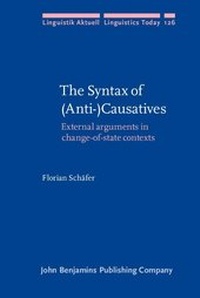
The Syntax of (Anti-)Causatives
External arguments in change-of-state contexts
1st Edition
Published on 26. June 2008
XI, 324 pages
978-90-272-9070-0 (ISBN)
Description

This book develops an approach to the causative alternation that assumes syntactic event decomposition and a configurational theta theory. It is couched within the framework of the Minimalist Program and, especially, within Distributed Morphology. Central to the work is the syntax and semantics of canonical external arguments of causative verbs as well as of oblique causers and causative PPs in the context of anticausative verbs in different languages such as Germanic, Romance, Balkan, and Caucasian languages. The book also develops a new account of the origin and nature of the morphological marking which is often found on anticausatives across languages. The main claim is that this morphology is a reflex of a syntactic way to prohibit the assignment of the external theta role. Moreover, the book develops an account about the origin of the implicit agent in generic middles which often bear the same morphology as marked anticausatives.
More details
Other editions
Additional editions
Book
06/2008
John Benjamins Publishing Co
€127.20
Shipment within 10-15 days
Person
Content
- The Syntax of (Anti-)Causatives
- Editorial page
- Title page
- LCC data
- Table of contents
- Acknowledgements
- List of abbreviations
- Introduction
- Chapter 1. The morphological patterns of anticausatives and their interpretation
- 1.1 The causative alternation
- 1.2 The causative alternation in German
- 1.3 Theories about the derivational relation between causatives and anticausatives
- 1.4 Semantic effects of anticausative morphology
- 1.4.1 Anticausatives in Italian
- 1.4.2 Anticausatives in French
- 1.4.3 Anticausatives in Greek
- 1.4.4 Conclusion and outlook
- 1.4.5 Anticausatives in German
- Chapter 2. The dative causer construction
- 2.1 Datives in the context of unmarked anticausatives and non-alternating unaccusative verbs
- 2.2 Datives in the context of marked anticausative verbs
- 2.3 The absence of the unintentional causer reading: Semantic blocking?
- 2.3.1 Do marked anticausatives involve external argument semantics?
- 2.3.2 Causer vs. causing event
- 2.3.2.1 Causative constructions without an external argument
- 2.3.2.1.1 The adversity causative in Japanese. Lexical causatives in Japanese as in (45) have, besides their ordinary causativ
- 2.3.2.1.2 The desiderative construction in Finnish. In Finnish it is possible to add a causative morpheme to an unergative ver
- 2.3.2.2 Is the dative causer blocked by a causative event?
- 2.3.3 Interim conclusion
- 2.4 Language comparison: Datives in anticausative structures
- 2.4.1 Introduction
- 2.4.2 The language survey ,
- Chapter 3. Datives and changes of state
- 3.1 Datives as specifiers of applicative heads
- 3.1.1 Low applicatives
- 3.1.2 Affected datives
- 3.1.3 Unintentional causer datives as high applicatives
- 3.2 Interim summary and some open questions
- 3.3 An alternative view on the unintentional dative causer
- 3.4 A typology of external arguments of causative events
- 3.5 Some crosslinguistic relatives of the dative causer
- 3.6 Conclusions: The syntax and semantics of the unintentional causer construction
- Chapter 4. The causative alternation
- 4.1 The core theory of (anti-)causatives
- 4.1.1 Problems for derivational analyses
- 4.1.1.1 Morphological marking
- 4.1.1.2 Verb restrictions and selection restrictions
- 4.1.1.3 PP-modification in passives and anticausatives
- 4.1.1.3.1 PP-modification in English.
- 4.1.1.3.2 PP-modification in German.
- 4.1.1.3.3 PP-modification in Greek.
- 4.1.1.4 Crosslinguistic differences in verb restrictions and selection restrictions
- 4.1.1.5 Interim conclusion
- 4.1.2 On the event decomposition of (anti-)causatives
- 4.1.3 The syntax of (anti-) causatives
- 4.2 Comments on the categorization of Roots
- 4.3 Comments on the decomposition of (anti-)causatives
- 4.3.1 The dative causer revisited
- Chapter 5. The syntax of marked anticausatives: Part I
- 5.1 The origin of anticausative morphology
- 5.1.1 Lexicalist accounts of the causative alternation revisited
- 5.1.2 The marked / unmarked contrast from a typological perspective
- 5.2 The phrase-structural representation of anticausative morphology
- 5.2.1 The morpho-syntactic properties of German marked anticausatives
- 5.2.1.1 Semantic intransitivity
- 5.2.1.2 Syntactic transitivity
- 5.2.1.3 Reflexive anticausatives: Resolving the contradiction
- 5.2.2 A typology of Voice
- 5.3 German marked anticausatives meet the unaccusativity diagnostics
- 5.3.1 Auxiliary selection
- 5.3.2 Prenominal past participle
- 5.3.3 Was-f r split
- 5.3.3.1 A further problem with the was-f r split
- 5.3.4 Split-NPs
- 5.3.5 Topicalization of Subject + Participle II
- 5.3.6 Passive n
- 5.3.7 Datives n
- 5.3.8 nom-dat order
- 5.3.9 Resultatives
- 5.3.10 The weak/strong reading of indefinites and bare plurals
- 5.3.11 Unaccusativity tests: Conclusion
- Chapter 6. Generic middles
- 6.1 The core characteristics of middles
- 6.2 Syntactic accounts
- 6.3 Pre-syntactic/lexicalist accounts
- 6.4 The source of the middle agent in a non-lexicalist framework
- 6.4.1 The causative alternation and the syntax of marked anticausatives
- 6.4.2 Middles at the C-I interface
- 6.4.2.1 Agentive Roots and V + Theme combinations
- 6.4.2.2 Verbs forming unmarked anticausatives
- 6.4.2.3 Verbs forming marked anticausatives
- 6.4.3 The source of the agent implicature
- 6.5 Unmarked middles in English and Dutch
- 6.6 A short discussion of impersonal middles
- Chapter 7. The syntax of marked anticausatives: Part II
- 7.1 Introduction
- 7.2 External argument reduction within a configurational theta theory
- 7.2.1 Binding theory
- 7.2.2 Verbal agreement and case
- 7.2.3 The derivations
- 7.2.4 Case under phase theory
- 7.3 Motivating the derivation of non-thematic reflexives
- 7.3.1 Dative causers again
- 7.3.1.1 A further note on dative antecedents
- 7.3.2 Scrambling and raising
- 7.3.3 Long-distance binding
- 7.4 The es-construction and the stray accusative construction
- 7.4.1 The causative alternation in Icelandic
- 7.4.2 Syntactic transitivity
- 7.4.3 Semantic transitivity
- 7.4.4 The origin of the FATE semantics
- 7.5 Conclusion
- References
- Index of names
- Index of subjects
- The series Linguistik Aktuell
