

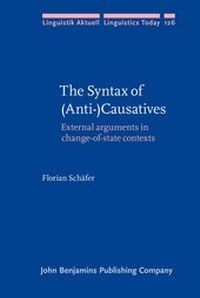
The Syntax of (Anti-)Causatives
External arguments in change-of-state contexts
Published on 26. June 2008
Book
Hardback
324 pages
978-90-272-5509-9 (ISBN)
Description
This book develops an approach to the causative alternation that assumes syntactic event decomposition and a configurational theta theory. It is couched within the framework of the Minimalist Program and, especially, within Distributed Morphology. Central to the work is the syntax and semantics of canonical external arguments of causative verbs as well as of oblique causers and causative PPs in the context of anticausative verbs in different languages such as Germanic, Romance, Balkan, and Caucasian languages. The book also develops a new account of the origin and nature of the morphological marking which is often found on anticausatives across languages. The main claim is that this morphology is a reflex of a syntactic way to prohibit the assignment of the external theta role. Moreover, the book develops an account about the origin of the implicit agent in generic middles which often bear the same morphology as marked anticausatives.
More details
Series
Language
English
Place of publication
Amsterdam
Netherlands
Target group
College/higher education
Dimensions
Height: 245 mm
Width: 164 mm
Weight
760 gr
ISBN-13
978-90-272-5509-9 (9789027255099)
Copyright in bibliographic data and cover images is held by Nielsen Book Services Limited or by the publishers or by their respective licensors: all rights reserved.
Schweitzer Classification
Other editions
Additional editions
E-Book
06/2008
1st Edition
John Benjamins Publishing Company
€149.99
Available for download
Person
Content
1. Acknowledgements; 2. List of abbreviations; 3. Introduction; 4. Chapter 1. The morphological patterns of anticausatives and their interpretation; 5. Chapter 2. The dative causer construction; 6. Chapter 3. Datives and changes of state; 7. Chapter 4. The causative alternation; 8. Chapter 5. The syntax of marked anticausatives: Part I; 9. Chapter 6. Generic middles; 10. Chapter 7. The syntax of marked anticausatives: Part II; 11. References; 12. Index of names; 13. Index of subjects