

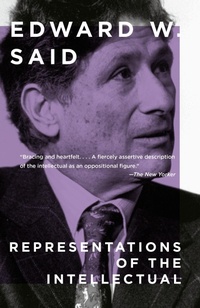
Representations of the Intellectual
The 1993 Reith Lectures
Published on 24. October 2012
144 pages
978-0-307-82962-7 (ISBN)
Description

In these six essays--delivered on the BBC as the prestigious Reith Lectures--Edward Said addresses the ways in which the intellectual can best serve society in the light of a heavily compromised media and of special interest groups who are protected at the cost of larger community concerns. Said suggests a recasting of the intellectual's vision to resist the lures of power, money, and specialization.
In these pieces, Said eloquently illustrates his arguments by drawing on such writers as Antonio Gramsci, Jean-Paul Sartre, Regis Debray, Julien Benda, and Theodore Adorno, and by discussing current events and celebrated figures in the world of science and politics: Robert Oppenheimer, Henry Kissinger, Dan Quayle, Vietnam and the Gulf War. Said sees the modern intellectual as an editor, journalist, academic, or political adviser--in other words, a highly specialized professional--who has moved from a position of independence to an alliance with powerful corporate, institutional, or governmental organizations. He concludes that it is the exile-immigrant, the expatriate, and the amateur who must uphold the traditional role of the intellectual as the voice of integrity and courage, able to speak out against those in power.
In these pieces, Said eloquently illustrates his arguments by drawing on such writers as Antonio Gramsci, Jean-Paul Sartre, Regis Debray, Julien Benda, and Theodore Adorno, and by discussing current events and celebrated figures in the world of science and politics: Robert Oppenheimer, Henry Kissinger, Dan Quayle, Vietnam and the Gulf War. Said sees the modern intellectual as an editor, journalist, academic, or political adviser--in other words, a highly specialized professional--who has moved from a position of independence to an alliance with powerful corporate, institutional, or governmental organizations. He concludes that it is the exile-immigrant, the expatriate, and the amateur who must uphold the traditional role of the intellectual as the voice of integrity and courage, able to speak out against those in power.
More details
Other editions
Additional editions
Book
04/1996
Vintage Books
€18.50
Shipment within 10-20 days

Edward W. Said | Shelley Wanger
Representations of the Intellectual
Book
08/1994
Pantheon Books
€38.40
Article exhausted; check different version
Person
Edward W. Said was born in 1935 in Jerusalem, raised in Jerusalem and Cairo, and educated in the United States, where he attended Princeton (B.A. 1957) and Harvard (M.A. 1960; Ph.D. 1964). In 1963, he began teaching at Columbia University, where he was University Professor of English and Comparative Literature. He died in 2003 in New York City.
He is the author of twenty-two books which have been translated into 35 languages, including Orientalism (1978); The Question of Palestine (1979); Covering Islam (1980); The World, the Text, and the Critic (1983); Culture and Imperialism (1993); Peace and Its Discontents: Essays on Palestine and the Middle East Peace Process (1996); and Out of Place: A Memoir (1999). Besides his academic work, he wrote a twice-monthly column for Al-Hayat and Al-Ahram; was a regular contributor to newspapers in Europe, Asia, and the Middle East; and was the music critic for The Nation.
He is the author of twenty-two books which have been translated into 35 languages, including Orientalism (1978); The Question of Palestine (1979); Covering Islam (1980); The World, the Text, and the Critic (1983); Culture and Imperialism (1993); Peace and Its Discontents: Essays on Palestine and the Middle East Peace Process (1996); and Out of Place: A Memoir (1999). Besides his academic work, he wrote a twice-monthly column for Al-Hayat and Al-Ahram; was a regular contributor to newspapers in Europe, Asia, and the Middle East; and was the music critic for The Nation.
Content
- Intro
- Other Books by This Author
- About the Author
- Title Page
- Copyright
- Dedication
- Contents
- Introduction
- I: Representations of the Intellectual
- II: Holding Nations and Traditions at Bay
- III: Intellectual Exile: Expatriates and Marginals
- IV: Professionals and Amateurs
- V: Speaking Truth to Power
- VI: Gods That Always Fail
