


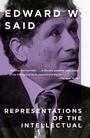
Representations of the Intellectual
The 1993 Reith Lectures
Published on 2. April 1996
Book
Paperback/Softback
144 pages
978-0-679-76127-3 (ISBN)
Description
In these impassioned and inspiring essays, based on his 1993 Reith Lectures, Edward Said explores what it means to be an intellectual today.
Are intellectuals merely the servants of special interests or do they have a larger responsibility? In these wide-ranging essays, one of our most brilliant and fiercely independent public thinkers addresses this question with extraordinary eloquence. Said sees the the intellectual as an exile and amateur whose role it is "to speak the truth to power" even at the risk of ostracism or imprisonment. Drawing on the examples of Jonathan Swift and Theodor Adorno, Robert Oppenheimer and Henry Kissinger, Vietnam and the Gulf War, Said explores the implications of this idea and shows what happens when intellectuals succumb to the lures of money, power, or specialization.
Are intellectuals merely the servants of special interests or do they have a larger responsibility? In these wide-ranging essays, one of our most brilliant and fiercely independent public thinkers addresses this question with extraordinary eloquence. Said sees the the intellectual as an exile and amateur whose role it is "to speak the truth to power" even at the risk of ostracism or imprisonment. Drawing on the examples of Jonathan Swift and Theodor Adorno, Robert Oppenheimer and Henry Kissinger, Vietnam and the Gulf War, Said explores the implications of this idea and shows what happens when intellectuals succumb to the lures of money, power, or specialization.
More details
Language
English
Place of publication
New York
United States
Publishing group
Random House USA Inc
Target group
College/higher education
Product notice
Paperback (trade)
Dimensions
Height: 203 mm
Width: 132 mm
Thickness: 11 mm
Weight
168 gr
ISBN-13
978-0-679-76127-3 (9780679761273)
Copyright in bibliographic data and cover images is held by Nielsen Book Services Limited or by the publishers or by their respective licensors: all rights reserved.
Schweitzer Classification
Other editions
Additional editions
E-Book
10/2012
Vintage
€16.99
Available for download
Person
Edward W. Said was born in 1935 in Jerusalem, raised in Jerusalem and Cairo, and educated in the United States, where he attended Princeton (B.A. 1957) and Harvard (M.A. 1960; Ph.D. 1964). In 1963, he began teaching at Columbia University, where he was University Professor of English and Comparative Literature. He died in 2003 in New York City.
He is the author of twenty-two books which have been translated into 35 languages, including Orientalism (1978); The Question of Palestine (1979); Covering Islam (1980); The World, the Text, and the Critic (1983); Culture and Imperialism (1993); Peace and Its Discontents: Essays on Palestine and the Middle East Peace Process (1996); and Out of Place: A Memoir (1999). Besides his academic work, he wrote a twice-monthly column for Al-Hayat and Al-Ahram; was a regular contributor to newspapers in Europe, Asia, and the Middle East; and was the music critic for The Nation.
He is the author of twenty-two books which have been translated into 35 languages, including Orientalism (1978); The Question of Palestine (1979); Covering Islam (1980); The World, the Text, and the Critic (1983); Culture and Imperialism (1993); Peace and Its Discontents: Essays on Palestine and the Middle East Peace Process (1996); and Out of Place: A Memoir (1999). Besides his academic work, he wrote a twice-monthly column for Al-Hayat and Al-Ahram; was a regular contributor to newspapers in Europe, Asia, and the Middle East; and was the music critic for The Nation.