

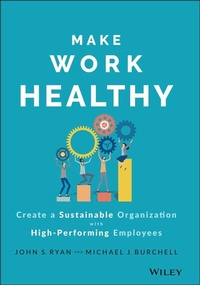
Make Work Healthy
Create a Sustainable Organization with High-Performing Employees
1st Edition
Published on 21. March 2023
304 pages
978-1-119-98982-0 (ISBN)
Description

Reach new levels of organizational productivity and achievement by redefining the phrase "workplace health"
In Make Work Healthy, a team of distinguished organizational transformation professionals delivers an insightful how-to manual for improving organizational performance with a new approach to workforce management. The book offers organizations, leaders, and managers with the knowledge, data, frameworks, and methodologies they need to radically transform how they approach day-to-day operations into a sustainable and resilient business success model.
The authors focus on workplace health--in a broad sense--as a way of focusing organizational attention on culture, building work capacity, productivity, and sustainability. They explain the tangible business value that comes from focusing on wellbeing as well as the symbiotic relationship between organizational health and employee health. Make Work Healthy includes:
* Strategies for moving beyond typical "wellness" initiatives such as just addressing illness and absence reduction to a more holistic understanding of "healthy work"
* Ways to locate, attract, recruit, and retain talent over the long-term by aligning organizational goals with employee health
* Tactics to help managers of dispersed, hybrid, and remote teams manage feelings of pressure and isolation
An indispensable, effective, and holistic new take on organizational and employee health, Make Work Healthy will earn a place in the hands of managers, executives, board members, and other business and human resources leaders who seek impressive gains in company productivity and fulfilment.
In Make Work Healthy, a team of distinguished organizational transformation professionals delivers an insightful how-to manual for improving organizational performance with a new approach to workforce management. The book offers organizations, leaders, and managers with the knowledge, data, frameworks, and methodologies they need to radically transform how they approach day-to-day operations into a sustainable and resilient business success model.
The authors focus on workplace health--in a broad sense--as a way of focusing organizational attention on culture, building work capacity, productivity, and sustainability. They explain the tangible business value that comes from focusing on wellbeing as well as the symbiotic relationship between organizational health and employee health. Make Work Healthy includes:
* Strategies for moving beyond typical "wellness" initiatives such as just addressing illness and absence reduction to a more holistic understanding of "healthy work"
* Ways to locate, attract, recruit, and retain talent over the long-term by aligning organizational goals with employee health
* Tactics to help managers of dispersed, hybrid, and remote teams manage feelings of pressure and isolation
An indispensable, effective, and holistic new take on organizational and employee health, Make Work Healthy will earn a place in the hands of managers, executives, board members, and other business and human resources leaders who seek impressive gains in company productivity and fulfilment.
More details
Other editions
Additional editions
JS Ryan
Make Work Healthy - Create a Sustainable Organization with High-Performing Employees
Create a Sustainable Organization with High-Performing Employees
Book
03/2023
1st Edition
Wiley
€26.50
Shipment within 15-20 days
Persons
JOHN S. RYAN is the Chief Executive Officer at Healthy Place to Work. He formerly led Great Place to Work Ireland and was a broadcast journalist. He is a regular international speaker and media contributor in Wellbeing, Trust, and Organizational Performance.
MICHAEL J. BURCHELL, EdD, is an independent consultant and executive coach. He is an expert in organizational change, well-being, team effectiveness, and DEI. He is the co-author of No Excuses: How You Can Turn Any Workplace Into a Great One and The Great Workplace: How to Build It, How to Keep It, and Why It Matters.
MICHAEL J. BURCHELL, EdD, is an independent consultant and executive coach. He is an expert in organizational change, well-being, team effectiveness, and DEI. He is the co-author of No Excuses: How You Can Turn Any Workplace Into a Great One and The Great Workplace: How to Build It, How to Keep It, and Why It Matters.
Content
- Cover
- Title Page
- Copyright Page
- Contents
- Introduction: A Critical Moment
- The Problem with Leaders
- What You Can Expect from This Book
- Part I
- Chapter 1 The Ultimate Driver of Organizational Performance
- Defining "Healthy Workplace"
- Knowing versus Doing
- Modeling the Healthy Way
- Demonstrating Care as Leaders
- Why Talk about Health Now?
- Chapter 2 Why Work Isn't Working
- Pandemic Overload and Other Extraordinary Demands
- The Horrible Micromanaging Boss
- No Room for Difference
- Ultimate Betrayals
- The Stress of the Daily Grind
- Social Pollution
- Chapter 3 How Work Can Be the Solution
- Thinking About Work in Terms of Energy
- One of Our Biggest Health Decisions
- Finding a Role That Helps You Flourish
- Take the Expert Assessment Quiz
- Wilmar Schaufeli
- Chapter 4 The Evolution of Workforce Health
- The Concept of "a Good and Virtuous Life" in Ancient Times
- Well-being Beginnings in Spain and Italy
- Developments in Great Britain During the Industrial Revolution
- Improvements in the Early Part of the Twentieth Century
- Changes in the United States After the World Wars
- Studies and Research from Governments and Universities
- Challenges in the Twenty-first Century
- Chapter 5 Salutogenesis: A New Model for Workplace Health
- A Pathogenic Orientation versus a Salutogenic Orientation
- The Ease to Dis-ease Continuum
- Salutogenesis in an Organizational Context
- Georg Bauer, MD, DrPH
- Part II
- Chapter 6 Accelerating to Success: Where Some Get It Right and Others Get It Wrong
- Knowing What Successful Organizations Do
- Avoiding Common Mistakes
- Ron Goetzel
- Chapter 7 The Symbiotic Relationship of Workforce and Workplace Health
- Individual Health Factors
- Organizational Health Factors
- Putting It All Together
- Chapter 8 The Development Scale: Where Is Your Organization?
- Leadership
- Ownership
- Investment
- Approach
- Interventions
- Shows Up As: How Managers Think About Organizational Health
- Employer Perception of Employees
- Peter Cheese
- Chapter 9 A New Lens: Individual and Organizational Measures
- Unhealthy to Healthy: An Overview of the Journey
- The Crucial Steps to Becoming a Healthy Workplace
- Dave Ulrich
- Jeffrey Pfeffer
- Chapter 10 From Unhealthy to Healthy: A Plan for Success
- Characteristics of Effective Change
- Core Considerations for a Healthy Plan
- Mapping the Terrain
- The Journey Continues
- Paul Litchfield
- Chapter 11 Healthy Interventions
- Moving from "Normal" to an Equity Lens
- Healthy Interventions Based on the Data
- Chapter 12 Stories of Healthy Success
- Centiro, Sweden, Organizational Design
- Thames Water Company, United Kingdom, Workforce Analytics
- Deloitte, United States, Healthy Sponsorship
- Aviva, United Kingdom, Net Positive Work
- IIH Nordic, Denmark, Four-day Workweek
- Takeda, Switzerland, Responding to Presenting Needs
- Cohesive, the Netherlands, Healthy Manager Conversations
- P&G, Latin America, Incentivizing Healthy Behaviors
- SAP, Ireland, Neurodiversity
- RSPCA, United Kingdom, Trauma Support
- Concentrix, Global, Flexible Working
- Futurice, Finland, Healthy Clients
- SAS Institute, United States, Recruit Well-being
- Amêndoas do Brasil, Brazil, A Culture of Well-being
- Leek United Building Society, United Kingdom, Healthy Strategy
- ISS, Denmark, Diversity at Its Core
- PwC, Building a Very Personalized Learning Future
- Kingston Council, United Kingdom, Leading the Way
- Danske Bank, United Kingdom, Podcasting Health
- Dubai Police, United Arab Emirates, Physical Readiness
- Version 1, Europe, a Healthy Strategy
- Chapter 13 A Deep Dive into the Science of Well-being
- Purpose
- Mental Resilience
- Connection
- Physical Health
- The Four Pillars and 21 Elements
- Dr. Els van der Helm
- Arnold Bakker
- International Well Building Institute
- Chapter 14 A Healthy Conclusion
- A Different Approach
- The Pandemic: Heroes Take a Bow and Workers Deliver Again
- A Need for a Major Shift
- Board Members' Roles and Responsibilities
- A Legacy in the Making
- Jim Loehr
- Notes
- Appendix: Assessment and Impact
- Context
- Method
- Key Findings
- Summary
- Acknowledgments
- About the Authors
- Index
- EULA
