

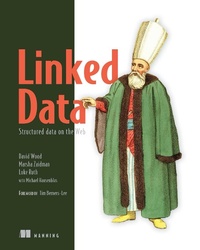
Linked Data
Structured data on the Web
Published on 30. December 2013
336 pages
978-1-63835-216-7 (ISBN)
Description

Summary
Linked Data presents the Linked Data model in plain, jargon-free language to Web developers. Avoiding the overly academic terminology of the Semantic Web, this new book presents practical techniques, using everyday tools like JavaScript and Python.
About this Book
The current Web is mostly a collection of linked documents useful for human consumption. The evolving Web includes data collections that may be identified and linked so that they can be consumed by automated processes. The W3C approach to this is Linked Data and it is already used by Google, Facebook, IBM, Oracle, and government agencies worldwide.
Linked Data presents practical techniques for using Linked Data on the Web via familiar tools like JavaScript and Python. You'll work step-by-step through examples of increasing complexity as you explore foundational concepts such as HTTP URIs, the Resource Description Framework (RDF), and the SPARQL query language. Then you'll use various Linked Data document formats to create powerful Web applications and mashups.
Written to be immediately useful to Web developers, this book requires no previous exposure to Linked Data or Semantic Web technologies.
Purchase of the print book includes a free eBook in PDF, Kindle, and ePub formats from Manning Publications.
What's Inside
About the Authors
David Wood is co-chair of the W3C's RDF Working Group. Marsha Zaidman served as CS chair at University of Mary Washington. Luke Ruth is a Linked Data developer on the Callimachus Project. Michael Hausenblas led the Linked Data Research Centre.
Table of Contents
Linked Data presents the Linked Data model in plain, jargon-free language to Web developers. Avoiding the overly academic terminology of the Semantic Web, this new book presents practical techniques, using everyday tools like JavaScript and Python.
About this Book
The current Web is mostly a collection of linked documents useful for human consumption. The evolving Web includes data collections that may be identified and linked so that they can be consumed by automated processes. The W3C approach to this is Linked Data and it is already used by Google, Facebook, IBM, Oracle, and government agencies worldwide.
Linked Data presents practical techniques for using Linked Data on the Web via familiar tools like JavaScript and Python. You'll work step-by-step through examples of increasing complexity as you explore foundational concepts such as HTTP URIs, the Resource Description Framework (RDF), and the SPARQL query language. Then you'll use various Linked Data document formats to create powerful Web applications and mashups.
Written to be immediately useful to Web developers, this book requires no previous exposure to Linked Data or Semantic Web technologies.
Purchase of the print book includes a free eBook in PDF, Kindle, and ePub formats from Manning Publications.
What's Inside
- Finding and consuming Linked Data
- Using Linked Data in your applications
- Building Linked Data applications using standard Web techniques
About the Authors
David Wood is co-chair of the W3C's RDF Working Group. Marsha Zaidman served as CS chair at University of Mary Washington. Luke Ruth is a Linked Data developer on the Callimachus Project. Michael Hausenblas led the Linked Data Research Centre.
Table of Contents
- Introducing Linked Data
- RDF: the data model for Linked
- Consuming Linked Data
- Creating Linked Data with
- SPARQL?querying the Linked
- Enhancing results from search
- RDF database fundamentals
- Datasets
- Callimachus: a Linked Data
- Publishing Linked Data?a recap
- The evolving Web
More details
Other editions
Additional editions
Book
01/2014
Manning Publications
€47.00
Article exhausted; check different version
Persons
Luke Ruth is a Linked Data developer supporting the Callimachus Project.
David Wood architected the first large-scale RDF database, re-architected the Persistent URL service to support Linked Data, and co-founded the Callimachus Project. He is also the co-chair of the World Wide Web Consortium's RDF Working Group.
Marsha Zaidman is Associate Professor Emerita of Computer Science at the University of Mary Washington, where she served as chair of the Department of Computer Science from 1997 to 2009.
Michael Hausenblas is a Solution Engineering Lead in the AWS open source observability service team. He covers Prometheus, Grafana, and OpenTelemetry upstream and in managed services. Before Amazon, Michael worked at Red Hat, Mesosphere (now D2iQ), and MapR.
David Wood architected the first large-scale RDF database, re-architected the Persistent URL service to support Linked Data, and co-founded the Callimachus Project. He is also the co-chair of the World Wide Web Consortium's RDF Working Group.
Marsha Zaidman is Associate Professor Emerita of Computer Science at the University of Mary Washington, where she served as chair of the Department of Computer Science from 1997 to 2009.
Michael Hausenblas is a Solution Engineering Lead in the AWS open source observability service team. He covers Prometheus, Grafana, and OpenTelemetry upstream and in managed services. Before Amazon, Michael worked at Red Hat, Mesosphere (now D2iQ), and MapR.
Content
- Intro
- Copyright
- Brief Table of Contents
- Table of Contents
- Foreword
- Preface
- Acknowledgments
- About this Book
- About the Cover Illustration
- Part 1. The Linked Data Web
- Chapter 1. Introducing Linked Data
- Chapter 2. RDF: the data model for Linked Data
- Chapter 3. Consuming Linked Data
- Part 2. Taming Linked Data
- Chapter 4. Creating Linked Data with FOAF
- Chapter 5. SPARQL-querying the Linked Data Web
- Part 3. Linked Data in the wild
- Chapter 6. Enhancing results from search engines
- Chapter 7. RDF database fundamentals
- Chapter 8. Datasets
- Part 4. Pulling it all together
- Chapter 9. Callimachus: a Linked Data management system
- Chapter 10. Publishing Linked Data-a recap
- Chapter 11. The evolving Web
- Appendix A. Development environments
- Appendix B. SPARQL results formats
- Glossary
- Index
- List of Figures
- List of Tables
- List of Listings
