

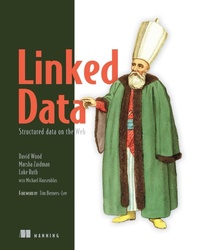
Linked Data
Structured Data on the Web
Published on 16. January 2014
Book
Paperback/Softback
425 pages
978-1-61729-039-8 (ISBN)
Description
DESCRIPTION
Linked Data is a standards-driven model for representing structured data on the Web that gives developers, publishers, and information architects a consistent, predictable way to publish, merge and consume data. It's been adopted by many well-known institutions, including Google, Facebook, IBM, Oracle, and government agencies, as well projects such as Drupal and WordPress.
Linked Data presents the Linked Data model in plain, jargon-free language and offers practical techniques using everyday tools like JavaScript and Python. It works through examples of increasing complexity while explaining foundational concepts such as HTTP URIs, the Resource Description Framework (RDF), and the SPARQL query language. Readers will learn to use various Linked Data document formats to create powerful Web applications and mashups, and to effectively use emerging Web standards to access, find, and query structured data on the Web.
RETAIL SELLING POINTS
Written by Web developers for web developers
A step-by-step, hands-on guide to using Linked Data
Shows how to utilize the power of tomorrow's Web today
AUDIENCE
Written for Web developers by Web developers, this book requires no previous exposure to Linked Data technologies.
ABOUT THE TECHNOLOGY
The launch of Schema.org in June 2011 by Google, Microsoft and Yahoo! and the publication of Linked Data by retailers such as Best Buy, Sears and Volkswagen brought Linked Data into the mainstream. Linked Data is a standards-driven model for representing structured data on the Web that gives developers, publishers, and information architects a consistent, predictable way to publish, merge and consume data.
Linked Data is a standards-driven model for representing structured data on the Web that gives developers, publishers, and information architects a consistent, predictable way to publish, merge and consume data. It's been adopted by many well-known institutions, including Google, Facebook, IBM, Oracle, and government agencies, as well projects such as Drupal and WordPress.
Linked Data presents the Linked Data model in plain, jargon-free language and offers practical techniques using everyday tools like JavaScript and Python. It works through examples of increasing complexity while explaining foundational concepts such as HTTP URIs, the Resource Description Framework (RDF), and the SPARQL query language. Readers will learn to use various Linked Data document formats to create powerful Web applications and mashups, and to effectively use emerging Web standards to access, find, and query structured data on the Web.
RETAIL SELLING POINTS
Written by Web developers for web developers
A step-by-step, hands-on guide to using Linked Data
Shows how to utilize the power of tomorrow's Web today
AUDIENCE
Written for Web developers by Web developers, this book requires no previous exposure to Linked Data technologies.
ABOUT THE TECHNOLOGY
The launch of Schema.org in June 2011 by Google, Microsoft and Yahoo! and the publication of Linked Data by retailers such as Best Buy, Sears and Volkswagen brought Linked Data into the mainstream. Linked Data is a standards-driven model for representing structured data on the Web that gives developers, publishers, and information architects a consistent, predictable way to publish, merge and consume data.
More details
Other editions
Additional editions
E-Book
12/2013
Manning
€49.44
Available for download
Persons
AUTHOR BIO
David Wood architected the first large-scale RDF database (http://mulgara.org), re-architected the Persistent URL service (http://purl.org, http://purlz.org) to support Linked Data, and co-founded the Callimachus Project (http://callimachusproject.org). He is co-chair of the World Wide Web Consortium's RDF Working Group ( http://w3.org/2011/rdf-wg/).
Marsha Zaidman is Associate Professor Emerita of Computer Science at the University of Mary Washington, where she served as chair of the Department of Computer Science from 1997 to 2009.
Luke Ruth is a Linked Data developer supporting the Callimachus Project (http://callimachusproject.org).
Michael Hausenblas leads the Linked Data Research Centre in Galway, Ireland. He is the project coordinator of the European Commission FP7 Support Action LOD Around-The-Clock (LATC) and other W3C standardization activities.
David Wood architected the first large-scale RDF database (http://mulgara.org), re-architected the Persistent URL service (http://purl.org, http://purlz.org) to support Linked Data, and co-founded the Callimachus Project (http://callimachusproject.org). He is co-chair of the World Wide Web Consortium's RDF Working Group ( http://w3.org/2011/rdf-wg/).
Marsha Zaidman is Associate Professor Emerita of Computer Science at the University of Mary Washington, where she served as chair of the Department of Computer Science from 1997 to 2009.
Luke Ruth is a Linked Data developer supporting the Callimachus Project (http://callimachusproject.org).
Michael Hausenblas leads the Linked Data Research Centre in Galway, Ireland. He is the project coordinator of the European Commission FP7 Support Action LOD Around-The-Clock (LATC) and other W3C standardization activities.