

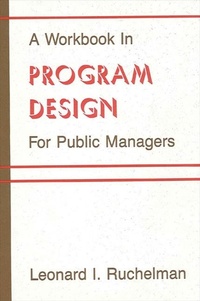
A Workbook in Program Design for Public Managers
Description

>
Leonard I. Ruchelman is Professor of Urban Studies and Public Administration at Old Dominion University.
More details
Other editions
Additional editions
Person
Leonard I. Ruchelman is Professor of Urban Studies and Public Administration at Old Dominion University.
Content
Preface
1. Introduction
What is Program Design
Program Design as Planned Change
Approaches for Understanding the Process of Change
The Program Design Process
2. Getting Started
Step 1-Selecting a Problem Area for Analysis
Step 2-Organizing for Program Design
Summary
3. Diagnosing the Organizational Setting
Step 1-Describing the Performance Gap
Step 2-Rating Individual Factors
Step 3-Rating Organizational Factors
Step 4-Identifying Environmental Factors
Step 5- the Feasibility of a program Design Project
Summary
4. Generating Public Support
Step 1-Restating the Problem as an Issue
Step 2-Identifying the Likely Actors
Step 3-Estimating the Issue Position, Power and Salience of Each Actor
Step 4-Calculating Weights and Probabilities
Step 5-Identifying Strategies
Summary
5. Preparing a Workplan
Step 1-Defining the Problem
Step 2-Describing the Current Program
Step 3-Establishing the Project Scope
Step 4-Describing the Program Design Methodology
Step 5-Establishing and Assigning Work Tasks
Step 6-Approving the Workplan
Summary
6. Establishing Goals, Objectives and Performance Criteria
Step 1-Reviewing Program Material
Step 2-Defining Program Goals
Step 3-Defining Program Objectives
Step 4-Establishing Performance Criteria
Summary
7. Developing Program Alternatives
Step 1-Generating Program Alternatives
Step 2-Screening Program Alternatives
Step 3-Forecasting
Step 4-Categorizing Alternatives
Summary
8. Data Collection
Step 1-Estimating Service Demand
Step 2-Estimating Costs
Step 3-Collecting Effectiveness Data
Step 4-Collecting Feasibility information
Summary
9. Synthesizing the Data
Step 1-Organizing the Data
Step 2-Comparing the Data
Step 3-Drawing Conclusions
Summary
10. Communicating the Results
Step 1-Preparing the Draft Report
Step 2-Reviewing the Draft Report
Step 3- Transmitting the Final Report
Summary
11. Preparing for Implementation
Step 1-Forming an Implementation Team
Step 2-Preparing an Implementation Workplan
Step 3-Methods for Monitoring Implementation Progress
Step 4-Follow-up Strategies
Summary and Conclusions
Appendix A. Guide to Information Sources in Public Services
Appendix B. Guide to Information Sources in Human Services
Appendix C. Search Services
Appendix D. Sample Program Design Report
Glossary
Annotated Bibliography
