

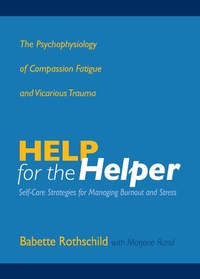
Help for the Helper
The Psychophysiology of Compassion Fatigue and Vicarious Trauma
1st Edition
Published on 4. December 2020
272 pages
978-0-393-71270-4 (ISBN)
Description

How empathy can jeopardize a therapist's well-being.
Therapist burnout is a pressing issue, and self-care is possible only when therapists actively help themselves. The authors examine the literature from neurobiology, social psychology, and folk psychology in order to explain how therapists suffer from an excess of empathy for their clients, and then they present strategies for dealing with burnout and stress.More details
Other editions
New editions
Babette Rothschild
Help for the Helper
Preventing Compassion Fatigue and Vicarious Trauma in an Ever-Changing World: Updated + Expanded
E-Book
12/2022
2nd Edition
W. W. Norton & Company
€26.99
Available for download
Additional editions
Babette Rothschild | Marjorie Rand
Help for the Helper
The Psychophysiology of Compassion Fatigue and Vicarious Trauma
Book
03/2006
WW Norton & Co
€50.95
Article exhausted; check for reprint
Person
Babette Rothschild, MSW, LCSW, is an internationally recognized PTSD specialist and best-selling author of seven books translated into twenty languages. She currently lives in Los Angeles, California.
Content
- Intro
- Title
- Contents
- Preface: Using Common Sense
- Introduction
- Overview
- Organization
- Disclaimer
- Chapter 1: Psychotherapists at Risk
- Therapist Assets and Deficits
- Identifying Terminology
- Countertransference
- Projective Identification
- Empathy
- Chapter 2: Managing the Ties That Bind
- Theory
- The Neurophysiology of Empathy
- Somatic Empathy
- Mirroring and Mimicry
- Skill Building
- Facial and Postural Awareness
- Conscious Postural Mirroring
- Unmirroring
- Chapter 3: Keeping Calm
- Theory
- The Neurophysiology of Arousal
- Skill Building
- Arousal Awareness
- The Therapist's Brakes
- How Close Is Too Close?
- Controlling Empathic Imagery
- Chapter 4: Thinking Clearly
- Theory
- The Neurophysiology of Clear Thinking
- Skill Building
- Know Thyself
- Strengthening the Observer
- Controlling Self-Talk
- Nurturing Your Work Space
- Structured Self-Care
- Chapter 5: Concluding Reflections
- Revisiting Projective Identification
- To Each Her Own Chair
- Evaluating Risks for Vicarious Trauma
- Reversing the Effects of Vicarious Trauma
- Final Words
- Appendix 1: Assessment
- Appendix 2: Pilot Research
- Acknowledgments
- References
- Index
- Also by Babette Rothschild
- Copyright
