

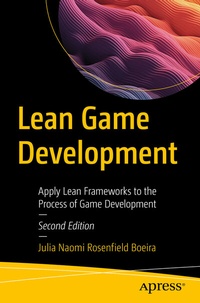
Lean Game Development
Description

Master Lean UX and Lean Startup techniques to improve your agile game development experience beyond Scrum. This updated version of the book focuses on applying lean and agile methodologies to the game development process and features improved examples, applied techniques, and a whole new section explaining how to test a game in Unity with CI.
You'll see how to define a minimum viable product (MVP) for games with Lean Canvas, allowing customers to iterate over it and collect feedback for improvement at every cycle. All of these are achieved while still using standard Agile techniques. The first part of the book explains the ideation process of a game and how lean methodologies allow developers, especially small studios, to avoid scope creep. Next, it it provides guidance on creating MVPs and using player feedback to iterate and improve games. The book then discusses continual improvement (CI) methods. A crucial part of CI is generation of Lean Canvas.
LeanGame Development, Second Edition shows you how to iterate until you develop a game that satisfies developers, gamers, and your studio's financial goals.
What You'll Learn
- Study lean and agile methodologies to enhance the game development process
- Find out how to improve the way game productions define value and iterate over it
- Apply development strategies to enrich the game development process
Who This Book Is For
People from all sectors of the gaming industry will find the book useful in planning their project in a more iterative way, unloading the management burden on the development process and collecting feedback to improve the game content as early as possible.
More details
Other editions
Additional editions
Previous edition
Person
Content
Chapter 1: Introduction.- Chapter 2: First steps with Lean.- Chapter 3: An Inception in practice.- Chapter 4: Do we really need a MVP.- Chapter 5: Examples of MVGs.- Chapter 6: Generating Hypothesis.- Chapter 7: Test Driven Deveopment.- Chapter 8: Continuous Integration.- Chapter 9: The world between Design and Build.- Chapter 10: Test, Code, Test.- Chapter 11: Measuring and Analyzing.- Chapter 12: Creating ideas for iterating.- Chapter 13: Consolidating Knowledge before Expanding.- Chapter 14: More about games.- Chapter 15: Example game using Automated testing for game development.
