

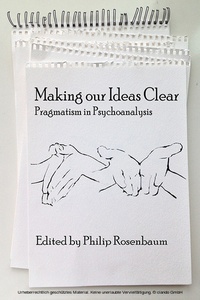
Making Our Ideas Clear
Pragmatism in Psychoanalysis
1st Edition
Published on 1. January 2015
345 pages
978-1-62396-869-4 (ISBN)
Description

This book brings pragmatic theory and praxis into dialogue with contemporary psychodynamic ideas, practitioners, and clinical issues. Generally considered as a historical footnote to psychoanalysis, the chapters in this volume demonstrate pragmatism's continued relevance for contemporary thought. Not only does pragmatism share many of the values and sensibilities of contemporary psychodynamics, its rich philosophical and theoretical emphasis on active meaning making and agentic being in the world complements and extends current thinking about the social nature of self and mind, how we occupy space in the world, non-linear development, and processes of communication.
All prices
More details
Other editions
Additional editions
Book
01/2015
Information Age Publishing
€69.40
Shipment within 3-4 weeks
Content
- Cover
- Making Our Ideas Clear
- Making Our Ideas Clear
- Copyrights
- CONTENTS
- SERIES EDITOR'S PREFACE : CONNECTING CULTURAL PSYCHOLOGY WITH PSYCHOANALYSIS
- TRAJECTORIES FOR THE FUTURE
- REFERENCES
- ACKNOWLEDGEMENTS
- INTRODUCTION : THE EFFECTS OF THE"POST MODERN"TURN IN RELATIONAL PSYCHOANALYSIS
- THE POSTMODERN TURN IN RELATIONAL PSYCHOANALYSIS
- Theoretical Questions and Controversies
- Clinical Questions and Controversies
- WHY PRAGMATISM?
- History of Pragmatism and Psychoanalysis
- Similarities and Differences
- Structure and Aims
- PRAGMATIC BEGINNINGS
- The Pragmatic Maxim
- Some General Features and Differences of Pragmatism
- Active Meaning Making: Thinking as a Tool
- Future Orientation
- Truth and the Importance of Fallibility
- Rejection of the Atomistic Self
- Whatever Works or Does It? Peirce's Pragmatism
- Scientific Process
- Actions and Enactments
- Signs and Intersubjectivity
- Expansion and Contraction: James's Pragmatism
- Pluralism
- Radical Empiricism
- Multiple Selves and Subjectivity
- CONCLUSIONS
- NOTES
- REFERENCES
- I : PRAGMATIC BEGINNINGS: A HISTORICAL OVERVIEW
- 1 : COMPATIBILITY BETWEEN EARLY PSYCHOANALYSIS AND PRAGMATISM
- INTRODUCTION
- PSYCHOANALYSIS
- PHILOSOPHY IN MIND: FREUD'S FORMATIVE YEARS
- THE MEETING THAT ONLY HALF HAPPENED: FREUD AND JAMES
- WILLIAM JAMES' PRAGMATISM
- PRAGMATIST GESTURES IN FREUD'S WORK
- How Can We Read This as Illustrating a Pragmatist Stance?
- . . . AND LATER ON
- NOTES
- REFERENCES
- 2 : SELF AS A SIGN
- INTRODUCTION
- SETTING THE STAGE: WHY STUDY SEMIOTICS?
- PRAGMATISM: HOW WE COME TO KNOW THE WORLD THROUGH SIGNS
- Charles Sanders Peirce-Considerations of Signs
- Peirce's Triadic Definition of the Sign
- Sign Types (Relations)
- Semiosis
- The Role of the Ground and Context
- Learning of Codes and Knowledge
- Peirce's View of Self
- Peirce in Summary
- HARRY STACK SULLIVAN: SEMIOTICS IN PRAXIS
- Conception of Reality and Mediation
- Sullivan's Theory of Signs
- Sullivan's Three Modes of Experience
- Prototaxic Experience
- Parataxic Experiencing
- Syntaxic Mode of Experience
- Sullivan's Consideration of the Self-System
- Self-System as a Semiotic Process
- Me-You Patterns
- Security Operations
- Sullivan in Summary
- CONCLUSIONS: IMPLICATIONS OF COMPARING SULLIVAN'S AND PEIRCE'S SELF
- NOTES
- REFERENCES
- 3 : WILFRED BION
- INTRODUCTION
- WILFRED BION
- Bion's Theory of Thinking and Terminology
- The Beta Space
- Alpha Function
- The Contact Barrier
- Reverie
- Bion's Infinite Series
- CHARLES SANDERS PEIRCE
- Peirce's Development of Semiotics
- The Theory of Signs
- Indexes, Icons, and Symbols
- Infinite Semiosis
- Development of Signs
- Peirce's Theory of Perception
- DISCUSSION
- A Peircean Reading of Perception
- A Peircean Reading of Development
- Clinical Example
- A Bionian Reading of Development
- Nachträglichkeit
- Infinite Series
- CONCLUSIONS
- NOTES
- REFERENCES
- COMMENTARY : COMMENTARY ON PRAGMATISM AND PSYCHOANALYSIS
- PRAGMATIC THEORIZING AND THE HUMAN CONDITION
- SULLIVAN AND PEIRCE: A QUESTION OF SELF
- REFERENCES
- II : APPLYING PRAGM ATIC THEORY TO CONTEMPORARY QUESTIONS
- 4 : DIALOGUE BETWEEN MULTIPLE SELF MODELS
- INTRODUCTION
- The Dialogical Self
- William James and the Self
- The Polyphonic Novel
- Dialogical Relationships
- The Dialogical Self as a Model of the Individual
- I-Positions
- Organization of the Dialogical Self
- The Multivoiced and Social Nature of the Dialogical Self
- The Traumatic Experience of Cancer From the Dialogical Self Perspective
- Destabilization of the Dialogical Self
- Regulation Through the Assumption of I-positions
- The Couple Dyad and I-Positions
- Limitations of the Dialogical Self Model
- MEAD AND THE BASIS FOR A RELATIONAL, MULTIPLE SELF MODEL
- The Social Origins of the Individual
- The Conversation of Gestures and the Significant Symbol
- The Generalized Other
- The "I" and the "Me"
- The Generalized Other and the Social Self
- Multiplicity in the Self
- MEAD AND THE DIALOGICAL SELF
- Similarities to the Dialogical Self
- Contrast With the Dialogical Self
- From Mead to Semiotic Mediation in the Dialogical Self
- Mead's Relevance to the Dialogical Self
- THE RELATIONAL SELF AND THE SEMIOTICALLY MEDIATED DIALOGICAL SELF MODEL
- Self States
- Dialogue Between Multiple Self Models
- The Relevance of Mead
- Semiotic Mediation of Affect
- Semiotic Mediation of the Dialogical Self5
- CONCLUSION
- NOTES
- REFERENCES
- 5 : ACHIEVING PURPOSE IN AN OPEN COSMOS
- INTRODUCTION
- THE SELF AND ITS FIELD
- Sullivan and the Self-System
- James and the "I"
- Pure Experience
- Bud Theory
- EXPERIENCE AND MEANING
- A Thick Universe
- Embodiment
- Finitude
- Encounters With Others
- Spiritual Experiences
- An Open Cosmos
- Tensions That Cause War
- Exertion
- Free Will
- The Moral Equivalent of War
- CONCLUSION: PSYCHOTHERAPY AND THE CREATIVE ADVANCE
- NOTES
- REFERENCES
- 6 : FROM MEANING TO SENSEMAKING
- INTRODUCTION
- THE TRADITIONAL IDEA OF MEANING
- THE AUTONOMY OF MEANING IN PSYCHOANALYSIS
- THE LIMITS OF THE TRADITIONAL VIEW OF MEANING
- THE PRAGMATIST AND DYNAMIC VIEW OF SEMIOSIS: FROM MEANING TO SENSEMAKING
- SIGNIFICANCE IN PRAESENTIA (SIP) AND SIGNIFICANCE IN ABSENTIA (SIA)
- The Variable Boundaries of the SIA
- THE ABDUCTIVE NATURE OF SENSEMAKING
- THE BOOTSTRAPPING MECHANISM OF SENSEMAKING
- IMPLICATIONS FOR THEORY AND THEORY OF TECHNIQUE
- Primary Process, Affects and Sensemaking: Rediscovering Metapsychology
- Clinical Theory in a Semiotic Key: Rethinking Projective Identification
- Considerations of Theory of Technique: A New Look at the Psychoanalytic Interpretation
- CONCLUSIONS
- ACKNOWLEDGMENT
- REFERENCES
- 7 : THE AMERICAN IDEA IN SIBLINGHOOD-INTERPERSONAL PSYCHOANALYSIS AND PRAGMATISM
- INTRODUCTION
- A BRIEF HISTORY OF TWO AMERICAN ORIGINALS, PRAGMATISM AND INTERPERSONAL PSYCHOANALYSIS
- FOUNDATIONS OF INTERPERSONAL PSYCHOANALYSIS
- THE POLITICS OF KNOWING
- EPISTEMOLOGY AND INTERPERSONAL PSYCHOANALYSIS
- Neopragmatism and Psychodynamic Consensus
- NOTES
- REFERENCES
- COMMENTARY : REFLECTIONS ON THE WAYS PRAGMATIC PHILOSOPHY AND INTERPERSONAL PSYCHOANALYSIS ARE "RELATED"
- CLOSE COUSINS
- Experiencing With New I's Through New Relationships
- DISTANT RELATIVES
- Expanding Different Boundaries of the Self
- The View From Different Fields
- THE VIEW FROM MY ANALYTIC HOME
- The Therapeutic Relationship and Curiosity
- The Therapy Relationship and the Opening of the Patient's "I's"
- REFERENCES
- III : PRAGMATIC METHODOLOGY IN CLINICAL WORK
- 8 : THE PSYCHOSEMIOTIC MODELFOR UNDERSTANDING THE BODY-MIND CONTINUUM
- THEORETICAL BACKGROUND
- The Four-Stage Symbolization-Reflectiveness Model to Describe the Self-Regulation and the Meaning Formation in the Human Mind
- The Reflective-Integrative Capacity
- RATIONALE FOR STUDYING UNIVERSITY STUDENTS
- The Scientific Basis of Psychotherapy: Qualitative Evidence Based Medicine, Circular Epistemology and Psychotherapy
- RESULTS
- The Psychosemiotic Development: The Development of Symbolization-Reflectiveness Capacity in a Typical Psychotherapy Process of Borderline Personality Disorder
- A Clinical Example of Psychoanalytic Psychotherapy: The Lack of Developmentally Appropriate Self
- How to Bear the Unbearable?
- The Creation of a New Structure
- The Feeling of Emptiness as a Mental Image Guiding the Treatment-Maria's Break into the Experience of Self
- DISCUSSION
- The First Part of the Therapy-The Indexical and Iconic Symbolic Process
- The Transition to Using Reflective-Integrative Function and its Therapeutic Significance
- Symbolization-Reflectiveness Model and the Borderline Personality Organization
- CONCLUSIONS
- The Four-Stage Symbolization-Reflectiveness Model for the Understanding of the Body-Mind Continuum
- Some Implications of the Four Models of Experiencing in the Body-Mind Continuum
- 1. The Indexical Experiencing
- 2. The Iconic Experiencing
- 3-4. The Conventional (Verbal) Symbolic Mode of Experiencing With Reflecting-Integrative Capacity
- ACKNOWLEDGEMENTS
- REFERENCES
- 9 : THE DYNAMICS OF CONTROL IN THE CASE OF MRS. C
- INTRODUCTION
- A PRAGMATIC APPROACH TO THE STUDY OF THERAPEUTIC INTERACTION
- BACKGROUND TO THE RESEARCH
- The Method
- Text Analysis
- Observation
- Observation
- Session 4
- Observation
- Session 5
- Observation
- Session 6
- Observation
- Session 9
- Observation
- Session 94
- Observation
- Session 98
- Observation
- Session 99
- Observation
- FINDINGS
- What Impact Does the Analytic Injunction to "Say What Is On Your Mind," and for the Analyst to "Take Note" Have on the Process?
- CONCLUSION
- REFERENCES
- 10 : CHILDREN'S DREAMS
- FREUD'S DREAMS
- BION'S CHALLENGE: WE SLEEP IN ORDER TO DREAM
- MATTE BLANCO'S BI-LOGIC
- METHODOLOGY
- THE MAJOR THEME IDENTIFIED IN THE DREAMS
- CONCLUSION
- REFERENCES
- 11 : HOW EMPIRICAL RESEARCH CAN HELP CLINICIANS EVALUATE PSYCHOANALYTIC THEORY AND PRACTICE
- THE IMPLICATIONS OF A PRAGMATIC APPROACH FOR PSYCHOANALYTIC THEORY
- Clinical Phenomena
- Developmental Research
- The Developmental Role of Early Relational Experience
- The Effect of Negative Experience
- Research That Demonstrates the Links Between Early Relational Trauma and Chronic PTSD in Adult Life
- Neuroscience
- Psychotherapy Outcome Studies
- CONCLUSION
- REFERENCES
- COMMENTARY : THE LANGUAGE OF DREAMS
- CLASSICAL THEORY
- OBJECT RELATIONS THEORY
- SYMBOLIC FUNCTION AND DISSOCIATION
- GUIDELINES IN WORKING WITH DREAMS
- DISSOCIATIVE PROCESS IN DREAM WORK
- SUMMARY
- REFERENCES
- CONCLUSION : THE PRAGMATIC MAXIM AND THE GOOD LIFE
- CONCLUDING THOUGHTS

