

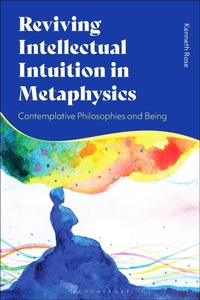
Reviving Intellectual Intuition in Metaphysics
Contemplative Philosophies and Being
1st Edition
Published on 28. November 2024
240 pages
978-1-350-37522-2 (ISBN)
Description

Calling for a revival of intellectual intuition in metaphysics long after its banning by Kant, Kenneth Rose overcomes the forgetfulness of being through contemplative ontology.
Rose argues for the reinstatement of intellectual intuition in metaphysics long after its banning by Kant. His claim is not merely the conclusion of a thought-experiment or of an exercise in conceptual analysis. It is the result of the contemplative recognition of being with a meditatively concentrated intellect: nous in Greek and buddhi in Sanskrit. Recognizing intellectual intuition as a long-neglected faculty of philosophical insight, Rose shows how it can result in an immediate, intuitive discerning of being. He discusses how being parcels itself out into the intellectual forms providing the underlying nonphysical arrangement of the physical and mental worlds.
By reviving the use of intellectual intuition in metaphysics, Rose draws upon historical sources across multiple Asian and Anglo-European philosophical schools. This is a work of contemplative constructive philosophy that breaks down divisions between science, philosophy, and religion and between diverse cultures and divergent worldviews.
Rose argues for the reinstatement of intellectual intuition in metaphysics long after its banning by Kant. His claim is not merely the conclusion of a thought-experiment or of an exercise in conceptual analysis. It is the result of the contemplative recognition of being with a meditatively concentrated intellect: nous in Greek and buddhi in Sanskrit. Recognizing intellectual intuition as a long-neglected faculty of philosophical insight, Rose shows how it can result in an immediate, intuitive discerning of being. He discusses how being parcels itself out into the intellectual forms providing the underlying nonphysical arrangement of the physical and mental worlds.
By reviving the use of intellectual intuition in metaphysics, Rose draws upon historical sources across multiple Asian and Anglo-European philosophical schools. This is a work of contemplative constructive philosophy that breaks down divisions between science, philosophy, and religion and between diverse cultures and divergent worldviews.
More details
Edition
1. Auflage
Language
English
Place of publication
London
United Kingdom
Publishing group
Bloomsbury Publishing PLC
Target group
Professional and scholarly
Illustrations
5 bw illus
ISBN-13
978-1-350-37522-2 (9781350375222)
Copyright in bibliographic data and cover images is held by Nielsen Book Services Limited or by the publishers or by their respective licensors: all rights reserved.
Schweitzer Classification
Other editions
Additional editions
Book
12/2024
Bloomsbury Academic
€126.37
Shipment within 15-20 days
Person
Kenneth Rose is a former Senior Research Fellow at the Graduate Theological Union, USA and Emeritus Professor of Philosophy and Religion at Christopher Newport University, USA. He is the author of Yoga, Meditation, and Mysticism (2016), Pluralism: The Future of Religion (2013), and Knowing the Real: John Hick on the Cognitivity of Religions and Religious Pluralism (1996).
Content
Preface
Introduction
1. The Forgetfulness of Being and Its Recovery
2. The Scope and History of Intellectual Intuition
3. Reviving Intellectual Intuition
4. Contemplative Metaphysical Practice
5. The Metaphysics of Intellectual Intuition
Conclusion: The Outcomes of Contemplative Metaphysics
Bibliography
Index
Introduction
1. The Forgetfulness of Being and Its Recovery
2. The Scope and History of Intellectual Intuition
3. Reviving Intellectual Intuition
4. Contemplative Metaphysical Practice
5. The Metaphysics of Intellectual Intuition
Conclusion: The Outcomes of Contemplative Metaphysics
Bibliography
Index
