

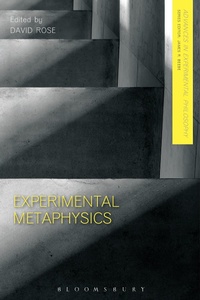
Experimental Metaphysics
1st Edition
Published on 29. June 2017
224 pages
978-1-4742-7863-8 (ISBN)
Description

Metaphysics, almost entirely neglected by experimental philosophers, is the central focus of Experimental Metaphysics. The volume brings together a range of views aimed at addressing the question of how cognitive science might be relevant to metaphysics.
With contributions from cognitive scientists and philosophers, chapters focus on theoretical and empirical issues involving the potential role of cognitive science in metaphysics. Alongside topics such as free will, objects and causation, in which relevant empirical evidence is discussed and connected to relevant metaphysical issues, more programmatic papers explore theoretical issues centered on the connection between cognitive science and metaphysics. This balanced approach exposes metaphysicians to philosophically relevant work in cognitive science, while showing cognitive scientists the ways in which their work might be important for philosophers.
Presenting cutting-edge empirical and theoretical research, Experimental Metaphysics pushes forward the discussion and encourages further engagement with issues at the intersection of cognitive science and metaphysics.
With contributions from cognitive scientists and philosophers, chapters focus on theoretical and empirical issues involving the potential role of cognitive science in metaphysics. Alongside topics such as free will, objects and causation, in which relevant empirical evidence is discussed and connected to relevant metaphysical issues, more programmatic papers explore theoretical issues centered on the connection between cognitive science and metaphysics. This balanced approach exposes metaphysicians to philosophically relevant work in cognitive science, while showing cognitive scientists the ways in which their work might be important for philosophers.
Presenting cutting-edge empirical and theoretical research, Experimental Metaphysics pushes forward the discussion and encourages further engagement with issues at the intersection of cognitive science and metaphysics.
More details
Series
Edition
1. Auflage
Language
English
Place of publication
London
United Kingdom
Publishing group
Bloomsbury Publishing PLC
Target group
Professional and scholarly
ISBN-13
978-1-4742-7863-8 (9781474278638)
Copyright in bibliographic data and cover images is held by Nielsen Book Services Limited or by the publishers or by their respective licensors: all rights reserved.
Schweitzer Classification
Other editions
Additional editions
David Rose
Experimental Metaphysics
Book
06/2017
Bloomsbury Academic
€124.50
Shipment within 15-20 days
Persons
David Rose is a graduate student in the Department of Philosophy at Rutgers University, USA.
Content
Introduction, David Rose (Rutgers University, USA)
1. Metaphysics and Conceptual Analysis: Experimental Philosophy's Place under the Sun, Uriah Kriegel (Institute Jean Nicod, France)
2. Experimental Philosophy, Conceptual Analysis, and Metasemantics, Jason Turner (University of Arizona, USA)
3. Intuitions and the Metaphysics of Causation, Sara Bernstein (Duke University, USA)
4. The Folk Psychological Roots of Free Will, Joshua Shepherd (University of Oxford, UK)
5. The Rationality of Psychological Essentialism, Shaun Nichols (University of Arizona, USA)
6. Folk Mereology is Teleological, David Rose and Jonathan Schaffer (Rutgers University, USA)
7. What Do the Folk Think about Composition, and Does It Matter?, Daniel Z. Korman (University of California, Santa Barbara, USA) and Chad Carmichael (Indiana University-Purdue, USA)
8. Folk Teleology and its Implications, Jacob W. Dink and Lance J. Rips (Northwestern University, USA)
Index
1. Metaphysics and Conceptual Analysis: Experimental Philosophy's Place under the Sun, Uriah Kriegel (Institute Jean Nicod, France)
2. Experimental Philosophy, Conceptual Analysis, and Metasemantics, Jason Turner (University of Arizona, USA)
3. Intuitions and the Metaphysics of Causation, Sara Bernstein (Duke University, USA)
4. The Folk Psychological Roots of Free Will, Joshua Shepherd (University of Oxford, UK)
5. The Rationality of Psychological Essentialism, Shaun Nichols (University of Arizona, USA)
6. Folk Mereology is Teleological, David Rose and Jonathan Schaffer (Rutgers University, USA)
7. What Do the Folk Think about Composition, and Does It Matter?, Daniel Z. Korman (University of California, Santa Barbara, USA) and Chad Carmichael (Indiana University-Purdue, USA)
8. Folk Teleology and its Implications, Jacob W. Dink and Lance J. Rips (Northwestern University, USA)
Index
