

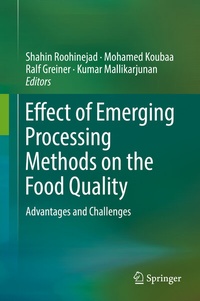
Effect of Emerging Processing Methods on the Food Quality
Description

This text comprehensively covers novel, innovative technologies used in the food and beverage industries in order to provide safe and healthy foods for consumers. The research provided in these chapters aims to show that the traditional pasteurization and commercial sterilization of foods result in unacceptable quality and nutrient retention, creating an important need for alternative methods used to minimize undesirable reactions such as thermal decomposition or degradation. Emerging processing methods to minimize heat induced alterations in foods and their applications are covered in-depth, demonstrating that these methods are useful not only for the inactivation of microorganisms and enzymes but also for improving the yield and development of ingredients and marketable foods with higher quality and better nutritional characteristics.
Effect of Emerging Processing Methods on the Food Quality: Advantages and Challenges not only covers the advantagesof using innovative processing methods, but also the disadvantages and challenges of using these techniques on food quality. Each chapter focuses on a different emerging processing technique, breaking down the sensory, textural and nutritional aspects for different food products in addition to the advantages and challenges for each method. New technologies and advanced theories are a major focus, pointing to innovative new paths for the quality and safety assurance in food products. From pulsed electric fields to ultrasounds, this work covers all aspects of emerging processing techniques for fruits and vegetables, foods and dairy products.
More details
Other editions
Additional editions
Persons
Shahin Roohinejad is a Research Scientist at Tillamook County Creamery Association, Oregon, USA. Previously, he was a Postdoctoral Research Associate at the Department of Food Science and Nutrition, University of Minnesota, St. Paul, USA.
Mohamed Koubaa is an Assistant Professor in the process and chemical engineering at the Graduate School of Organic and Mineral Chemistry (Ecole Supérieure de Chimie Organique et Minérale) in Compiègne (France).
Ralf Greiner is a Professor in the Department of Food Technology and Bioprocess Engineering at the Max Rubner-Institut, Federal Research Institute of Nutrition and Food in Karlsruhe, Germany.
Kumar Mallikarjunan is a Professor in the Department of Food Science and Nutrition, University of Minnesota, St. Paul, USA.
Content
Assessment of food quality using profiling techniques: Pros and cons aspects.- Handling the data generated by profiling techniques for evaluation the food quality.- High pressure processing.- Pulsed electric fields.- Ultraviolet.- Pulsed light.- Irradiation.- Ultrasounds
