

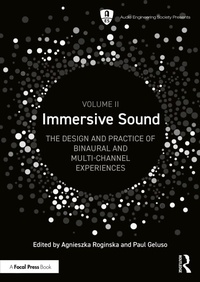
Immersive Sound Volume II
The Design and Practice of Binaural and Multi-Channel Experiences
Published on 26. May 2026
544 pages
978-1-040-69975-1 (ISBN)
Description

Immersive Sound Volume II: The Design and Practice of Binaural and Multi-Channel Experiences is a collection of interviews and essays providing a comprehensive guide to the history, theory, and creative applications of 3D and spatial audio across music, production, theater, installations, and film.
Offering both foundational knowledge and practical insights into the design and implementation of immersive sound experiences, expert contributors present each topic in depth, with chapters structured for both sequential learning and standalone reference. By combining historical context, cognitive perspectives, and real-world applications, this book connects theory with practice and helps readers expand their technical, academic, and creative potential in the rapidly evolving field of spatial audio.
This is a valuable resource for all spatial audio content creators, including audio engineers, sound designers, researchers, educators, composers, performers, and students seeking a comprehensive understanding of immersive sound and its applications across different disciplines. This book serves as a companion to Immersive Sound: The Art and Science of Binaural and Multi-Channel Audio.
Offering both foundational knowledge and practical insights into the design and implementation of immersive sound experiences, expert contributors present each topic in depth, with chapters structured for both sequential learning and standalone reference. By combining historical context, cognitive perspectives, and real-world applications, this book connects theory with practice and helps readers expand their technical, academic, and creative potential in the rapidly evolving field of spatial audio.
This is a valuable resource for all spatial audio content creators, including audio engineers, sound designers, researchers, educators, composers, performers, and students seeking a comprehensive understanding of immersive sound and its applications across different disciplines. This book serves as a companion to Immersive Sound: The Art and Science of Binaural and Multi-Channel Audio.
More details
Series
Language
English
Place of publication
Oxford
United Kingdom
Publishing group
Taylor & Francis Ltd
Target group
College/higher education
Professional and scholarly
Product notice
Reflowable
Illustrations
15 Tables, black and white; 84 Line drawings, black and white; 29 Halftones, black and white; 113 Illustrations, black and white
File size
33,79 MB
ISBN-13
978-1-040-69975-1 (9781040699751)
Copyright in bibliographic data and cover images is held by Nielsen Book Services Limited or by the publishers or by their respective licensors: all rights reserved.
Schweitzer Classification
Other editions
Additional editions
Agnieszka Roginska | Paul Geluso
Immersive Sound Volume II
The Design and Practice of Binaural and Multi-Channel Experiences
Book
05/2026
1st Edition
Routledge
€82.00
Shipment within 15-20 days
Agnieszka Roginska | Paul Geluso
Immersive Sound Volume II
The Design and Practice of Binaural and Multi-Channel Experiences
Book
05/2026
1st Edition
Routledge
€201.50
Shipment within 15-20 days
Persons
Agnieszka Roginska conducts research in the simulation and applications of immersive and 3D audio including the capture, analysis, and synthesis of auditory environments. Applications of her work include AR/VR/XR, gaming, and mission critical. She is the author of numerous publications on the topics of acoustics and psychoacoustics of immersive audio and is Professor of Music Technology at New York University. Agnieszka is a Fellow of the Audio Engineering Society (AES) and a Past President of the AES.
Paul Geluso is a New York-based sound engineer, educator, and musician. He has worked professionally in many areas of sound and music production, being credited as engineer, producer, composer, and musician on hundreds of commercial releases including Grammy and Latin Grammy nominated recordings. He is Professor of Music Technology and founder of the Tonmeister program at New York University. He has served as Chief Sound Engineer at Harvestworks Digital Media Arts for over three decades.
Paul Geluso is a New York-based sound engineer, educator, and musician. He has worked professionally in many areas of sound and music production, being credited as engineer, producer, composer, and musician on hundreds of commercial releases including Grammy and Latin Grammy nominated recordings. He is Professor of Music Technology and founder of the Tonmeister program at New York University. He has served as Chief Sound Engineer at Harvestworks Digital Media Arts for over three decades.
Content
Introduction: Artistic intention and technical considerations; 1 History of immersive sound experiences; PART I Guiding principles and system design 2 Hamasaki-Square, Hamasaki-Cube, and the development of the 22.2 system; 3 Early immersive sound and the development of Auro-3D; 4 Immersive experience: Height, acoustics and emotional impact; 5 Natural listening, binauralization, and recording workflow; 6 Immersive workflow: Mixing in binaural and mixing for large space; 7 Immersive acoustics and reverberation; 8 Creating and distributing immersive audio experiences; 9 From measurement to immersion: Historical acoustics and modern applications; 10 Volumetric sound capture; 11 From live sound to virtual and distributed experiences; 12 Acoustic and perceptual factors in sound design for XR; 13 Take me out: Moving virtual reality outside academic laboratories to medical clinics and museums; 14 Enhancing museum experiences with real-time, immersive 3D audio technology; 15 Immersive technologies and artificial intelligence: Therapeutic tools for the treatment of neurocognitive diseases and functional diversity; PART II Production and creative practice 16 Sound installations: The art and implementation; 17 Perspectives on multi-channel compositions; 18 Spatial sound composition: Concept and practice; 19 Immersive theatre: The emergent edge of storytelling with sound and spectacle; 20 Sound for immersive theater: Audio engineering for Sleep No More; 21 Cinematic sound immersion; 22 Make the loudspeakers disappear; 23 Music composing for immersive experiences; 24 Immersion in 3D audio music productions; 25 Creating and producing music in immersive audio; 26 Immersive audio case studies for immersive audio in rock and pop music; 27 Producing and recording acoustic music in immersive; 28 Perspectives on immersive recordings; 29 The vertical AB system, content correlation, and the David Bowie exhibit; 30 Recording and mixing Picturing the Invisible: focus 1; 31 Recording Soundtrack of the American Soldier and remixing Star Wars; 32 Immersive music production for Latin American artists; 33 Mastering for immersive
