

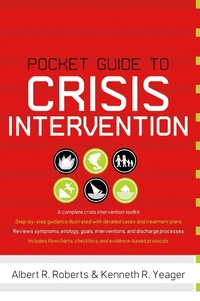
Pocket Guide to Crisis Intervention
1st Edition
Published on 2. March 2009
229 pages
978-0-19-972478-9 (ISBN)
Description

Crisis workers make split-second decisions every day that affect the mental health and well-being of individuals, families, and entire communities. They support and guide people through health diagnoses, bankruptcies, sexual assaults, deaths of loved ones, suicide attempts, and natural or man-made disasters from the front lines. While professions vary from mental health professionals, emergency responders, educators, business managers or volunteers such as suicide hotline workers, all have a common and urgent need for a rapid reference that covers every type of traumatic event they may be asked to respond to in the course of an unpredictable and highly stressful day.
The Pocket Guide to Crisis Intervention is a complete crisis toolkit, a trusted resource to consult on the fly, packed with easy-to-follow, step-by-step evidence-based protocols for responding effectively to a broad range of traumatic events. Checklists, bullets, and boxes highlight symptoms & warning signs and provide action plans, do's & don'ts, and screening & assessment questions. The open layout and two-color design make this pocket guide as visually appealing as it practical, ensuring at-a-glance lookup of the essentials of managing the most common types of crisis.
More than just a collection of action lists, though, this pocket guide explains theories and models in clear, jargon-free language, offering tips for clinical practice, treatment planning, referrals, and coordinating services as needed. It can be used as a field manual for seasoned professionals or as a training tool for new recruits and practitioners seeking to sharpen their skills.
More details
Other editions
Additional editions
Albert R. Roberts | Kenneth R. Yeager
Pocket Guide to Crisis Intervention
Book
03/2009
Oxford University Press Inc
€84.20
Shipment within 15-20 days
Persons
The late Albert R. Roberts was Professor Criminal Justice, School of Arts and Sciences, Rutgers University Livingston College Campus and Editor-in-Chief, Brief Treatment and Crisis Intervention. Dr. Roberts was a member of The Board of Scientific and Professional Advisors, and a Board Certified Expert in Traumatic Stress for The American Academy of Experts in Traumatic Stress.
Kenneth R. Yeager is an Associate Professor of Psychiatry & Social Work at The Ohio State University, Director of Quality Assurance at The Ohio State University Medical Center, and Clinical Director of Outpatient Psychiatry Services of OSU Harding Hospital.
Content
- Intro
- Contents
- Foreword
- Preface
- Acknowledgements
- Chapter 1 Definition, History, and Nature of Crisis
- Chapter 2 Public versus Private Crisis
- Chapter 3 Events That Precipitate a Crisis
- Chapter 4 Indicators of a Crisis-Prone Person
- Chapter 5 Types of Crises
- Chapter 6 Burgess and Roberts' Stress-Crisis-Trauma Continuum
- Chapter 7 Psychophysiological Reactions to a Crisis
- Chapter 8 Stress Symptomatology and the General Adaptation Syndrome
- Chapter 9 Common Signs, Symptoms, and Psychological Responses to Crisis (Emotional, Cognitive, and Behavioral)
- Chapter 10 Roberts' Seven-Stage Crisis Intervention Model
- Chapter 11 The Crisis Management Plan
- Chapter 12 Dos and Don'ts for Crisis Hotline Workers
- Chapter 13 Suicide Risk Assessment Protocol and Warning Signs
- Chapter 14 Crisis Intervention With Families
- Chapter 15 Crisis Intervention With Substance Abusers
- Chapter 16 Crisis Intervention With Accident Survivors
- Chapter 17 Crisis Intervention With Violent Crime Victims
- Chapter 18 Crisis Intervention With Abused Children
- Chapter 19 Crisis Intervention With Battered Women
- Chapter 20 Crisis Intervention With Sexual Abuse/Assault Victims
- Chapter 21 Crisis Intervention With Mental Illness: Determining Safety Needs
- Chapter 22 Crisis Intervention With Persons Diagnosed HIV Positive
- Chapter 23 Crisis Intervention After the Death of a Loved One
- Chapter 24 Crisis Intervention With Children in the Aftermath of School Violence
- Chapter 25 Crisis Intervention After Natural Disasters-Hurricanes, Earthquakes, Floods
- Chapter 26 Crisis Intervention After Terrorist Bombings in Planes, Railroads, or Buildings: The ACT Model of Crisis Intervention
- Chapter 27 Crisis Intervention After Bioterrorism
- Chapter 28 Crisis Intervention With Homicide Attempt Survivors
- Chapter 29 The Ten Stages of Acute Traumatic Stress Management
- Chapter 30 Critical Incident Stress Debriefing Model
- Chapter 31 Multicomponent Critical Incident Stress Management
- Chapter 32 Signs and Symptoms of Clinician Stress and Burnout
- Chapter 33 Stress Reduction and Coping Skills for Clinicians Working in Crisis or Disaster Relief Positions
- References
- Index
- A
- B
- C
- D
- E
- F
- G
- H
- I
- J
- K
- L
- M
- N
- O
- P
- R
- S
- T
- U
- V
- W
- X
- Z
