

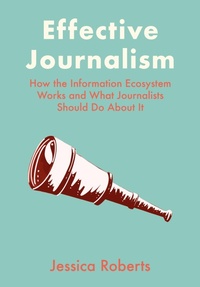
Effective Journalism
How the Information Ecosystem Works and What Journalists Should Do About It
Published on 25. March 2024
216 pages
978-1-78938-904-3 (ISBN)
Description

This book provides journalists and the public with a broad overview of all the ways modern communication technologies and information approaches make it difficult for people to effectively find and interpret information, and what they can do about it. The public may have a general awareness that things like confirmation bias, content algorithms, and the backfire effect exist and can influence their behaviour, but this book will explain them in one place, in plain language. Journalists likewise know that their audiences are dealing with some of these issues, but continue to operate under the assumption that if they just publish facts, the truth will win out in the court of public opinion.
The central argument of the book is that journalists and audiences can no longer afford to pretend that all information is competing on an even playing field, and that it is enough for journalists to simply publish "the facts." Just as behavioural economics provided a new way of thinking about economics, one that understood people as non-rational actors, this book attempts to explain the reality, rather than the ideal, of how people seek and process information, and what journalists and their audiences can do to try to create an informed public in the face of that reality.
For many American journalists, their work and their responsibility to the public is grounded in the concept of a marketplace of ideas. Journalists believe they should just report the facts, as neutrally as possible, and let the public judge those facts and put them in context. The marketplace of ideas requires individuals to rationally consider the information that is presented to them and weigh it against other available information. Through this process, bad ideas will be judged and dismissed, and good ideas will win out. We might like to believe that we are all capable of carefully and rationally evaluating information, but the evidence is clear that it is simply not true. If it were true, we would not observe such things as the continued persistence of flat-Earthers and moon-landing sceptics, and others who champion backward social ideas that were dismissed decades or even centuries ago. The fact that these ideas continue to persist tells us that the public is not engaging in a clear-eyed rational consideration of all the available verified facts.
The central argument of the book is that journalists and audiences can no longer afford to pretend that all information is competing on an even playing field, and that it is enough for journalists to simply publish "the facts." Just as behavioural economics provided a new way of thinking about economics, one that understood people as non-rational actors, this book attempts to explain the reality, rather than the ideal, of how people seek and process information, and what journalists and their audiences can do to try to create an informed public in the face of that reality.
For many American journalists, their work and their responsibility to the public is grounded in the concept of a marketplace of ideas. Journalists believe they should just report the facts, as neutrally as possible, and let the public judge those facts and put them in context. The marketplace of ideas requires individuals to rationally consider the information that is presented to them and weigh it against other available information. Through this process, bad ideas will be judged and dismissed, and good ideas will win out. We might like to believe that we are all capable of carefully and rationally evaluating information, but the evidence is clear that it is simply not true. If it were true, we would not observe such things as the continued persistence of flat-Earthers and moon-landing sceptics, and others who champion backward social ideas that were dismissed decades or even centuries ago. The fact that these ideas continue to persist tells us that the public is not engaging in a clear-eyed rational consideration of all the available verified facts.
Reviews / Votes
'In this volume, a synthesis of cross-disciplinary theory combines with an overview of new journalism movements to warn that faith in a marketplace of ideas is ill-suited to the 21st-century information ecosystem and the distortions caused by global competition for user attention. Studies of confirmation bias, thinking shortcuts, and emotional responses to information (such as outrage and compassion fatigue) illustrate that technologies structured to exploit people's limited capacity to find and understand facts promote "junk" information that, in turn, causes audiences to avoid the news when they believe it negatively affects their mood or presents intractable events. Fact-based journalists, social media companies, funding agencies, and government regulators have a duty to adopt strategies to counteract incivility, including undemocratic tendencies, fomented by a sped-up, nonstop information environment. Universally recognized ethics-such as prompt, accurate and fair reporting-can align with movements like slow journalism, solutions reporting, and service journalism, each aimed at accounting for the limits of human cognition by providing context. Individuals can also slow down: "When we feel moral satisfaction or certainty while reading something, we should remember to be critical in questioning the facts and framing of the information."The volume offers timely strategies to provoke thought among professional journalists and news consumers alike. Recommended.' -- R. Pagano, CHOICE
More details
Language
English
Place of publication
Bristol
United Kingdom
Publishing group
Intellect
Target group
Professional and scholarly
ISBN-13
978-1-78938-904-3 (9781789389043)
Copyright in bibliographic data and cover images is held by Nielsen Book Services Limited or by the publishers or by their respective licensors: all rights reserved.
Schweitzer Classification
Other editions
Additional editions
Jessica Roberts
Effective Journalism
How the Information Ecosystem Works and What Journalists Should Do About It
Book
04/2024
Intellect Books
€136.10
Shipment within 3-4 weeks
Person
Jessica Roberts is assistant professor of communication studies at Universidade Catolica Portuguesa.
Content
Acknowledgements
Introduction
PART I: STRUCTURAL CHALLENGES IN OUR INFORMATION ECOSYSTEM
1. Information Proliferation
2. The Attention Economy
3. Customization and Filters and Bots
4. The Competitive Advantage of Junk News
PART II: COGNITIVE AND AFFECTIVE BARRIERS TO PROCESSING INFORMATION
5. The Dual-Process Model
6. Motivated Reasoning and Bias
7. Emotion and Information
PART III: THE SOLUTIONS
8. New Movements in Journalism
9. Strategies to Effectively Debunk False Information
10. Empathy Cultivation and Building Community
11. Effective Journalism Practices
12. Solutions for Tech Companies, Government, and the Public
Conclusion
Index
Introduction
PART I: STRUCTURAL CHALLENGES IN OUR INFORMATION ECOSYSTEM
1. Information Proliferation
2. The Attention Economy
3. Customization and Filters and Bots
4. The Competitive Advantage of Junk News
PART II: COGNITIVE AND AFFECTIVE BARRIERS TO PROCESSING INFORMATION
5. The Dual-Process Model
6. Motivated Reasoning and Bias
7. Emotion and Information
PART III: THE SOLUTIONS
8. New Movements in Journalism
9. Strategies to Effectively Debunk False Information
10. Empathy Cultivation and Building Community
11. Effective Journalism Practices
12. Solutions for Tech Companies, Government, and the Public
Conclusion
Index
