

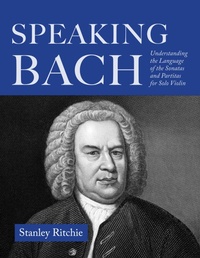
Speaking Bach
Description

Known around the world as a skilled violinist, teacher, and advocate for historically informed performance of early music, Stanley Ritchie has developed a definitive performer's guide to comprehending and performing J. S. Bach's musical language.
In Speaking Bach, Ritchie widens the focus of his study of Bach's six solo sonatas and partitas to incorporate questions about how technical approaches to performing these pieces are affected by considerations of rhetoric, harmonic structure, and subtleties of expression. In doing so, Ritchie helps violinists form a deeper understanding of this essential repertoire, even as they work to perfect their skills and interpretations. Speaking Bach includes sections on technique, harmonic and melodic structure, expression and ornamentation, and analytical exercises, all using passages from the solo sonatas and partitas to address the specific challenges posed by playing Bach.
An important addition to any violinist's collection, Speaking Bach shows us how J. S. Bach thought about his own music and illuminates what is both technically and musically appropriate for this essential repertoire.
More details
Other editions
Additional editions
Person
Stanley Ritchie is Distinguished Professor Emeritus of Violin at the Indiana University Jacobs School of Music. He is author of Before the Chinrest: A Violinist's Guide to the Mysteries of Pre-Chinrest Technique and Style and The Accompaniment in "Unaccompanied" Bach: Interpreting the Sonatas and Partitas for Violin.
Content
Acknowledgments
Introduction
Bach's Orthography
Part I: Technique
1. Right-Arm Technique
The Basic Bow Stroke
Articulation
(a) Détaché
(b) Lifted Strokes
(c) Z-Bowing
(d) The Swift-Bow
(e) The Choreography of the Bow
(f) Chordal Technique
(g) Bariolage
(h) Ondeggiando
(i) To Slur or Not to Slur
(j) Sautillé
2. Left-Hand Technique
Basics
Intonation
The Swing
Fingerings
(a) Choosing Fingerings
(b) Avoiding Jumping
(c) Use of the Fourth Finger
(d) Half Position
(e) Vibratos
Part II: Harmonic and Melodic Structure
3. Analysis
The Bass Line and Harmonic Progressions
(a) Figured Bass
(b) Implicit Harmony
(c) Patterns
(d) Beaming
(e) Punctuation
(f) Tension and Release
(g) Cadences
4. Polyphony
Notation
Arpeggiation
Part III: Expression and Ornamentation
5. Expression
The Word in the Top Left-Hand Corner
Rhetoric
Dynamics and Nuances
Rubato
Questions and Exclamations
6. Ornamentation
The Appoggiatura
Spontaneous Ornamentation
Vocal Ornaments
Part IV: Analytical Exercises
7. Applying the Principles
Bass Line and Figures
Melodic Extraction
Articulation
Expression
Coda
Bibliography
