

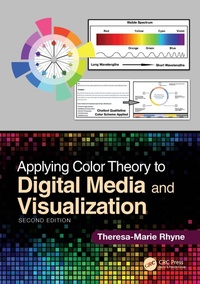
Applying Color Theory to Digital Media and Visualization
2nd Edition
Published on 19. December 2024
227 pages
978-1-040-22922-4 (ISBN)
Description

Applying Color Theory to Digital Media and Visualization provides an overview of the application of color theory concepts to digital media and visualization. It highlights specific color concepts such as color harmony and data color schemes. Examples of generative AI solutions for color scheme suggestion are provided. The usage of these concepts is shown with actual online and mobile tools. Color deficiencies are reviewed, and color tools for examining how a specific color map design will look to someone with the deficiency are discussed. A five-stage colorization process is defined and applied to case study examples.
Features:
Presents color theory and data color concepts that can be applied to digital media and visualization problems over and over again
Offers a comprehensive review of the historical progression of color models
Demonstrates actual case study implementations of color analyses tools
Provides overview of color theory and harmony analytics in terms of online and mobile analysis tools
Teaches the color theory language to use in interacting with color management professionals
Unlike many books on color, which examine artists' use of color, color management or color science, this book applies fundamental color concepts to digital media and visualization solutions, and the new edition includes generative AI solutions for color suggestion. A video summary of the chapters by the author can also be found here: https://www.youtube.com/watch?v=aGDXyTd1UWk. This is the ideal book for digital media and visualization content creators and developers.
Features:
Presents color theory and data color concepts that can be applied to digital media and visualization problems over and over again
Offers a comprehensive review of the historical progression of color models
Demonstrates actual case study implementations of color analyses tools
Provides overview of color theory and harmony analytics in terms of online and mobile analysis tools
Teaches the color theory language to use in interacting with color management professionals
Unlike many books on color, which examine artists' use of color, color management or color science, this book applies fundamental color concepts to digital media and visualization solutions, and the new edition includes generative AI solutions for color suggestion. A video summary of the chapters by the author can also be found here: https://www.youtube.com/watch?v=aGDXyTd1UWk. This is the ideal book for digital media and visualization content creators and developers.
Reviews / Votes
"As someone from the field of data analytics, which heavily utilizes visualizations, I have been delighted with this book. It is well laid out to provide a neophyte with all the knowledge and tools to be able to take that information and apply it to aid in creating colorful visualizations that best impart information, in a wide range of subtle ways. The section on color range deficiencies and adjusting color choices to ensure anyone can get full comprehension of my graphics was an unexpected bonus. This book feels like it should be on the 'must read' list for any professional who uses color in their work."--Sue Hayden, Data Process Engineer
"A much-needed guide for scientists of all stripes and for anyone interested in the biology of color vision and the artistic interplay of colors in any setting. The book is well-written and engaging. It is unusual because it is both scholarly and accessible. Each chapter is self-contained and remarkably well-referenced. The opening chapters on color models, color vision, and defining the color gamut lay the foundation for understanding how digital media specialists can use color to create effective and harmonious presentations. The case studies and practical presentations make this a training book as well. My perspective on digital media and my own presentations have been advanced by this scholarly and pragmatic text."
--Daniel Schmitt, Professor of Evolutionary Anthropology, Duke University
"I have attended many of Theresa-Marie's SIGGRAPH courses on color selection over the years, and kept her course notes around as references. When the first edition of this book came out, I was thrilled because it was so nice to have everything collected in one easy-to-read, easy-to-store, easy-to-understand place. The first edition immediately went on my closest-to-my-desk bookshelf.
Now the second edition is out. It is longer, physically larger, and has brilliant color on almost every page.
There are many things new in the second edition, too many to mention here. But one new topic with which I was particularly intrigued was the use of ChatGPT to generate color sequences. The exact prompt used is shown in the book. (Thank goodness! I would not have thought to phrase it so well.) ChatGPT then generated eight diverging color options complete with hex codes. But, as could be expected, some of the ChatGPT selections were inaccurate in terms of systematic color sequencing. The author then shows how the freely-available Adobe Color app can be used to "clean up" the ChatGPT suggestions. I can hardly wait to try this myself!
I also found the book's "5-step process to colorizing a data visualization" to be useful:
1. Establish data classes for visualization and key color for visualization
2. Select color rule, color harmony per criteria of your data.
3. Build color scheme. A color suggestion tool might be helpful.
4. Check and revise due to color deficiency, contrasts, or any pre-existing conditions.
5. Apply color scheme to data visualization. Some modifications might result.
When you think about it, these steps should be obvious, but I am pretty sure they are not, at least not to most of us. Plugging these rules, especially #3, into the use of generative AI would then give a practitioner a fighting chance at generating data visualizations that just work. It is a Data World out there. It is nice to go into it armed with such good tools as this book encompasses. Now it is the second edition that occupies a place of honor on my closest-to-my-desk bookshelf."
--Mike Bailey, Professor of Computer Science, Oregon State University, USA
More details
Edition
2nd edition
Language
English
Place of publication
London
United Kingdom
Publishing group
Taylor & Francis Ltd
Target group
College/higher education
Professional and scholarly
Illustrations
151 Line drawings, color; 2 Line drawings, black and white; 32 Halftones, color; 183 Illustrations, color; 2 Illustrations, black and white
ISBN-13
978-1-040-22922-4 (9781040229224)
Copyright in bibliographic data and cover images is held by Nielsen Book Services Limited or by the publishers or by their respective licensors: all rights reserved.
Schweitzer Classification
Other editions
Additional editions
Theresa-Marie Rhyne
Applying Color Theory to Digital Media and Visualization
Book
12/2024
2nd Edition
CRC Press
€101.00
Shipment within 10-20 days
Theresa-Marie Rhyne
Applying Color Theory to Digital Media and Visualization
Book
12/2024
2nd Edition
CRC Press
€182.30
Shipment within 10-20 days
Person
Theresa-Marie Rhyne has over three decades of experience in producing and colorizing digital media and visualization. She has consulted with the Stanford University Visualization Group on a color suggestion prototype system, the Center for Visualization at the University of California at Davis, and the Scientific Computing and Imaging Institute at the University of Utah on applying color theory to ensemble data visualization. Prior to her consulting work, she founded two visualization centers: (1) the United States Environmental Protection Agency's Scientific Visualization Center in the 1990s and (2) the Center for Visualization and Analytics at North Carolina State University in the 2000s. Theresa-Marie received a BS degree, two MS degrees, and the Degree of Engineer in Civil Engineering from Stanford University. She is an internationally recognized digital media artist who began creating digital media with early Apple computers, including the colorization of early Macintosh educational software. In 2023, she received an IEEE Computer Society Distinguished Contributor Award. She is currently exploring and writing on the use of Generative AI for color scheme suggestion.
Her website is: www.theresamarierhyne.com.
Her website is: www.theresamarierhyne.com.
Content
Chapter 1: Introduction to Color Models. Chapter 2: Review of Color Vision Principals. Chapter 3: Defining Color Gamut, Color Spaces and Color Systems. Chapter 4: Defining Color Harmony. Chapter 5: Translating Between Color Harmony and Data Color Schemes. Chapter 6: Analyzing and Modifying with Online and Mobile Color Tools. Chapter 7: Case Study Examples of Colorizing Data Visualizations. Chapter 8: Review of Basic Concepts Covered
