

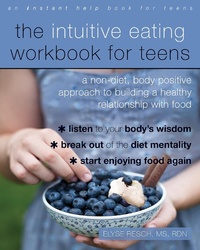
Intuitive Eating Workbook for Teens
Description

A new, non-diet approach to adopting healthy eating habits! Drawing on the same evidence-based practices introduced in Intuitive Eating, this workbook for teens addresses the ten principles of intuitive eating to help you listen to your body's natural hunger and fullness cues.
Do you struggle with stress eating, overeating, emotional eating, or binge eating? You aren't alone. Sometimes, when we're not feeling so good, food can seem like a great comfort. The problem is that over time, overeating can lead to several physical health problems, as well as depression and lowered self-esteem. So, how can you put a stop to unhealthy eating behaviors before they become ingrained, lifelong habits?
With this breakthrough workbook, you'll learn to notice and respect your body's natural hunger and fullness signals, find real eating satisfaction, cultivate body positivity, and build a profound connection to your mind and body for years to come. Each chapter includes an important principle of intuitive eating, and includes worksheets and activities to help you connect with and deepen your skills.
Whether you're a teen, a parent, a clinician, or a certified intuitive eating counselor, this proven-effective workbook is an essential resource.
More details
Other editions
Additional editions
Content
- Intro
- introduction
- chapter 1: What's Wrong with Dieting?
- activity 2 weighing the pros and cons of dieting: for you to know
- activity 3 feeling the power of deprivation: for you to know
- activity 4 dieting leads to necessary rebellion
- activity 5 intuitive eating is all about autonomy
- activity 6 getting rid of the diet mentality
- chapter 2: Savor and Be Satisfied!
- activity 7 what needs to change?
- activity 8 choosing the foods you crave
- activity 9 why dieting is no fun
- activity 10 finding a sense of satisfaction
- activity 11 appearance can be appealing
- activity 12 feeling body satisfaction
- activity 13 planning a satisfying meal
- activity 14 exploring your eating environment: distractions and speed
- activity 15 exploring your eating environment: hunger and emotion
- activity 16 exploring your eating environment: conflict and chaos
- activity 17 satisfaction: seeing the big picture
- chapter 3: Your License to Eat What You Like
- activity 18 identifying your food rules
- activity 19 recognizing where your food rules come from
- activity 20 breaking your food rules-and letting them go
- activity 21 understanding habituation
- activity 22 tracking what you eat for a week
- activity 23 food rules and friends
- activity 24 exploring your favorite foods
- chapter 4: Banishing the Food Police
- activity 25 spotting the food police
- activity 26 challenging the food police: getting started
- activity 27 challenging the food police: banishing black-and-white Thinking
- activity 28 challenging the food police: the trap of perfectionism
- activity 29 challenging the food police: using "for the most part" thinking
- activity 30 exploring how your feelings affect your actions
- activity 31 speaking up for yourself
- chapter 5: Do You Hear Your Stomach Growling?
- activity 32 getting in touch with physical hunger: signals
- activity 33 getting in touch with physical hunger: rating your signals
- activity 34 testing out taste hunger
- activity 35 emotional hunger
- activity 36 experience-sharing hunger
- activity 37 energy-seeking hunger
- activity 38 setups for negative outcomes
- chapter 6: Full and Comfortable
- activity 39 what fullness feels like
- activity 40 learning to identify fullness: staying present
- activity 41 learning to identify fullness: eating slowly
- activity 42 learning to identify fullness: avoiding primal hunger
- activity 43 learning to identify fullness: starting to eat when you're comfortably hungry
- activity 44 learning to identify fullness: paying attention to why you start eating
- activity 45 learning to identify fullness: navigating family rules
- chapter 7: Is Food Your Frenemy?
- activity 46 understanding why people eat
- activity 47 practicing compassion
- activity 48 practicing gratitude
- activity 49 exploring your range of emotions
- activity 50 practicing self-care
- activity 51 finding balance
- activity 52 feeling the power of nurturance
- activity 53 building your emotional muscle: sit with difficult feelings
- activity 54 building your emotional muscle: allow the sadness of saying "enough"
- activity 55 building your emotional muscle: get to know what you feel and what you really need
- activity 56 using helpful distraction
- activity 57 preparing and rehearsing
- chapter 8: Your Body: Temple, Fortress, or Foe?
- activity 58 temple, fortress, or foe?
- activity 59 unlocking the door to the fortress
- activity 60 showing yourself compassion, once again
- activity 61 rejecting the foe
- activity 62 making your body your temple
- activity 63 accepting mother nature's plan
- activity 64 recognizing the many miraculous things your body can do
- activity 65 finding even more gratitude
- activity 66 taking care of your body's needs
- activity 67 saying nice things about your body
- activity 68 wearing comfortable clothes you enjoy
- activity 69 doing nurturing things for your body
- activity 70 stopping comparisons
- activity 71 changing your social media habits
- chapter 9: Joyful Movement
- activity 72 every living thing moves!
- activity 73 exploring exercise vs. movement
- activity 74 learning about NEAT
- activity 75 being sedentary
- activity 76 wondering about exercise resistance
- activity 77 why include movement?
- activity 78 recognizing overexercising
- chapter 10: From Nutrition to Play Food-Room for It All
- activity 79 figuring out if you're really ready for nutrition facts
- activity 80 paying attention to how eating can affect how you feel
- activity 81 learning exactly what nutrition is
- activity 82 exploring how play food fits in
- activity 83 learning about commonsense nutrition
- activity 84 putting it all together
- Acknowledgments
