

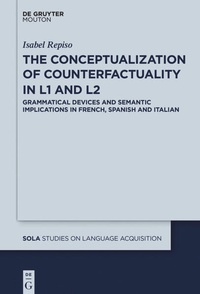
The Conceptualization of Counterfactuality in L1 and L2
Description

Counterfactual thinking is a universal cognitive process in which reality is compared to an imagined view of what might have been. This type of reasoning is at the center of daily operations, as decision-making, risk preventability or blame assignment. More generally, non-factual scenarios have been defined as a crucial ingredient of desire and modern love. If the areas covered by this reasoning are so varied, the L2 learner will be led to express 'what might have been' at some point of her acquisitional itinerary. How is this reasoning expressed in French, Spanish and Italian? By the use of what lexical, syntactic and grammatical devices? Will the learner combine these devices as the native French speakers do? What are the L1 features likely to fossilize in the L2 grammar? What are the information principles governing a communicative task based on the production of counterfactual scenarios? These are some of the questions addressed by the present volume.
More details
Other editions
Additional editions
Person
Content
- Intro
- Acknowledgements
- Table of contents
- Tables and figures
- Dedication
- Quote
- Introduction
- 1. Counterfactuality: a theoretical overview
- 2. Expressing conditionality in French, Spanish and Italian
- 3. Acquisition of counterfactuality in L1 and L2
- 4. Methodology
- 5. Results in L1 French, Spanish and Italian
- 6. Results in L2 French
- 7. Discussion
- Concluding remarks
- References
- Index
