

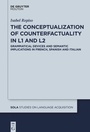
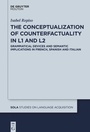
The Conceptualization of Counterfactuality in L1 and L2
Description
Alles über E-Books | Antworten auf Fragen rund um E-Books, Kopierschutz und Dateiformate finden Sie in unserem Info- & Hilfebereich.
Counterfactual thinking is a universal cognitive process in which reality is compared to an imagined view of what might have been. This type of reasoning is at the center of daily operations, as decision-making, risk preventability or blame assignment. More generally, non-factual scenarios have been defined as a crucial ingredient of desire and modern love. If the areas covered by this reasoning are so varied, the L2 learner will be led to express 'what might have been' at some point of her acquisitional itinerary. How is this reasoning expressed in French, Spanish and Italian? By the use of what lexical, syntactic and grammatical devices? Will the learner combine these devices as the native French speakers do? What are the L1 features likely to fossilize in the L2 grammar? What are the information principles governing a communicative task based on the production of counterfactual scenarios? These are some of the questions addressed by the present volume.
More details
Other editions
Additional editions

Person
System requirements
File format: ePUB
Copy protection: Watermark-DRM (Digital Rights Management)
System requirements:
- Computer (Windows; MacOS X; Linux): Use a reading software that can process the file format ePUB: e.g., Adobe Digital Editions or FBReader – both free (see eBook Help).
- Tablet/Smartphone (Android; iOS): Before downloading, install the free app Adobe Digital Editions (see eBook Help).
- E-reader: Bookeen, Kobo, Pocketbook, Sony, Tolino and many more (not Kindle).
The file format ePUB works well for novels and non-fiction books – i.e., „flowing” text without complex layout. On an e-reader or smartphone, line and page breaks automatically adjust to fit the small displays.
This eBook uses Watermark-DRM, a „soft” copy protection. This means that there are no technical restrictions to prevent illegal distribution. However, there is a personalised watermark embedded in the eBook that can be used to identify the purchaser of the eBook in the event of misuse and to provide evidence for legal purposes.
For more information, see our eBook Help page.