

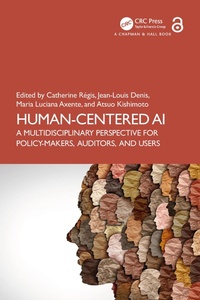
Human-Centered AI
A Multidisciplinary Perspective for Policy-Makers, Auditors, and Users
1st Edition
Published on 22. March 2024
358 pages
978-1-003-86079-2 (ISBN)
Description

Artificial intelligence (AI) permeates our lives in a growing number of ways. Relying solely on traditional, technology-driven approaches won't suffice to develop and deploy that technology in a way that truly enhances human experience. A new concept is desperately needed to reach that goal. That concept is Human-Centered AI (HCAI).
With 29 captivating chapters, this book delves deep into the realm of HCAI. In Section I, it demystifies HCAI, exploring cutting-edge trends and approaches in its study, including the moral landscape of Large Language Models. Section II looks at how HCAI is viewed in different institutions-like the justice system, health system, and higher education-and how it could affect them. It examines how crafting HCAI could lead to better work. Section III offers practical insights and successful strategies to transform HCAI from theory to reality, for example, studying how using regulatory sandboxes could ensure the development of age-appropriate AI for kids. Finally, decision-makers and practitioners provide invaluable perspectives throughout the book, showcasing the real-world significance of its articles beyond academia.
Authored by experts from a variety of backgrounds, sectors, disciplines, and countries, this engaging book offers a fascinating exploration of Human-Centered AI. Whether you're new to the subject or not, a decision-maker, a practitioner or simply an AI user, this book will help you gain a better understanding of HCAI's impact on our societies, and of why and how AI should really be developed and deployed in a human-centered future.
With 29 captivating chapters, this book delves deep into the realm of HCAI. In Section I, it demystifies HCAI, exploring cutting-edge trends and approaches in its study, including the moral landscape of Large Language Models. Section II looks at how HCAI is viewed in different institutions-like the justice system, health system, and higher education-and how it could affect them. It examines how crafting HCAI could lead to better work. Section III offers practical insights and successful strategies to transform HCAI from theory to reality, for example, studying how using regulatory sandboxes could ensure the development of age-appropriate AI for kids. Finally, decision-makers and practitioners provide invaluable perspectives throughout the book, showcasing the real-world significance of its articles beyond academia.
Authored by experts from a variety of backgrounds, sectors, disciplines, and countries, this engaging book offers a fascinating exploration of Human-Centered AI. Whether you're new to the subject or not, a decision-maker, a practitioner or simply an AI user, this book will help you gain a better understanding of HCAI's impact on our societies, and of why and how AI should really be developed and deployed in a human-centered future.
Reviews / Votes
"Regis, Denis, Axente, and Kishimoto's book is among the pioneering works emphasizing the importance of human-centered AI. It plays a vital role in addressing our common challenge: How do we envision our future with AI? And what will we do to activate this vision?"--Yoshua Bengio, Professor of Computer Science at Universite de Montreal, Canada
More details
Series
Edition
1. Auflage
Language
English
Place of publication
London
United Kingdom
Publishing group
Taylor & Francis Ebooks
Target group
College/higher education
Professional and scholarly
Illustrations
2 Tables, black and white; 20 Line drawings, black and white; 4 Halftones, black and white; 24 Illustrations, black and white
File size
23,60 MB
ISBN-13
978-1-003-86079-2 (9781003860792)
Copyright in bibliographic data and cover images is held by Nielsen Book Services Limited or by the publishers or by their respective licensors: all rights reserved.
Schweitzer Classification
Other editions
Additional editions
Catherine Regis | Jean-Louis Denis | Maria Luciana Axente
Human-Centered AI
A Multidisciplinary Perspective for Policy-Makers, Auditors, and Users
Book
03/2024
1st Edition
Chapman & Hall/CRC
€74.20
Shipment within 10-20 days

Catherine Regis | Jean-Louis Denis | Maria Luciana Axente
Human-Centered AI
A Multidisciplinary Perspective for Policy-Makers, Auditors, and Users
Book
03/2024
1st Edition
Chapman & Hall/CRC
€176.80
Shipment within 10-20 days
Persons
Catherine Regis is a specialist in health law and innovation law at Universite de Montreal. Most of her work explores how to best regulate AI at the national at the international level. She holds a Canada Research Chair in Health Law and Policy and a Canada-CIFAR Chair in Artificial Intelligence. She has co-chaired (2021-2023) the Responsible AI Working Group of the Global Partnership on AI and is an associate academic member at MILA, the world's largest academic research center in machine learning.
Jean-Louis Denis is professor of health policy and management at the School of Public Health of Universite de Montreal and a senior scientist the Research Center of Quebec's largest hospital, CHUM. He holds the Canada Research Chair on Health System Design and Adaptation. He cochairs, with Catherine Regis, the HAICU Lab on human-centered AI of the U7+ Alliance of Global Universities.
Maria Luciana Axente is an award-winning AI ethics and public policy expert, a member of various Advisory Boards and an Intellectual Forum Senior Research Associate at the University of Cambridge, researching human-centric AI at the intersection between tech policy and ethics in the industry.
Atsuo Kishimoto is Professor at the Institute for Datability Science and Director of the Research Center on Ethical, Legal and Social Issues at the Osaka University. He is originally an economist by training and has worked for the National Institute of Advanced Industrial Science and Technology (AIST) as a risk assessor.
Jean-Louis Denis is professor of health policy and management at the School of Public Health of Universite de Montreal and a senior scientist the Research Center of Quebec's largest hospital, CHUM. He holds the Canada Research Chair on Health System Design and Adaptation. He cochairs, with Catherine Regis, the HAICU Lab on human-centered AI of the U7+ Alliance of Global Universities.
Maria Luciana Axente is an award-winning AI ethics and public policy expert, a member of various Advisory Boards and an Intellectual Forum Senior Research Associate at the University of Cambridge, researching human-centric AI at the intersection between tech policy and ethics in the industry.
Atsuo Kishimoto is Professor at the Institute for Datability Science and Director of the Research Center on Ethical, Legal and Social Issues at the Osaka University. He is originally an economist by training and has worked for the National Institute of Advanced Industrial Science and Technology (AIST) as a risk assessor.
Content
Foreword Yoshua Bengio. Introduction Atsuo Kishimoto, Catherine Regis, Jean-Louis Denis, Maria Axente. Section 1. 1. Defining Human-Centered AI: An Interview with Shannon Vallor Shannon Vallor. 2. Towards Addressing Inequality and Social Exclusion by Algorithms: Human-Centric AI Through the Lens of Ubuntu Malwina Anna Wojcik. 3. Redefining Human-Centered AI: The human impact of AI-based recommendation engines Oshri Bar-Gil. 4. Ethics at the Intersection: Human-Centered AI & User Experience Design Christopher Quintana. 5. Human-Centered Artificial Intelligence (HCAI): From conceptual examination to legislative action Pierre Larouche. 6. Privacy in the Future Era of AI Matt Malone. 7. The Moral Landscape of General-Purpose Large Language Models Giada Pistilli. 8. Anand Rao's Commentary Anand Rao. 9. Benjamin Prud'homme's Commentary Benjamin Prud'homme. Section 2. 1. Implementing Good Governance Strategies for Human-Centered AI in Healthcare: Connecting Norms and Context Michael Da Silva, Jean-Louis Denis, and Catherine Regis. 2. Human-Centered AI for Sustainability and Agriculture Jennifer Garard, Allison Cohen, Ernest Habanabakize, Erin Gleeson, Melisande Teng, Gaetan Marceau Caron, Daoud Piracha, Rosette Lukonge Savanna, Kinsie Rayburn, Melissa Rosa, Kaspar Kundert, and Eliane Ubalijoro. 3. AI and Judiciary Decisions Takehiro Ohya. 4. Crafting human-centred AI in workspaces for better work Christian Levesque, Cassandra Bowkett, Julie (M.E.) Garneau, and Sara Perez-Lauzon. 5. Artificial Intelligence in Higher Education: Opportunities, Issues and Challenges Bruno Poellhuber, Normand Roy, and Alexandre Lepage. 6. HCAI-based service provision for an engaged university Cristina Mele, Tiziana Russo Spena, Irene Di Bernardo, Angelo Ranieri, and Marialuisa Marzullo. 7. How human-centred are the AI systems that implement social media platforms? Alistair Knott, Tapabrata Chakraborti, and Dino Pedreschi. 8. CHOM5KY vs. CHOMSKY: A reflection on Emulations, Meanings and metaphors Sandra Rodriguez. 9. Christina Colclough's Commentary Christina Colclough. 10. Joseph Nsengimana's Commentary Joseph Nsengimana. Section 3. 1. A Human-Centered Approach to AI Governance: Operationalizing Human Rights Through Citizen Participation Karine Gentelet, and Sarit K. Mizrahi. 2. Operationalising AI Regulatory Sandboxes for Children's Rights and Well-being Vicky Charisi, and Virginia Dignum. 3. Towards the social acceptability of algorithms Marina Teller. 4. Human-Centered AI for Industry 5.0 (HUMAI5.0): Design framework and Case Studies Mario Passalacqua, Garrick Cabour, Robert Pellerin, Pierre-Majorique Leger, and Philippe Doyon-Poulin. 5. Agile Governance as AI Governance: A challenge for governance reformation in Japan Kodai Zukeyama, Tomoumi Nishimura, Haluna Kawashima, and Tatsuhiko Yamamoto. 6. A Framework for Human-Centered AI-based Public Policies Jakob Kappenberger, and Heiner Stuckenschmidt. 7. Three Implementation Gaps to Harnessing Inclusive AI in Organizations Clementine Collett, Gina Neff, and Maria Axente. 8. Tatiana Revilla's Commentary Tatiana Revilla. 9. Rebecca Finlay's Commentary Rebecca Finlay.
