

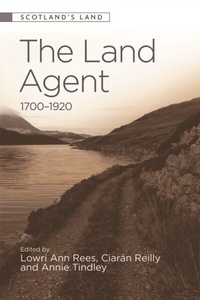
Land Agent
Description

Explores the role of land agents in Britain and its imperial territories between c. 1700-1920
This book brings together leading researchers of British and Irish rural history to consider the role of the land agent, or estate manager, in the modern period. Land agents were an influential and powerful cadre of men, who managed both the day-to-day running and the overall policy direction of landed estates. As such, they occupy a controversial place in academic historiography as well as popular memory in rural Britain and Ireland. Reviled in social history narratives and fictional accounts, the land agent was one of the most powerful tools in the armoury of the British and Irish landed classes and their territorial, political and social dominance. By unpacking the nature and processes of their power, The Land Agent explores who these men were and what was the wider significance of their roles, thus uncovering a neglected history of British rural society.
Contributors
- David Gent, University of York
- Ewen A. Cameron, University of Edinburgh
- John MacGregor, Independent Scholar
- Fidelma Byrne, Maynooth University
- Rachel Murphy, University College Cork
- Finlay McKichan, Independent Scholar
- Lowri Ann Rees, Bangor University
- Anne Casement, Independent Scholar
- Ciarán Reilly, Independent Scholar
- Shaun Evans, Bangor University
- Robin K. Campbell, Independent Scholar
- Kirsty Gunn, University of Dundee
- Annie Tindley, Newcastle University
More details
Other editions
Additional editions
Content
- Intro
- The Land Agent
- Copyright
- Contents
- Figures
- Acknowledgements
- Notes on the Contributors
- Introduction
- Part I Power and its Constructions on Landed Estates
- 1 'Stirring and advancing times': Landlords, Agents and Improvement on the Castle Howard Estate, 1826-66
- 2 'Not a popular personage': The Factor in Scottish Property Relations, c. 1870-1920
- Part II The Transnational Land Agent: Managing Land in the Four Nations and Beyond
- 3 The Factor and Railway Promotion in the Scottish Highlands: The West Highland Railway
- 4 Divisions of Labour: Inter-managerial Conflict among the Wentworth-Fitzwilliam Agents
- 5 The Courtown Land Agents and Transnational Estate Management, 1850-1900
- 6 Peter Fairbairn: Highland Factor and Caribbean Plantation Manager, 1792-1822
- Part III Challenges and Catastrophe: The Land Agent under Fire
- 7 The Tenant Right Agitation of 1849-50: Crisis and Confrontation on the Londonderry Estates in Coun
- 8 Frustrations and Fears: The Impact of the Rebecca Riots on the Land Agent in Carmarthenshire, 1843
- 9 The Evolution of the Irish Land Agent: The Management of the Blundell Estate in the Eighteenth Century
- 10 'Between two interests': Pennant A. Lloyd's Agency of the Penrhyn Estate, 1860-77
- Part IV Social Memory and the Land Agent
- 11 John Campbell ('Am Baillidh Mor'), Chamberlain to the 7th and 8th Dukes of Argyll: Tradition and Social Memory
- 12 'Castle government': The Psychologies of Land Management in Northern Scotland, c. 1830-90
- Postscript
- 13 The Land Agent in Fiction
- 14 Poor Beasts
- Index
