

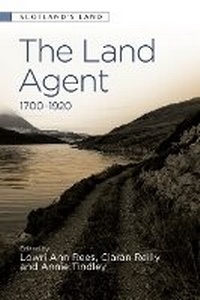
The Land Agent
1700 - 1920
Published on 18. November 2019
Book
Paperback/Softback
272 pages
978-1-4744-3887-2 (ISBN)
Description
This book brings together leading researchers of British and Irish rural history to consider the role of the land agent, or estate manager, in the modern period. Land agents were an influential and powerful cadre of men, who managed both the day-to-day running and the overall policy direction of landed estates. As such, they occupy a controversial place in academic historiography as well as popular memory in rural Britain and Ireland. Reviled in social history narratives and fictional accounts, the land agent was one of the most powerful tools in the armoury of the British and Irish landed classes and their territorial, political and social dominance. By unpacking the nature and processes of their power, The Land Agent explores who these men were and what was the wider significance of their roles, thus uncovering a neglected history of British rural society.
Reviews / Votes
Through their thematic and chronological approach, the editors have created a volume which begins to fill the gaps in the literature. Although this is just the beginning of our understanding of the extent to which the land agent influenced the diurnal management of the estate and the management of local society its case study methodology demonstrates how the approach needed varied, locally, regionally and nationally... At the core of the volume are the different relationships which land agents had to develop and thus this research will have a broad appeal, not just to those interested in rural history, but also to those whose research lies in the relationships forged in the rural community more generally. -- Geoff Monks, University of Leicester * Family & Community History * This is a very important and pioneering comparative study of land agents in Ireland and Britain, a class often reviled in historiography and literature. Ambitious in its scope, and accessible in its scholarship, it is crammed with significant original details about the lives, social backgrounds, education, training, capabilities and weaknesses of a class central to Irish and British rural life in the long nineteenth centuries. -- Prof Terence Dooley, Maynooth University.More details
Series
Language
English
Place of publication
Edinburgh
United Kingdom
Target group
Professional and scholarly
Illustrations
12 black and white illustrations, 1 colour map
Dimensions
Height: 156 mm
Width: 234 mm
Thickness: 19 mm
Weight
432 gr
ISBN-13
978-1-4744-3887-2 (9781474438872)
Copyright in bibliographic data and cover images is held by Nielsen Book Services Limited or by the publishers or by their respective licensors: all rights reserved.
Schweitzer Classification
Other editions
Additional editions
E-Book
06/2018
1st Edition
Edinburgh University Press
€22.49
Available for download
E-Book
06/2018
1st Edition
Edinburgh University Press
€0.00
Available for download
Persons
Lowri Ann Rees is Lecturer in Modern History, School of History and Archaeology, Bangor University. Her research interests centre on eighteenth- and nineteenth-century Wales, in particular the landed elite and their country estates. Lowri has published on paternalism and rural protest, the Rebecca Riots, Welsh sojourners in India, and is currently researching upward social mobility in Wales. Ciaran Reilly is based at the Centre for the Study of Historic Irish Houses & Estates, Maynooth University and is a historian of nineteenth and twentieth-century Irish history. Annie Tindley is Professor of British and Irish Rural History at Newcastle University and Head of the School of History, Classics & Archaeology. Her work interrogates land issues in the modern period including ownership, management and reform. In 2015 she established and became the first director of the Centre for Scotland's Land Futures, an inter-institutional and interdisciplinary research centre, and is the series editor for Scotland's Land, an interdisciplinary book series published by Edinburgh University Press. She is the author of The Sutherland Estate, 1850-1920 (Edinburgh University Press, 2010), and Lachlan Grant of Ballachulish, 1871-1945 (co-edited with Ewen A. Cameron, Birlinn, 2015).
Content
Acknowledgements List of illustrations Introduction, Lowri Ann Rees, Ciaran Reilly & Annie Tindley
Section I: Power and its constructions on landed estates1. 'Stirring and advancing times:' John Henderson, the Earls of Carlisle and Improvement on the Castle Howard estate, c. 1827-1867. David Gent2. 'Not a popular personage': the factor in Scottish property relations, c. 1870-1920. Ewen A. Cameron3. The factor and railway promotion in the Scottish Highlands: the West Highland Railway, John McGregor
Section II: The transnational land agent: managing land in the four nations and beyond4. Divisions of labour: inter-managerial conflict among the Wentworth-Fitzwilliam agents, Fidelma Byrne5. The Courtown Land Agents and Transnational Estate Management, 1850-1900. Rachel Murphy6. Peter Fairbairn: Highland Factor and Caribbean plantation manager, 1792-1822. Finlay McKichan
Section III: Challenges and catastrophe - the land agent under fire7. The Tenant Right Agitation of 1849-50: crisis and confrontation on the Londonderry estate in County Down, Anne Casement8. Frustrations and fears: the impact of the Rebecca Riots on the land agent in Carmarthenshire, 1843. Lowri Ann Rees9. The evolution of the Irish Land Agent: the management of the Blundell estate in the eighteenth century, Ciaran Reilly10, 'Between two interests': Pennant A. Lloyd's agency of the Penrhyn estate, 1860-77. Shaun Evans
Section IV: Social memory and the land agent11. John Campbell ('Am Baillidh Mor'), chamberlain to the 7th & 8th dukes of Argyll: tradition and social memory, Robin K. Campbell12. 'Castle Government': the psychologies of land management in northern Scotland, c.1830-1890. Annie Tindley
Postscript 13. The Land Agent in Fiction, Lowri A. Rees, Ciaran Reilly & Annie Tindley.14. Poor Beasts, Kirsty Gunn.Index
Section I: Power and its constructions on landed estates1. 'Stirring and advancing times:' John Henderson, the Earls of Carlisle and Improvement on the Castle Howard estate, c. 1827-1867. David Gent2. 'Not a popular personage': the factor in Scottish property relations, c. 1870-1920. Ewen A. Cameron3. The factor and railway promotion in the Scottish Highlands: the West Highland Railway, John McGregor
Section II: The transnational land agent: managing land in the four nations and beyond4. Divisions of labour: inter-managerial conflict among the Wentworth-Fitzwilliam agents, Fidelma Byrne5. The Courtown Land Agents and Transnational Estate Management, 1850-1900. Rachel Murphy6. Peter Fairbairn: Highland Factor and Caribbean plantation manager, 1792-1822. Finlay McKichan
Section III: Challenges and catastrophe - the land agent under fire7. The Tenant Right Agitation of 1849-50: crisis and confrontation on the Londonderry estate in County Down, Anne Casement8. Frustrations and fears: the impact of the Rebecca Riots on the land agent in Carmarthenshire, 1843. Lowri Ann Rees9. The evolution of the Irish Land Agent: the management of the Blundell estate in the eighteenth century, Ciaran Reilly10, 'Between two interests': Pennant A. Lloyd's agency of the Penrhyn estate, 1860-77. Shaun Evans
Section IV: Social memory and the land agent11. John Campbell ('Am Baillidh Mor'), chamberlain to the 7th & 8th dukes of Argyll: tradition and social memory, Robin K. Campbell12. 'Castle Government': the psychologies of land management in northern Scotland, c.1830-1890. Annie Tindley
Postscript 13. The Land Agent in Fiction, Lowri A. Rees, Ciaran Reilly & Annie Tindley.14. Poor Beasts, Kirsty Gunn.Index