

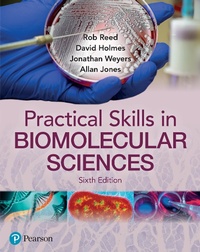
Practical Skills in Biomolecular Science
6th Edition
Published on 25. October 2021
653 pages
978-1-292-39709-2 (ISBN)
Description

An essential companion for students across a range of disciplines, including biochemistry, biomedical sciences, microbiology and molecular biology throughout your entire degree programme, this sixth edition of Practical Skills in Biomolecular Sciences, has been updated and expanded to provide you with a complete and easy-to-read guide. It's an all-in-one solution for the key practical skills needed for all cellular and molecular life sciences, including: comprehensive coverage of study and examination skills; fundamental laboratory methods; investigative and analytical techniques and analysis and presentation of data.
This new edition comes with increased coverage on laboratory skills, new chapters on working with bacteria, eukaryotic microbes and viruses, and on assaying biomolecules, as well as new sections on online learning in a post-COVID world. In addition, 250 new and updated illustrations, tables, and tips - including 25 new 'how to' boxes - have been added, along with numerous end-of-chapter study exercises (with answers provided on the companion website) to support self-evaluation.
This new edition comes with increased coverage on laboratory skills, new chapters on working with bacteria, eukaryotic microbes and viruses, and on assaying biomolecules, as well as new sections on online learning in a post-COVID world. In addition, 250 new and updated illustrations, tables, and tips - including 25 new 'how to' boxes - have been added, along with numerous end-of-chapter study exercises (with answers provided on the companion website) to support self-evaluation.
More details
Edition
6th edition
Language
English
Place of publication
Harlow
United Kingdom
Target group
College/higher education
ISBN-13
978-1-292-39709-2 (9781292397092)
Copyright in bibliographic data and cover images is held by Nielsen Book Services Limited or by the publishers or by their respective licensors: all rights reserved.
Schweitzer Classification
Other editions
Additional editions
Rob Reed | David Holmes | Jonathan Weyers
Practical Skills in Biomolecular Science
Book
12/2021
6th Edition
Pearson Education Limited
€62.50
Shipment within 10-20 days
Persons
Rob Reed, Professor Emeritus (Education and Science) at Central Queensland University, Australia.
David Holmes, Emeritus Professor of Medical Sciences, St George's International School of Medicine, Grenada.
Jonathan Weyers, Honorary Senior Lecturer at the University of Dundee, UK.
Allan Jones, Chancellor's Award Fellow in Ecology, Environmental Science and Zoology at the University of Dundee, UK.
David Holmes, Emeritus Professor of Medical Sciences, St George's International School of Medicine, Grenada.
Jonathan Weyers, Honorary Senior Lecturer at the University of Dundee, UK.
Allan Jones, Chancellor's Award Fellow in Ecology, Environmental Science and Zoology at the University of Dundee, UK.
Content
Preface
List of abbreviations
Study strategies
Developing your skills
Self-management
Learning effectively
Making the most of learning resources
Locating and citing published information
Evaluating information
Working with others
Mapping your personal development
Assessment skills
Succeeding in assessments
Scientific writing
Writing essays
Reporting practical and project work
Tackling literature surveys and reviews
Presenting written assignments
Preparing a poster
Giving a spoken presentation
Revision strategies
Improving your performance in exams
Fundamental laboratory techniques
Preparing for practical work
Working safely in the lab
Basic laboratory skills
Measuring and dispensing liquids
Preparing solutions - principles and practice
Measuring and maintaining pH
Understanding microscopy
Setting up and using a light microscope
The investigative approach
Making measurements
Understanding SI units and their use
Designing experiments
Understanding bioethics
Recording data and images
Tackling project work and placements
Working with microbes, cells and tissues
Learning sterile technique
Culturing cells and measuring growth
Collecting and isolating microbes
Identifying microbes
Naming microbes and other organisms
Working with bacteria
Working with eukaryotic microbes: fungi and protists
Working with viruses
Working with animal and plant cells and tissues
Homogenising and fractionating cells and tissues
Analytical techniques
Understanding calibration and quantitative analysis
Centrifugation techniques
Measuring light
Using advanced spectroscopy and spectrometry
Carrying out basic spectroscopy and spectrometry
Separating compounds using chromatography
Detecting and analysing compounds after chromatography
Methods of electrophoresis
Advanced electrophoretic techniques
Electroanalytical techniques
Using immunological methods
Using radioisotopes
Analysing stable isotopes
Assaying biomolecules and studying metabolism
Analysing biomolecules
Assaying amino acids, peptides and proteins
Assaying lipids
Assaying carbohydrates
Assaying nucleic acids and nucleotides
Protein purification
Studying enzymes
Measuring membrane transport
Quantifying photosynthesis and respiration
Genetics and molecular biology
Studying Mendelian and population genetics
Studying bacterial and phage genetics
Understanding molecular genetics - fundamental principles
Using the polymerase chain reaction in molecular genetics
Genetic manipulation techniques
Applying bioinformatics
Analysing and presenting data
Manipulating and transforming raw data
Analysing data with spreadsheets
Summarising data in tables
Illustrating data in graphs
Solving numerical problems
Using descriptive statistics
Selecting and interpreting statistical tests
Appendix 1
Index
List of abbreviations
Study strategies
Developing your skills
Self-management
Learning effectively
Making the most of learning resources
Locating and citing published information
Evaluating information
Working with others
Mapping your personal development
Assessment skills
Succeeding in assessments
Scientific writing
Writing essays
Reporting practical and project work
Tackling literature surveys and reviews
Presenting written assignments
Preparing a poster
Giving a spoken presentation
Revision strategies
Improving your performance in exams
Fundamental laboratory techniques
Preparing for practical work
Working safely in the lab
Basic laboratory skills
Measuring and dispensing liquids
Preparing solutions - principles and practice
Measuring and maintaining pH
Understanding microscopy
Setting up and using a light microscope
The investigative approach
Making measurements
Understanding SI units and their use
Designing experiments
Understanding bioethics
Recording data and images
Tackling project work and placements
Working with microbes, cells and tissues
Learning sterile technique
Culturing cells and measuring growth
Collecting and isolating microbes
Identifying microbes
Naming microbes and other organisms
Working with bacteria
Working with eukaryotic microbes: fungi and protists
Working with viruses
Working with animal and plant cells and tissues
Homogenising and fractionating cells and tissues
Analytical techniques
Understanding calibration and quantitative analysis
Centrifugation techniques
Measuring light
Using advanced spectroscopy and spectrometry
Carrying out basic spectroscopy and spectrometry
Separating compounds using chromatography
Detecting and analysing compounds after chromatography
Methods of electrophoresis
Advanced electrophoretic techniques
Electroanalytical techniques
Using immunological methods
Using radioisotopes
Analysing stable isotopes
Assaying biomolecules and studying metabolism
Analysing biomolecules
Assaying amino acids, peptides and proteins
Assaying lipids
Assaying carbohydrates
Assaying nucleic acids and nucleotides
Protein purification
Studying enzymes
Measuring membrane transport
Quantifying photosynthesis and respiration
Genetics and molecular biology
Studying Mendelian and population genetics
Studying bacterial and phage genetics
Understanding molecular genetics - fundamental principles
Using the polymerase chain reaction in molecular genetics
Genetic manipulation techniques
Applying bioinformatics
Analysing and presenting data
Manipulating and transforming raw data
Analysing data with spreadsheets
Summarising data in tables
Illustrating data in graphs
Solving numerical problems
Using descriptive statistics
Selecting and interpreting statistical tests
Appendix 1
Index
