

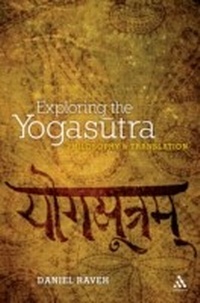
Exploring the Yogasutra
Philosophy and Translation
1st Edition
Published on 8. March 2012
184 pages
978-1-4411-1466-2 (ISBN)
Description

Patanjali's Yogasutra is an ancient canonic Indian text composed in Sanskrit in the 3rd or 4th century. Belonging to a very different cultural milieu, this multi-layered text is philosophical, psychological and practical in nature. Offering a philosophical reading of Patanjali's Yogasutra, this book discusses themes such as freedom, self-identity, time and transcendence, and translation - between languages, cultures and eras. Drawing substantially upon contemporary Indian materials, it discusses for the first time classical yoga as reflected upon by Daya Krishna (1924-2007) with constant reference to Krishna Chandra Bhattacharyya's (1875-1949) studies in yoga philosophy. The genuine attempt on behalf of these two original thinkers to engage philosophically with Patanjala-yoga sets the tone of the textual exploration provided here. This book features a new annotated translation of the Yogasutra, and the author provides a useful background to the extensive Samkhya terminology employed by Patanjali. Daniel Raveh also offers a close reflection of the very act of translation, and the book concludes with suggestions for further reading and a glossary of central notions.
Reviews / Votes
'Thinking anew with Patanjali: this is a modern-day translation and meditation on the spiritual praxis and philosophy of the Yogasutras, the great ancient Indian classic. Daniel Raveh's refreshing book is, at the same time, a sensitive reflection on meaningful cross-cultural and cross-epochal translation which he sees as a process of creative transformation, a process inevitable for retaining significance.' 'Raveh's thoughtful reflections on the nature of translation, his investigation of five key themes: practice, dispassion, ignorance, clinging, and yogic knowledge, as well as his skilfully rendered new translation of the Yoga Sutra make this book indispensible reading for anyone with a serious interest in the study of classical Yoga.' 'As a philosophical work attempting to answer some questions that Patanjali's YS raises, it is a refreshing change from the recent trend of Yoga books dealing mainly with "physical-Yoga".' 'Exploring the Yogasutra presents a new, engaging perspective on Patanjali from a philosophical point of view. It is a contribution invaluable for anybody interested in this authoritative source of Yoga theory.' 'Raveh undertakes an extraordinary clarification of the old, profound, paradoxical, often mysterious inward-seeking inwardness of the Yogasutra...Altogether, the book is a great didactic success in the translation of the thought and practice of one culture into the terms of another.' [Raveh's] appreciation of the many commentarial perspectives on the text is a welcome change from other authors who claim to be able to divine the true meaning of Patanjali's sutras ... [A] valuable and thought-provoking addition to the literature on Yogasutra. * Religious Studies Review *More details
Edition
1. Auflage
Language
English
Place of publication
New York
United States
ISBN-13
978-1-4411-1466-2 (9781441114662)
Copyright in bibliographic data and cover images is held by Nielsen Book Services Limited or by the publishers or by their respective licensors: all rights reserved.
Schweitzer Classification
Other editions
Additional editions
Book
05/2012
Continuum Publishing Corporation
€51.80
Shipment within 15-20 days
Person
Daniel Raveh is Lecturer of Indian and Comparative Philosophy at Tel Aviv University, Israel.
Content
Acknowledgements
Abbreviations
List of Transliteration
Entree: Translating the Other: Reflections on a Fictional Dialogue
Introduction: Yoga, Translation, the Other
1. Abhyasa/Vairagya: A Conceptual Investigation into the Process of Yoga
2. Revisiting avidya and abhinivesa: A note on Yoga Psychology
3. Rethinking Prajna: Yogasutra 1.49 under a Philosophical Magnifying Glass
4. Text as a Process: A dialogue with Daya Krishna
5. "The Undeciphered Text: Anomalies, Problems and Paradoxes in the Yogasutra" by Daya Krishna
Concise
Glossary
Appendix I: Introduction to the Yogasutra Translation, or: why another translation?
Appendix II: The Yogasutra in Transliteration
Appendix III: The Yogasutra in Translation
Bibliography
Index
Abbreviations
List of Transliteration
Entree: Translating the Other: Reflections on a Fictional Dialogue
Introduction: Yoga, Translation, the Other
1. Abhyasa/Vairagya: A Conceptual Investigation into the Process of Yoga
2. Revisiting avidya and abhinivesa: A note on Yoga Psychology
3. Rethinking Prajna: Yogasutra 1.49 under a Philosophical Magnifying Glass
4. Text as a Process: A dialogue with Daya Krishna
5. "The Undeciphered Text: Anomalies, Problems and Paradoxes in the Yogasutra" by Daya Krishna
Concise
Glossary
Appendix I: Introduction to the Yogasutra Translation, or: why another translation?
Appendix II: The Yogasutra in Transliteration
Appendix III: The Yogasutra in Translation
Bibliography
Index
