
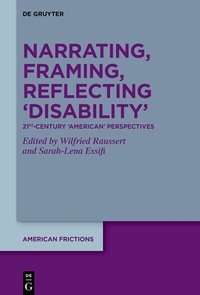
Narrating, Framing, Reflecting 'Disability'
Description
Alles über E-Books | Antworten auf Fragen rund um E-Books, Kopierschutz und Dateiformate finden Sie in unserem Info- & Hilfebereich.
Fostering a dialog between Critical Disability Studies, American Studies, InterAmerican Studies, and Global Health Studies, the edited compilation conceptualizes disability and (mental) illnesses as a cultural narrative enabling a deeper social critique. By looking at contemporary cultural productions primarily from the USA, Canada, and the Caribbean, the books' objective is to explore how literary texts and other cultural productions from the Americas conceptualize, construct, and represent disability as a narrative and to investigate the deep structures underlying the literary and cultural discourses on and representations of disability including parameters such as disease, racism, and sexism among others. Disability is read as a shifting phenomenon rooted in the cultures and histories of the Americas.
More details
Other editions
Additional editions
Persons
Wilfried Raussert; Sarah-Lena Essifi , Bielefeld University, Germany.

System requirements
File format: ePUB
Copy protection: Watermark-DRM (Digital Rights Management)
System requirements:
- Computer (Windows; MacOS X; Linux): Use a reading software that can process the file format ePUB: e.g., Adobe Digital Editions or FBReader – both free (see eBook Help).
- Tablet/Smartphone (Android; iOS): Before downloading, install the free app Adobe Digital Editions (see eBook Help).
- E-reader: Bookeen, Kobo, Pocketbook, Sony, Tolino and many more (not Kindle).
The file format ePUB works well for novels and non-fiction books – i.e., „flowing” text without complex layout. On an e-reader or smartphone, line and page breaks automatically adjust to fit the small displays.
This eBook uses Watermark-DRM, a „soft” copy protection. This means that there are no technical restrictions to prevent illegal distribution. However, there is a personalised watermark embedded in the eBook that can be used to identify the purchaser of the eBook in the event of misuse and to provide evidence for legal purposes.
For more information, see our eBook Help page.