

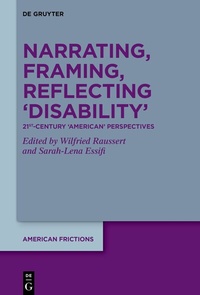
Narrating, Framing, Reflecting 'Disability'
Description

Fostering a dialog between Critical Disability Studies, American Studies, InterAmerican Studies, and Global Health Studies, the edited compilation conceptualizes disability and (mental) illnesses as a cultural narrative enabling a deeper social critique. By looking at contemporary cultural productions primarily from the USA, Canada, and the Caribbean, the books' objective is to explore how literary texts and other cultural productions from the Americas conceptualize, construct, and represent disability as a narrative and to investigate the deep structures underlying the literary and cultural discourses on and representations of disability including parameters such as disease, racism, and sexism among others. Disability is read as a shifting phenomenon rooted in the cultures and histories of the Americas.
More details
Other editions
Additional editions
Persons
Wilfried Raussert; Sarah-Lena Essifi , Bielefeld University, Germany.
Content
- Intro
- Acknowledgments
- Contents
- Introduction: Narrating, Framing, Reflecting 'Disability': Twenty-First Century 'American' Perspectives
- Part I: Disability and Life Narratives
- Life Writing, Writing Life: Autobiography, Neoliberalism, and Disability in Mitchell Levitz's and Jason Kingsley's Count Us In
- Reflecting 'Disability': Illness and Literary Diagnosis in David Chariandy's Soucouyant (2007)
- "There're two kinds of psychosis": Mental Illness as Metaphor in the Worlds of Charlie Kaufman
- When the System Fails - How Dementia Undermines the Cultural Narrative of the Mind
- Part II: Disability, Trauma, and Healing
- "Ah can't prevent it. Is in we blood." Bodymind Expressions of Ancestral Trauma, Depression, and Healing in Nicole Dennis-Benn's, Patsy (2019)
- Transcending Trauma: Decolonial Feminist Healing in the Novels Birdie (2015) by Tracey Lindberg and The Break (2016) by Katharena Vermette
- Part III: Disability, Gender, and Intersectionality
- Much-Needed Rest? Female Agency and the Rest Cure in Treatments of Depression in Charlotte Perkins Gilman's "The Yellow Wall-Paper" and Ottessa Moshfegh's My Year of Rest and Relaxation
- An Intersectional Reading of Toni Morrison's "Recitatif": Exploring the Entanglements of Race, Gender, Class and Disability
- Deer Women: Cut in The Straight Story. An Ecofeminist Reading of Road Movies and Roads
- Part IV: Disability, Body-Ability, Eco-Ability, and Speciesism
- Civil War "Supercrip": John Smith's Funny ??? Adventures as a One-Legged Soldier
- The Abilities of the Body: A Study from the Theater
- Eco-Ability as Narrative Prosthesis: Narrating Disability along Ecocide and Environmental Resistance in Imbolo Mbue's How Beautiful We Were
- Words Unspoken - Thinking about Intersections of Ableism and Speciesism
- About the Authors
- Index
