

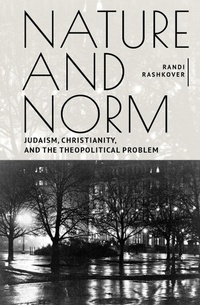
Nature and Norm
Judaism, Christianity, and the Theopolitical Problem
1st Edition
Published on 2. February 2021
246 pages
978-1-64469-511-1 (ISBN)
Description

Nature and Norm is a book about the encounter between Jewish and Christian thought and the fact-value divide that invites the unsettling recognition of the dramatic acosmism that shadows and undermines a considerable number of modern and contemporary Jewish and Christian thought systems.
More details
Other editions
Additional editions
Book
12/2020
Academic Studies Press
€99.20
Shipment within 3-4 weeks
Person
Rashkover Randi:
Randi Rashkover holds the Nathan and Sofia Gumenick Chair in Judaic Studies at William & Mary. She is the author of Freedom and Law: A Jewish-Christian Apologetics (Fordham University Press, 2011) and Revelation and Theopolitics: Barth, Rosenzweig and the Politics of Praise (T&T Clark, 2005).Randi Rashkover holds the Nathan and Sofia Gumenick Chair in Judaic Studies at William & Mary. She is the author of Freedom and Law: A Jewish-Christian Apologetics (Fordham University Press, 2011) and Revelation and Theopolitics: Barth, Rosenzweig and the Politics of Praise (T&T Clark, 2005).
Randi Rashkover holds the Nathan and Sofia Gumenick Chair in Judaic Studies at William & Mary. She is the author of Freedom and Law: A Jewish-Christian Apologetics (Fordham University Press, 2011) and Revelation and Theopolitics: Barth, Rosenzweig and the Politics of Praise (T&T Clark, 2005).Randi Rashkover holds the Nathan and Sofia Gumenick Chair in Judaic Studies at William & Mary. She is the author of Freedom and Law: A Jewish-Christian Apologetics (Fordham University Press, 2011) and Revelation and Theopolitics: Barth, Rosenzweig and the Politics of Praise (T&T Clark, 2005).
Content
Table of ContentsIntroductionChapter One: Theology and Subjectivism in Rosenzweig and KantI. Kant, Rosenzweig, and the Challenge of SkepticismA. Kant and the Limits of Practical Reason
B. Rosenzweig and the Subjective TurnII. Diagnosing the Problem: Kant, Rosenzweig, and the Fact-Value DivideIII. Symptoms of the Fact-Value DivideChapter Two: Acceptance and the Theopolitical ProblemI. AcceptanceII. Case Study: Spinoza and HobbesChapter Three: From Redescription to External CritiqueI. Redescription or the Turn to the "More"II. Case Study: Martin Buber and Carl Schmitt Chapter Four: From External Critique to the Crisis of Skepticism I. External CritiqueII. Case Study: Karl Barth and Leo StraussChapter Five: Beyond the Fact-Value DivideI. The Philosophical Demands of the Theopolitical ProblemII. Characteristics of a Post-Fact-Value Jewish and Christian ThinkingA. Intelligibility, Justification, and the Who, How, and When of Knowledge
B. Habituation, Disuse, and Rehabituation: The Social Determination of Warranted AssertabilityIII. Case Study: Peter Ochs and Nicholas Adams Chapter Six: Science Apprehending ScienceI. The Fact-Value Model: From Sense-Certainty to Self-Alienated CultureA. Pre-Idealism: Epistemology, Self-Consciousness, and the Fact-Value Value Paradigm
B. Transcendental Idealism and Scientific Theory
C. Transcendental Idealism and Practical FreedomII. External Critique: Pure Insight and the EnlightenmentIII. Immanent Critique: From the Moral Law to Communal JustificationA. Immanent Critique: From Moral Consciousness to the Reconciliatory
B. Religious Representation and Philosophical AuthorityIV. ConclusionBibliography
B. Rosenzweig and the Subjective TurnII. Diagnosing the Problem: Kant, Rosenzweig, and the Fact-Value DivideIII. Symptoms of the Fact-Value DivideChapter Two: Acceptance and the Theopolitical ProblemI. AcceptanceII. Case Study: Spinoza and HobbesChapter Three: From Redescription to External CritiqueI. Redescription or the Turn to the "More"II. Case Study: Martin Buber and Carl Schmitt Chapter Four: From External Critique to the Crisis of Skepticism I. External CritiqueII. Case Study: Karl Barth and Leo StraussChapter Five: Beyond the Fact-Value DivideI. The Philosophical Demands of the Theopolitical ProblemII. Characteristics of a Post-Fact-Value Jewish and Christian ThinkingA. Intelligibility, Justification, and the Who, How, and When of Knowledge
B. Habituation, Disuse, and Rehabituation: The Social Determination of Warranted AssertabilityIII. Case Study: Peter Ochs and Nicholas Adams Chapter Six: Science Apprehending ScienceI. The Fact-Value Model: From Sense-Certainty to Self-Alienated CultureA. Pre-Idealism: Epistemology, Self-Consciousness, and the Fact-Value Value Paradigm
B. Transcendental Idealism and Scientific Theory
C. Transcendental Idealism and Practical FreedomII. External Critique: Pure Insight and the EnlightenmentIII. Immanent Critique: From the Moral Law to Communal JustificationA. Immanent Critique: From Moral Consciousness to the Reconciliatory
B. Religious Representation and Philosophical AuthorityIV. ConclusionBibliography
