

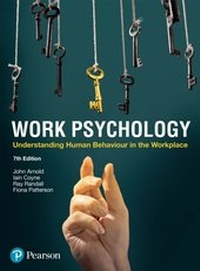
Work Psychology
Understanding Human Behaviour In The Workplace
7th Edition
Published on 21. February 2020
656 pages
978-1-292-26945-0 (ISBN)
Description

Gain a clear and authoritative introduction to human behaviour in the workplace
Work Psychology, 7th edition, by Arnold, Coyne, Randall and Patterson is an accessible and fascinating examination of human behaviour in today's workplace, written by authors who are all experts in their fields. Substantially updated with new chapters from new authors, and new material that reflects current research and debate in the area, the text retains its popular blend of theory, research and engaging examples. Covering a broad range of core topics, this text is suitable for undergraduate students in business, management, and psychology as well as those studying for professional qualifications.
New to this edition:
A clear and consistent structure, including an opening and closing case study and other exercises within each chapter to help you to apply what you've learnt
Attractive full-colour design that aids navigation and enlivens the text
Embedded within each chapter, coverage of diversity, technology and internationalization issues
Learning outcomes, multiple-choice questions, discussion questions, a glossary, annotated further reading and weblinks to enable your learning within and beyond the textbook
All the latest research and hot topics in the field of work psychology
A 'Key debate' feature that directs you to key controversies and contemporary debate around work psychology today
A 'Research methods in focus' feature that demystifies and illustrates with examples the use of strong research methods in practice
A 'Point of integration' feature which clearly links the theories between chapters, allowing for a greater understanding of the topic as a whole
Additional material for lecturers is available at go.pearson.com/uk/he/resources
John Arnold is Professor of Organisational Behaviour in the School of Business and Economics at Loughborough University.
Iain Coyne is Senior Lecturer in Organisational Psychology, School of Business and Economics, Loughborough University, UK.
Ray Randall is Senior University Teacher in Work Psychology, Institute of Work Psychology, Sheffield University Management School, UK.
Fiona Patterson is Founder Director of the Work Psychology Group, Visiting Researcher, University of Cambridge and Visiting Professor, City University, London, UK.
Pearson, the world's learning company.
Work Psychology, 7th edition, by Arnold, Coyne, Randall and Patterson is an accessible and fascinating examination of human behaviour in today's workplace, written by authors who are all experts in their fields. Substantially updated with new chapters from new authors, and new material that reflects current research and debate in the area, the text retains its popular blend of theory, research and engaging examples. Covering a broad range of core topics, this text is suitable for undergraduate students in business, management, and psychology as well as those studying for professional qualifications.
New to this edition:
A clear and consistent structure, including an opening and closing case study and other exercises within each chapter to help you to apply what you've learnt
Attractive full-colour design that aids navigation and enlivens the text
Embedded within each chapter, coverage of diversity, technology and internationalization issues
Learning outcomes, multiple-choice questions, discussion questions, a glossary, annotated further reading and weblinks to enable your learning within and beyond the textbook
All the latest research and hot topics in the field of work psychology
A 'Key debate' feature that directs you to key controversies and contemporary debate around work psychology today
A 'Research methods in focus' feature that demystifies and illustrates with examples the use of strong research methods in practice
A 'Point of integration' feature which clearly links the theories between chapters, allowing for a greater understanding of the topic as a whole
Additional material for lecturers is available at go.pearson.com/uk/he/resources
John Arnold is Professor of Organisational Behaviour in the School of Business and Economics at Loughborough University.
Iain Coyne is Senior Lecturer in Organisational Psychology, School of Business and Economics, Loughborough University, UK.
Ray Randall is Senior University Teacher in Work Psychology, Institute of Work Psychology, Sheffield University Management School, UK.
Fiona Patterson is Founder Director of the Work Psychology Group, Visiting Researcher, University of Cambridge and Visiting Professor, City University, London, UK.
Pearson, the world's learning company.
All prices
More details
Edition
7th edition
Language
English
Place of publication
Harlow
United Kingdom
Target group
Professional and scholarly
ISBN-13
978-1-292-26945-0 (9781292269450)
Copyright in bibliographic data and cover images is held by Nielsen Book Services Limited or by the publishers or by their respective licensors: all rights reserved.
Schweitzer Classification
Other editions
New editions
John Arnold | Iain Coyne | Ray Randall
Work Psychology
E-Book
04/2025
8th Edition
Pearson
€59.49
Available for download
Additional editions
John Arnold | Iain Coyne | Ray Randall
Work Psychology
Understanding Human Behaviour In The Workplace
Book
02/2020
7th Edition
Pearson Education Limited
€96.86
Shipment within 10-20 days
Persons
John Arnold is Professor of Organisational Behaviour in the School of Business and Economics at Loughborough University.
Iain Coyne is Senior Lecturer in Organisational Psychology, School of Business and Economics, Loughborough University.
Ray Randall is Senior University Teacher in Work Psychology, Institute of Work Psychology, Sheffield University Management School.
Fiona Patterson is Founder Director of the Work Psychology Group, Visiting Researcher, University of Cambridge and Visiting Professor, City University, London.
Iain Coyne is Senior Lecturer in Organisational Psychology, School of Business and Economics, Loughborough University.
Ray Randall is Senior University Teacher in Work Psychology, Institute of Work Psychology, Sheffield University Management School.
Fiona Patterson is Founder Director of the Work Psychology Group, Visiting Researcher, University of Cambridge and Visiting Professor, City University, London.
Content
Chapter 1: The discipline of work psychology: An initial orientation
Chapter 2: Individual differences
Chapter 3: Selection: Analysing jobs, competencies and selection methods
Chapter 4: Assessing performance at work
Chapter 5: Attitudes at work
Chapter 6: Work motivation
Chapter 7: Training and development
Chapter 8: Work-related stress and well-being
Chapter 9: Groups, teams and teamwork
Chapter 10: Leadership
Chapter 11: Careers and career management
Chapter 12: Understanding organisational change and culture
Chapter 13: The psychology of dispersed work
Glossary
References
Index
Chapter 2: Individual differences
Chapter 3: Selection: Analysing jobs, competencies and selection methods
Chapter 4: Assessing performance at work
Chapter 5: Attitudes at work
Chapter 6: Work motivation
Chapter 7: Training and development
Chapter 8: Work-related stress and well-being
Chapter 9: Groups, teams and teamwork
Chapter 10: Leadership
Chapter 11: Careers and career management
Chapter 12: Understanding organisational change and culture
Chapter 13: The psychology of dispersed work
Glossary
References
Index
