

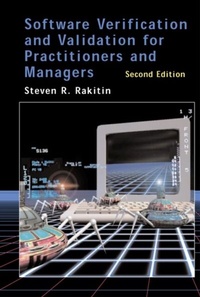
Software Verification And Validation For Practitioners And Managers, Second Edition
1st Edition
Published on 1. January 2000
424 pages
978-1-58053-473-4 (ISBN)
Description

Suitable for software quality assurance professionals, software engineers, project managers and senior managers, this book is a concise and practical introduction to the basic principles of effective software verification and validation (V&V). This new edition has been thoroughly revised and includes five new chapters and five new appendices focused on management techniques to make your company's software V&V efforts more cost-effective. For Managers, you learn how to help your organization create more accurate estimates and schedules. For practitioners, you learn fundamental software verification and validation practices such as the formal inspection process, configuration management, effective testing techniques, and how to use measurements to drive further process improvements. This easy-to-use resource offers you guidance in essential software V&V techniques and helps you balance the conflicting demands of quality, features, and schedules. You also learn how to balance the conflicting needs of people, process, and product, and manage commitments and risk. Other key topics include: metrics, configuration management, and software reliability growth modeling. The 15 appendices contain checklists for several kinds of inspections, document templates, an outline for a software development process, information on using the "e;Yellow Sticky Method"e; for estimating and scheduling, a comparison of software development "e;Best Practices,"e; Software Quality "e;Best Practices,"e; Conducting Project Post-Mortems, and Performing Root Cause Analysis.
More details
Other editions
Additional editions
Book
08/2001
2nd Edition
Artech House Publishers
€100.50
Shipment within 10-20 days
Content
- Intro
- Contents
- Preface to the Second Edition
- Acknowledgments
- Part I Introduction
- 1 Software in Perspective
- 1.1 The Software Crisis
- 1.2 The Elusive Silver Bullet
- 1.3 Other Attempts to Resolve the Crisis
- 1.3.1 Formal Proof of Correctness
- 1.3.2 Independent Verification and Validation
- 1.3.3 Software Quality Assurance
- 1.3.4 Cleanroom Process
- 1.4 Understanding the Nature of Software
- 1.5 Software Process Improvement Initiatives
- 1.5.1 SEI Capability Maturity Model ( CMM SM)
- 1.5.2 ISO SPICE
- 1.5.3 Bootstrap
- 1.5.4 ISO 12207
- 1.5.5 Trillium
- 1.6 Summary
- References
- Web Resources
- 2 Software Development Life- Cycle Models
- 2.1 The Waterfall Model
- 2.2 Concurrent Development Model
- 2.3 The Rapid Prototyping Model
- 2.4 The Spiral Model
- 2.5 Hybrid Models
- 2.6 Model- Based Development
- 2.7 Object- Oriented Models
- 2.8 Summary
- References
- 3 Software Development Process
- 3.1 Software Development Process FAQs
- 3.2 Summary
- References
- 4 Economic Justification
- 4.1 Economic Justification
- 4.2 Software Defect Cost Models
- 4.3 Measuring the Cost of Quality
- 4.4 Summary
- References
- Selected Bibliography
- Part II Overview of Software Verification Activities
- Reference
- 5 The Inspection Process
- 5.1 Inspection Process FAQs
- 5.2 Summary
- References
- Selected Bibliography
- Web Resources
- 6 Applying the Inspection Process
- 6.1 Attributes of a Good Process
- 6.1.1 Institutionalizing Inspections
- 6.1.2 Real- Life Experiences
- 6.2 Requirements Inspections
- 6.2.1 Objectives and Prerequisites
- 6.2.2 Requirements Inspection Process
- 6.3 Design Inspection
- 6.3.1 Objectives and Prerequisites
- 6.3.2 Design Inspection Process
- 6.4 Code Inspection
- 6.4.1 Objectives and Prerequisites
- 6.4.2 Code Inspection Process
- 6.5 Test Script Inspection
- 6.5.1 Objectives and Prerequisites
- 6.5.2 Test Procedure Inspection Process
- 6.6 Summary
- References
- 7 Software Quality Metrics
- 7.1 Strategy for Implementing a Software Metrics Program
- 7.2 Software Quality Metrics Framework
- 7.2.1 Definitions
- 7.2.2 The Framework
- 7.2.3 Applying the Software Quality Metrics Methodology
- 7.3 Metrics That Support Software Verification Activities
- 7.3.1 Complexity
- 7.3.2 Defect Metrics
- 7.3.3 Product Metrics
- 7.3.4 Process Metrics
- 7.4 Summary
- References
- Web References
- 8 Configuration Management
- 8.1 Software Configuration Managment Basics
- 8.1.1 Definitions
- 8.1.2 Example of a Manufacturing Process
- 8.2 Identification
- 8.2.1 Naming and Labeling
- 8.2.2 Version Control
- 8.2.3 Software Configuration Items
- 8.3 Baseline Management
- 8.3.1 Workspace Management
- 8.3.2 Baseline Change Assessment
- 8.3.3 Version Management
- 8.4 Auditing and Reporting
- 8.4.1 Auditing
- 8.4.2 Configuration Status Accounting
- 8.4.3 Reports, Record Collection, and Retention
- 8.5 Summary
- References
- Part III Overview of Software Validation Activities
- Reference
- 9 Testing
- 9.1 Levels, Methods, and Types of Tests
- 9.1.1 Test Levels
- 9.1.2 Test Methods
- 9.1.3 Test Types
- 9.2 Concurrent Development/ Validation Testing Model
- 9.2.1 Informal Validation
- 9.2.2 Validation Readiness Review
- 9.2.3 Formal Validation
- 9.3 Test Planning
- 9.3.1 Test Plan
- 9.3.2 Test Procedure
- 9.3.3 Test Report
- 9.4 Summary
- References
- Web Resources
- 10 Validation Metrics
- 10.1 Time Measures
- 10.1.1 Find- Fix Cycle Time
- 10.1.2 Cumulative Test Time
- 10.2 Test Coverage Metrics
- 10.2.1 Code Coverage
- 10.2.2 Requirements Coverage
- 10.3 Quality Metrics
- 10.3.1 Defect Removal Percentage
- 10.3.2 Defects Reported in Each Baseline
- 10.3.3 Defect Detection Efficiency
- 10.4 Summary
- References
- 11 Software Reliability Growth
- 11.1 Definitions
- 11.2 The Test- Analyze- Fix Process
- 11.3 Reliability Growth Modeling
- 11.3.1 Objectives of Modeling
- 11.3.2 Types of Models
- 11.3.3 Model Assumptions
- 11.3.4 Model Selection Process
- 11.3.5 Applying the Selected Model
- 11.3.6 Reliability Modeling Tools
- 11.4 Summary
- References
- Web Resources
- Part IV Predictable Software Development
- Reference
- 12 Motivation for Becoming Predictable
- 12.1 Introduction to Predictable Software Development
- 12.2 Characteristics of Unpredictable Organizations
- 12.3 Characteristics of Predictable Organizations
- 12.4 Management Can Change the Organization
- 12.5 Summary
- References
- 13 Balancing Quality, Features, and Schedule
- 13.1 Quality
- 13.1.1 The Impact of Poor Quality
- 13.1.2 Quality and Risk
- 13.2 Features
- 13.3 Schedules
- 13.3.1 Most Projects Are Scheduled Backwards
- 13.3.2 We Don't Teach Estimating and Scheduling Skills
- 13.3.3 We Don't Cultivate Software Project Management Skills
- 13.3.4 We Don't Manage Risk and Commitments
- 13.3.5 We Don't Manage Change
- 13.4 Balancing Quality, Features, and Schedule
- 13.5 Summary
- References
- Selected Bibliography
- 14 Accurate Estimating and Scheduling
- 14.1 Why Estimates and Schedules Are Wrong Most of the Time
- 14.2 A Typical Scheduled Backwards Project
- 14.3 Software Estimating Techniques
- 14.3.1 Function Points and Feature Points
- 14.3.2 COCOMO II
- 14.3.3 Wideband Delphi Method
- 14.4 Scheduling Techniques
- 14.4.1 PERT and CPM
- 14.4.2 The Yellow Sticky Method
- 14.5 Summary
- References
- Selected Bibliography
- Web Resources
- 15 Balancing People, Process, and Product
- 15.1 Process
- 15.1.1 Economic Motivation
- 15.1.2 The Process- Oriented Organization
- 15.1.3 Finding the Right Process
- 15.2 People
- 15.2.1 Provide Motivation
- 15.2.2 Reduce Turnover
- 15.2.3 Build Effective Teams
- 15.2.4 Best Practices for Managing People
- 15.3 Product
- 15.3.1 Project Postmortems
- 15.3.2 Triage Process
- 15.3.3 Root- Cause Analysis
- 15.4 Summary
- References
- 16 Managing Commitment and Risk
- 16.1 Managing Commitments
- 16.2 Risk
- 16.3 Risk- Management Techniques
- 16.4 Summary
- References
- Appendix A: Inspection Roles and Responsibilities
- A. 1 Roles
- A. 2 Responsibilities
- A. 2.1 Moderator
- A. 2.2 Producer
- A. 2.3 Reader
- A. 2.4 Inspectors
- A. 2.5 Recorder ( Optional Role)
- A. 2.6 Manager
- Appendix B: A Sample Inspection Process
- B. 1 Planning
- B. 1.1 Objectives
- B. 1.2 Entry Criteria
- B. 1.3 Activities
- B. 1.4 Exit Criteria
- B. 1.5 Metrics
- B. 2 Overview Meeting ( Optional)
- B. 2.1 Objective
- B. 2.2 Entry Criteria
- B. 2.3 Activities
- B. 2.4 Exit Criteria
- B. 2.5 Metrics
- B. 3 Preparation
- B. 3.1 Objective
- B. 3.2 Entry Criteria
- B. 3.3 Activities
- B. 3.4 Exit Criteria
- B. 3.5 Metrics
- B. 4 Inspection Meeting
- B. 4.1 Objective
- B. 4.2 Entry Criteria
- B. 4.3 Activities
- B. 4.4 Exit Criteria
- B. 4.5 Metrics
- B. 5 Follow- Up
- B. 5.1 Objective
- B. 5.2 Entry Criteria
- B. 5.3 Activities
- B. 5.4 Exit Criteria
- B. 5.5 Metrics
- Appendix C: Inspection Process Forms
- Appendix D: Inspection Checklists
- D. 1 Requirements Inspection Checklist
- D. 2 Design Inspection Checklist: High- Level Design
- D. 3 Design Inspection Checklist: Detailed Design
- D. 4 Code Inspection Checklist for C Code
- D. 5 A C++ Code Inspection Checklist
- D. 5.1 Variable Declarations
- D. 5.2 Data Usage
- D. 5.3 Initialization
- D. 5.4 Macros
- D. 5.5 Sizing of Data
- D. 5.6 Dynamic Allocation
- D. 5.7 Pointers
- D. 5.8 Casting
- D. 5.9 Computation
- D. 5.10 Conditionals
- D. 5.11 Flow Control
- D. 5.12 Assignment
- D. 5.13 Argument Passing
- D. 5.14 Return Values
- D. 5.15 Function Calls
- D. 5.16 Files
- D. 5.17 Errors Due to Implicit Type Conversions
- D. 5.18 Errors Due to Loss of " Precision" in Return Values
- D. 5.19 Loop Checklist
- D. 5.20 Copyright Notices
- D. 6 Test Procedure Inspection Checklist
- Appendix E: Attributes of Good Requirements Specifications
- Appendix F: Sample Criteria for Selecting Modules for Code Inspection
- Appendix G: Sample Software Development Process Based on the Waterfall Model
- G. 1 Requirements Analysis Phase
- G. 2 Requirements Definition Phase
- G. 3 Design Phase
- G. 4 Coding Phase
- G. 5 Testing Phase
- G. 6 Maintenance Phase
- Appendix H: Document Outlines
- H. 1 Product Concept Document
- H. 2 Software Requirements Specification ( SRS)
- H. 3 Software Design Description ( SDD)
- H. 4 Software Development Plan
- H. 5 Software Quality Assurance Plan
- H. 6 Software Validation Test Plan
- H. 7 Software Validation Test Procedure
- H. 8 Software Validation Test Report
- H. 9 Software Validation Test Script
- H. 10 Software Configuration Management Plan
- H. 11 Software Release Procedure
- Appendix I: Test Cases for the Triangle Program
- Reference
- Appendix J : Software Reliability Models
- J. 1 Jelinski- Moranda Model
- J. 2 Geometric Model
- J. 3 Schick- Wolverton Model
- J. 4 Goel- Okumoto Nonhomogeneous Poisson Process
- J. 5 Generalized Poisson Model
- J. 6 Brooks- Motley Model
- Appendix K: The Yellow Sticky Method
- K. 1 Start with a Complete Software Requirements Specification
- K. 2 Group Requirements into " Must Haves" and " Wants"
- K. 3 Commit to Deliver Only the Must Haves, Not the Wants
- K. 4 Yellow Sticky Estimating Rules
- K. 5 Identifying Tasks and Creating Initial Estimates
- K. 6 Building the Schedule Going Forward
- K. 7 Negotiate Based on Factual Information
- K. 8 Manage the Project to the Schedule
- K. 9 Benefits
- Appendix L: Software Development Best Practices
- L. 1 Define Requirements First
- L. 2 Binary Quality Gates at the Inch- Pebble Level
- L. 3 Risk Management
- L. 4 Peer Reviews
- L. 5 Project- wide Visibility of Project Plan
- L. 6 Defect Tracking Against Quality Targets
- L. 7 People- Aware Management
- References
- Appendix M: Software Quality Best Practices
- Selected Bibliography
- Appendix N: Project Postmortems
- Appendix O: Root- Cause Analysis
- Reference
- About the Author
- Index
